Nathaniel Hawthorne Quotes
One terrible idea occurs in reference to this matter [the Civil War]. Even supposing the war should end to-morrow, and the army melt into the mass of the population within the year, what an incalculable preponderance will there be of military titles and pretensions for at least half a century to come! Every country-neighborhood will have its general or two, its three or four colonels, half a dozen majors, and captains without end,—besides non-commissioned officers and privates, more than the recruiting offices ever knew of,—all with their campaign stories, which will become the staple of fireside-talk forevermore. Military merit, or rather, since that is not so readily estimated, military notoriety, will be the measure of all claims to civil distinction. One bullet-headed general will succeed another in the Presidential chair; and veterans will hold the offices at home and abroad, and sit in Congress and the State legislatures
The Founding Fathers wanted to be sure that the American Culture would not be a military one. But with each American war, there was a little more of it as many men identified themselves not by their occupation or current organizational title but by their highest military title. Hawthorne and many other Americans were reluctant to see this occur. However, Hawthorne turned out to be right about the behavior of the Civil War officers long after the war had ended. In Kentucky, the governor was given the right to appoint anyone a Colonel in the state militia, and to this day Kentucky Colonels proliferate. The American military to boost the prestige of retiring officers developed the practice of promoting each officer to the next higher rank the day he retired. So Captains could be Majors, and Majors could thereafter be Colonels, and Colonels, Generals
Nathaniel Hawthorne, 1804-1864, Writer, “Chiefly About War Matters”, The Atlantic Monthly, July 1862
Sourced by: Eigen's Political and Historical Quotations


Note the egalitarian and democratic nature of the method of selection of military officers. This was typical of frontier thinking—the men who were putting their lives on the line should have a say in who their leaders would be. The Governor and the legislature could only select the top officers like the Adjutant General or the Major General. Congress had retained the power to appoint general officers but allowed them and the civilian secretaries of the armed services to select all other officers. The latter enabled wealthy people to be appointed officers without any necessary competence and many even in the Civil War in effect bought their appointments by paying for the uniforms or bringing weapons. While America became more democratic and egalitarian over its first two centuries, the appointment of military officers is the one area where it became less democratic and egalitarian. The election of officers so popular in many states was gradually and finally abolished.

See {629263} for more on the “Gentleman” Southern officers.

Eggleston was an accomplished writer who had served in the Confederate army of the Civil War. 20 year after the war he wrote a series of articles for the prestigious Northern Atlantic Monthly trying to convey the war from the Southerner’s point of view.
Eggleston was an accomplished writer who had served in the Confederate army of the Civil War. 20 year after the war he wrote a series of articles for the prestigious Northern Atlantic Monthly trying to convey the war from the Southerner’s point of view.

Rush ran the hospitals for the Revolutionary Army and talked to many officers and enlisted men, and also observed much of the British military practices. These suggestions were discussed but never passed as regulations. They are fascinating insights into the problems of the general officers of the time who were generally selected for their socioeconomic status rather than other qualifications. Note the drunkenness limitation for a commanding general was proposed to be limited to only 1 allowed bout of drunkenness every 24 hours. It was, he thought, totally unrealistic to require generals to be always sober when on duty. With the mediocre quality of senior officers, Washington had to depend on foreigners like Lafayette, Von Steuben and others. And Generals who were leading attacks out in front of their men like Benedict Arnold immediately became heroes and one of the reasons he ended up as a traitor was that he thought that he was badly treated relative to the “society” Generals who would not accept him and denigrated his exploits when they themselves had never been close to a battle front.

Socioeconomic class was a major factor in the Continental Army just as it was in the British Army. New York, unlike New England, did not have the clear-cut majority in favor of independence. Most of the working class at this stage had no opinion on independence as they did not need to and were not of the social class that had been discussing and arguing about the relationship with England. The upper class had been discussing the issue for some time and were polarized into Patriot and Loyalist sympathies. When the Patriots of New York voted to raise its first Regiment, the first people to volunteer were the men of the upper class who had been debating the question for some time. Because of their social class, they had to be officers. The lower classes got into the intellectual and political debate later, and they too were divided. The Patriots among them then volunteered to provide the privates and other enlisted men to the NY regiment. But the early contingents of New Yorkers were very top heavy with officers. While not as rigid as the Continental Army, the modern American Armed Services are still affected by this tradition. While there are many exceptions, there is still a strong correlation between military rank and socioeconomic family status.


The nation was bitterly split over the issue of slavery and fighting a brutal civil war. The stress on the Government leaders was immense.


The original 1909 title was Europe’s Optical Illusion but it was changed after the first printing.

There have been many power struggles between the Legislative and Executive branches, but one of the more humorous began on August 27, 1906. President Theodore Roosevelt directed the Public Printer to observe a new orthographic convention designed to simplify the spelling of English. A furor broke out as Congress fought against such a radical departure The President was defeated and so was "simplified spelling."


Marcus Porcius Cato. The title was given by many to George Washington and it still often refers to him in America.

Defending himself against the charge that he had fathered an illegitimate child:


Depressed by the Union defeat at Fredericksburg in January of 1963, Lincoln observed of the presidency:
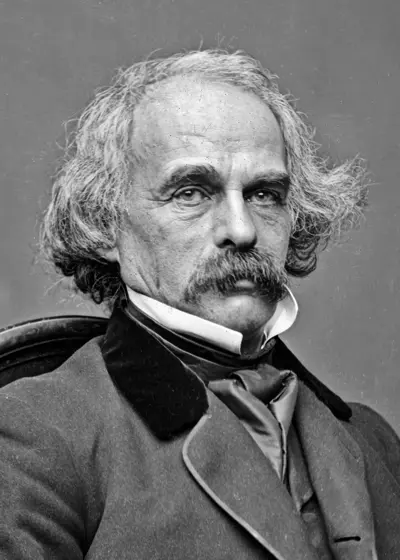
Nathaniel Hawthorne was an American novelist, dark romantic, and short story writer. His works often focus on history, morality, and religion.
