Matthew Hale Carpenter Quotes
And now when our maimed soldiers have returned from the Civil War and apply for Federal office, the duties of which they are perfectly competent to discharge, they will be rejected to give places to those who were cramming themselves with facts and principles from the books, while they were bleeding for their country, because they do not know the fluctuations of the tide at the Cape of Good Hope, how near the moon ever approaches the earth, or the names of the principal rivers emptying into the Caspian Sea.
Matthew Hale Carpenter, 1824-1881, U.S. Senator (Republican, WI), Argument against civil service exams Senate Debate, January 18, 1872
Sourced by: Eigen's Political and Historical Quotations


This law established the Civil Service Commission and for the first time in American History required open examinations for the appointing of government employees. Japan had required examinations for civil service for hundreds of years. President Garfield had called for such legislation in his inaugural address {586804} 2 years earlier. This was the legislation that implemented it.


Webb’s opponent had accused him of not being patriotic because he opposed many of President George W. Bush’s Iraq War policies. This technique of publicly intimating that an opponent was not patriotic because he opposed the hawkish proposals of the President, had worked very well for the Republicans before. Presidential Candidate John Kerry, a decorated war hero, was attacked and remarkably Senator Max Cleland who had lost three of his four limbs in battle was unseated by attacking his patriotism. When Senator George Allen, fighting for reelection, used the technique on Webb, Web responded much more aggressively than earlier Democrats had when faced with the accusation. Senator Allen, like most of the patriotism critics of heroic veterans, had never been in combat.

Carpenter was generally a reformer but having examinations for Civil Service jobs, went to far for him.

This was an argument for paying public employees.

The punctuation was not in the original but our editors have added it to facilitate understanding. Uriah had been a veteran from Indiana, and benefited from the Homestead Act. Veteran’s benefits at the time changed the face of America and made for a social class mobility that had a profound change on America then, just as the GI Bill of Rights would after WWII.
This is one of the most eloquent writings on the racial discrimination issue in American History. The young man who wrote it was a free Black born and educated in Troy, New York who became a seaman in New Bedford. He enlisted in the famous Massachusetts 54th Black Regiment. He also sent bi-weekly news dispatches to The New Bedford Mercury. In the midst of the assault on Fort Wagner in Charleston Harbor on July 18, 1863, and in the battle of Oustlee, Florida, on February 20, 1864. In the latter battle, he was wounded and captured. He was murdered by the inhuman conditions in the infamous Confederate prison camp at Andersonville, GA. He was only 27 years old.

When she was campaigning for women’s suffrage, the famous and prestigious Newspaper Editor, Horace Greeley, publicly challenged her by asking if she was willing to also fight for the country as the men did.

The George W. Bush administration, violated the Civil Service Law and the traditions of the Justice Department by making hiring and assignment decisions on the basis of political ideology and participation. Making the situation worse, the political people who were put in senior positions of authority were often not very well qualified and far less so than the people they ended up supervising and outranking. The inspector general of the Justice Department, after being stonewalled, finally uncovered the mess and Monica Goodling, one of the worst offenders, was barred from ever working for the Justice Department again.


The U. S. Navy had Black sailors even before the Civil War. Blacks had shipped out on Northern merchant vessels and whaling ships starting in colonial times. Many Blacks had nautical experience and were welcomed by the Northern Navy and treated very well. The Union Army in contrast was much more ambivalent about Blacks serving. Ironically the Navy was disbanded to save money and when it was reconstituted it was on a racially segregated basis completely foreign to American Naval history. It was the last of the American armed services to integrate and its officer corps has not desecrated as much as the other services.

There were few reformers who had such a long, extensive, and activist career in both England and India. She began her career as a minister’s wife but was literally turned out of her house by her husband for whom she was not religiously orthodox enough. This started her religious activism which ended with her as an atheist. She led a match-girl’s strike, founded a Hindu college in India, and was even arrested for pornography in England when she wrote a book advocating birth control. She is on many lists of “Great Indians” along with Gandhi and Nehru. She was Jiddu Krishnamurti’s teacher.


The Great Depression was afflicting the nation. Farmers and homeowners who lost jobs (over 35%) or could not sell produce at a decent price could not pay their mortgage debts and homes and farms were being foreclosed in record numbers. Veterans who had saved the nation in WWI and farmers who had fed the population were impoverished and homeless. Rankin appealed to President Herbert Hoover to place a moratorium in bank foreclosures, which not only ruined the individuals but drove down the value of real estate by throwing so much on the market at a time when few had money to buy. Hoover, an otherwise decent man and an excellent administrator, had a blind spot and would not consider having the government solve or alleviate any of these problems as he felt that this would be bad for the national character. By 1932, the voters threw Hoover out and elected Franklin Delano Roosevelt who used the power of government in new and imaginative ways, improved the economy. Profided relief, and prevented a popular revolution and many believed saved capitalism from its own excesses.


The Founding Fathers wanted to be sure that the American Culture would not be a military one. But with each American war, there was a little more of it as many men identified themselves not by their occupation or current organizational title but by their highest military title. Hawthorne and many other Americans were reluctant to see this occur. However, Hawthorne turned out to be right about the behavior of the Civil War officers long after the war had ended. In Kentucky, the governor was given the right to appoint anyone a Colonel in the state militia, and to this day Kentucky Colonels proliferate. The American military to boost the prestige of retiring officers developed the practice of promoting each officer to the next higher rank the day he retired. So Captains could be Majors, and Majors could thereafter be Colonels, and Colonels, Generals
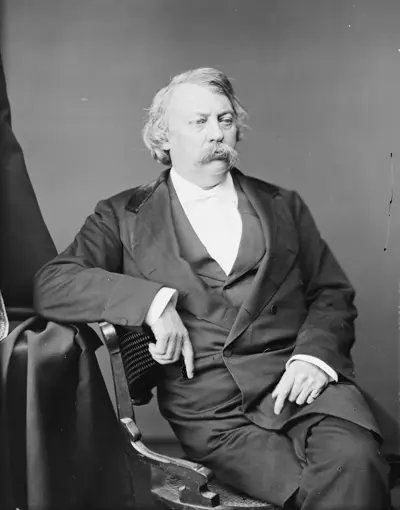
Matthew Hale Carpenter was an American attorney and U.S. Senator representing the state of Wisconsin. He served in the Senate from 1869 to 1875 and again from 1879 to 1881. Recognized as an authority on constitutional law, he made some of the most important legal arguments of 19th-century America. Carpenter presented cases before the U. S. Supreme Court involving such matters as states' rights and regulation of corporations.
