Matthew Hale Carpenter Quotes
So, sir, it comes to this at last, that … the dunce who had been crammed up to a diploma at Yale, and comes fresh from his cramming, will be preferred in all civil service appointments to the ablest, most successful, and most upright business man of the country, who either did not enjoy the benefit of early education, or from whose mind, long engrossed in practical pursuits, the details and niceties of academic knowledge have faded away as the headlands disappear when the mariner bids his native land good night.
Carpenter was generally a reformer but having examinations for Civil Service jobs, went to far for him.
Matthew Hale Carpenter, 1824-1881, U.S. Senator (Republican, WI), Congressional Debate
Sourced by: Eigen's Political and Historical Quotations


The Civil Service Reformers of the time were so doctrinaire, that they attacked even supports when the supporters did not agree with everything. This was largely responsible for Cleveland losing the election.

President Andrew Johnson was one of the worst Presidents America has elected. He was a tailor and became governor of Tennessee before he ascended to the Presidency on the assassination of Abraham Lincoln.


We shall have a system where When Roosevelt became Police Commissioner, virtually every appointment, promotion, and disciplinary action was controlled politically. Nothing could be more shocking to the police and the politicians than Roosevelt’s statement. But he implemented that policy and the result developed into the finest urban police department in the country. The political influence however returned a few decades later.

At the time Canada was one of the preferred destinations of escaping slaves traveling the Underground Railroad.


He sounds here like a modern left-wing prison reform candidate. However, in {614901} he sounds like a modern right wing conservative. Smith had written to most of the then likely Presidential candidates of both major parties asking for their position on the Mormons who were facing persecution wherever they went. None of the politicians would make any satisfactory commitments. Smith took Direct Action and became the only major religious official to have run for the Presidency of the United States until Pat Robertson tried and failed in 2000. Smith’s assassination shortly thereafter cut his run for the Presidency short before it made much headway and politically he had no chance to affect the race.
Although an Irishman, he was commenting about the British government of which Ireland was then a part.


Booker T. Washington was a Black leader who did much for his people, but his objectives were quite limited. He was “the white’s favorite Black man.” Du Bois not only took on the White establishment but the Black establishment as well.


“Musalmans” was then another English term for Muslims. At the time, the Hindus and Muslims of India were both under the rule of the British. As bad as Colonial Rule was, it had some advantages for the subjects and their desire to reform government and education. Ironically, there is no Islamic nation today, with the exception of Turkey, where Muslims have the rights, freedom and privileges as they had at the turn of the century in Colonial India.

This quotation makes it very difficult for Muslim modernists and reformers to persuade Muslims to adopt ideas, methods and approaches of the West, or China or India as this statement of the Prophet is a de facto stricture and inhibition against imitation of non-Muslims in any area.
The occasion was the opening of the Institute for the Formation of Character, a combination school and day care center. Most of us have never realized that day care is not a new feminist idea of the 1960s but was operational as early as 1816.

Generally politicians have little good to say about civil servants in major public addresses. This is one of the few exceptions.

In any significant change of public policy including public investments, some will benefit more than others, and some interests will be harmed. Unless the politician is willing to face this reality there will be little or no progress. Bloomberg invested a great deal in improving air quality of the city, but there were some companies who had to pay more to reduce their pollution.

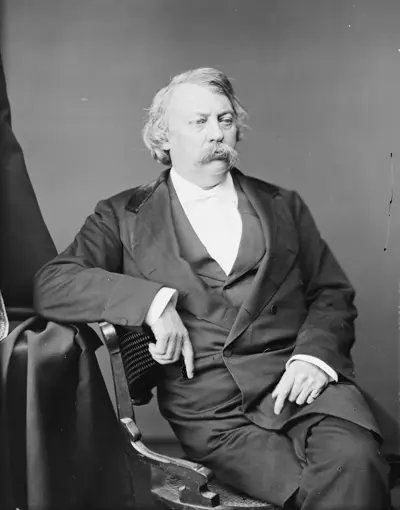
Matthew Hale Carpenter was an American attorney and U.S. Senator representing the state of Wisconsin. He served in the Senate from 1869 to 1875 and again from 1879 to 1881. Recognized as an authority on constitutional law, he made some of the most important legal arguments of 19th-century America. Carpenter presented cases before the U. S. Supreme Court involving such matters as states' rights and regulation of corporations.
