Isaac Jan Alexander Gogel Quotes
Nothing is easier for us than to talk of revolution. But we do not want a revolution if we cannot protect our fellow citizens from pillage and murder in reprisal … We rest on your promises given to us a month ago. We await your help and will answer with our heads for the success of the invasion.
The French had agreed that once the Dutch started the uprising, they would send French troops to support the revolution. The French Revolutionary government was ideologically opposed to the Dutch Monarchy of the House of Orange on their border nor did they want the British influence which existed by virtue of the support England gave to William V and the Orangists. When the uprising started, the French kept their word and sent in an army of invasion to support the revolutionary government. See {639776}.
Isaac Jan Alexander Gogel, 1765-1821, Dutch Politician, Patriot & Revolutionist, Minister of Finance, Agent for Foreign Affairs, Letter to the French Revolutionary Leadership, September 1794
Sourced by: Eigen's Political and Historical Quotations

The “Revolutionary Government” were the Patriot Coup leaders who had seized part of the country but the monarch still had many supporters including his soldiers. This proclamation, with the French troops to back it up, assured that the coup would succeed. Daendels had earlier fled to France when his first Dutch revolutionary efforts failed and he had a price on his head. He was in Paris during the French Revolution and was an enthusiastic supporter. For his support and with his military experience not associated with royalty, he was made a General of the Revolutionary French Army. When the Dutch Patriots tried again to revolt, the new French Government took their side and sent Daendels to Holland at the head of a small French Army to protect the Patriots. This was his position when he issued this proclamation to the great distress of William V and his supporters. William’s troops were particularly intimidated and many deserted and would not protect the monarch against the Patriots.

“The enemy were the Dutch revolutionists and the French who had sent a small army to assist the Dutch rebels. The Count had his Castle right near the border of Holland in the Austrian controlled part of the Netherlands.


Mengustu seized power in a coup. However his Marxist Dictatorship was very unpopular and a civil war soon started. The poorly armed opposition used guerrilla warfare insurgency techniques. Since the government was hated by most people there was much support for the guerrilla in the villages and countryside. Mengustu adopted a policy of genocide. The areas of the country which were sympathetic to the revolutionaries were then systematically starved by the government withholding food and attacked by allies who he armed.
Hunting and fishing had been much restricted to aristocrats for whom it was a sport. But for common people it was part of subsistence. Just like so many corporations and wealthy people end up paying lower tax rates than the average person in modern American society, in Holland then it was the aristocrats who paid little or no taxes. And much of the tax revenue went to provide them with an opulent lifestyle. Ending their tax exemptions and their subsidies, would lower taxes on everyone else. And democracy would give the people control over the government. Daendels had in earlier years fled to France when his first Dutch revolutionary efforts failed and he had a price on his head. He was in Paris during the French Revolution and was an enthusiastic supporter. For his support and with his military experience not associated with royalty, he was made a General of the Revolutionary French Army. When the Dutch Patriots tried again to revolt, the new French Government took their side and sent Daendels to Holland at the head of a small French Army to protect the Patriots. This was his position when he issued this proclamation to the great distress of William V and his supporters.
Daendels had in earlier years fled to France when his first Dutch revolutionary efforts failed and he had a price on his head. He was in Paris during the French Revolution and was an enthusiastic supporter. For his support and with his military experience not associated with royalty, he was made a General of the Revolutionary French Army. When the Dutch Patriots tried again to revolt, the new French Government took their side and sent Daendels to Holland at the head of a small French Army to protect the Patriots. This was his position when he issued this proclamation to the great distress of William V and his supporters.

Grant was a new Brigadier General and occupied Paducah

French Foreign Minister Charles Gravier, Comte de Vergennes The diplomatic, financial and military assistance of France was critical to American survival at that time.


Shortly after he refused to join, his brother who had joined the Resistance had been captured, tortured and murdered by the Germans. He then joined the active resistance even though the Americans had not yet arrived. He realized that resistance was just an annoyance to the Germans, and the time the Resistance could really make a difference was after the Americans and British had landed in France.


He had just assumed his post 6 days earlier. At this point he did not have enough knowledge to favor or oppose the regime change, but he did realize that the decision was a serious one and there would be no turning back. Diem was a creature of the Central Intelligence Agency. An anti-Communist Christian in a Buddhist county, the CIA engineered his rise to power, created his political party, provided him with cash to bribe other Vietnamese politicians, and paid for all the propaganda so he would “win” the Presidential elections. However, he abused the Buddhists, was thoroughly corrupt and ran a corrupt administration, but worst of all from the American point of view, he was unable to motivate the South Vietnamese population to fight the Communists. He reached the point where he was more of a liability, and the Central Intelligence Agency engineered a coup d’etat to remove him from power and replace him with a President more to our liking. (See {634540}.)


Claude-Henri de Rouvroy. He had married a Dutch Countess and settled in Utrecht so he knew the situation in Holland well. The Dutch Revolution was very much like the American Revolution in the it pitted one half of the establishment against the other.

William V, Prince of Orange, was in a very precarious position and might be deposed. Officially Harris and the British were supporting him and Harris was giving him money to firm up his regime, but their great fear was that the French would support and control the Patriot Revolutionary movement, then quite active. And William was very tentative in dealing with the growing Patriot revolutionary movement. Actually, to cover all eventualities, Harris was secretly aiding the Patriots as well. See {639752}.
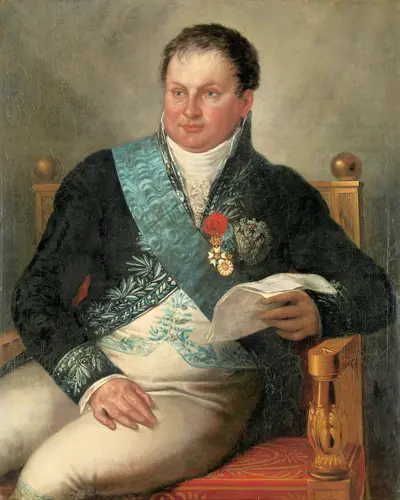
- Born: December 10, 1765
- Died: June 13, 1821
- Nationality:
- Profession:
Isaac Jan Alexander Gogel was the first minister of finance of the Batavian Republic and the Kingdom of Holland. He married Catharina van Hasselt in 1800, and had three children.
