Herman Willem Daendels Quotes
O my friends. How happy we shall be once our dear Land is scourged of the brutish aristocracy…every man will be free to hunt and to fish as he pleases, taxes and dues will be reduced and no longer fall so heavily on the poor. Our country will be ruled by brave Burghers (city dwellers) and farmers through their public voice.
Hunting and fishing had been much restricted to aristocrats for whom it was a sport. But for common people it was part of subsistence. Just like so many corporations and wealthy people end up paying lower tax rates than the average person in modern American society, in Holland then it was the aristocrats who paid little or no taxes. And much of the tax revenue went to provide them with an opulent lifestyle. Ending their tax exemptions and their subsidies, would lower taxes on everyone else. And democracy would give the people control over the government. Daendels had in earlier years fled to France when his first Dutch revolutionary efforts failed and he had a price on his head. He was in Paris during the French Revolution and was an enthusiastic supporter. For his support and with his military experience not associated with royalty, he was made a General of the Revolutionary French Army. When the Dutch Patriots tried again to revolt, the new French Government took their side and sent Daendels to Holland at the head of a small French Army to protect the Patriots. This was his position when he issued this proclamation to the great distress of William V and his supporters.
Herman Willem Daendels, 1762–1818, Dutch Politician & Military Leader, Patriot Revolutionary, General of the Revolutionary French Army, Governor General of the Dutch East Indies, Proclamation to the Citizens of Holland, 1794
Sourced by: Eigen's Political and Historical Quotations

Daendels had in earlier years fled to France when his first Dutch revolutionary efforts failed and he had a price on his head. He was in Paris during the French Revolution and was an enthusiastic supporter. For his support and with his military experience not associated with royalty, he was made a General of the Revolutionary French Army. When the Dutch Patriots tried again to revolt, the new French Government took their side and sent Daendels to Holland at the head of a small French Army to protect the Patriots. This was his position when he issued this proclamation to the great distress of William V and his supporters.
The “Revolutionary Government” were the Patriot Coup leaders who had seized part of the country but the monarch still had many supporters including his soldiers. This proclamation, with the French troops to back it up, assured that the coup would succeed. Daendels had earlier fled to France when his first Dutch revolutionary efforts failed and he had a price on his head. He was in Paris during the French Revolution and was an enthusiastic supporter. For his support and with his military experience not associated with royalty, he was made a General of the Revolutionary French Army. When the Dutch Patriots tried again to revolt, the new French Government took their side and sent Daendels to Holland at the head of a small French Army to protect the Patriots. This was his position when he issued this proclamation to the great distress of William V and his supporters. William’s troops were particularly intimidated and many deserted and would not protect the monarch against the Patriots.

the Dutch monarchy supported by England The French fear of course was that the revolutionary fervor spreading to the bourgeois could easily spread to France, and that is exactly what happened 4 years later. See {639769} for more of his view on the Dutch revolutionary spirit that might infect France.
Claude-Henri de Rouvroy. He had married a Dutch Countess and settled in Utrecht so he knew the situation in Holland well. The Dutch Revolution was very much like the American Revolution in the it pitted one half of the establishment against the other.

The University Presidents had written to the American Public arguing that the German aggression was the result of the militarists in the German society dominating the people and pushing them to war. They argued that most German people were not really responsible. Lamprecht took exception and argued that the German policy was the democratic will of the majority of the German people. He claimed that Germany at the time was more of a de facto democracy than America—as the Untied States did not have a Voting Rights Act or any way of de facto ensuring that all citizens could vote—particularly Negroes in the South. While he was accurate about the voting aspects of a democracy, Germany neither had the Constitution nor a judiciary that was independent and co-equal to the executive and legislature, but Germany did not have the institutions with democratic traditions. The greatest embarrassment to modern Germans is that Adolf Hitler was actually elected by a majority of Germans and was very popular until things in Germany started to go poorly. This quotation is very important in that it shows the importance of a Constitution to limit the powers of even a popularly elected government.

Although Holland was more egalitarian and fairer than most nations of Europe, it was not quite as desirable as Diderot described it. He only visited a part of Holland that was the most educated and affluent.

The French had agreed that once the Dutch started the uprising, they would send French troops to support the revolution. The French Revolutionary government was ideologically opposed to the Dutch Monarchy of the House of Orange on their border nor did they want the British influence which existed by virtue of the support England gave to William V and the Orangists. When the uprising started, the French kept their word and sent in an army of invasion to support the revolutionary government. See {639776}.
See {639757} for more of his view on the Dutch revolutionary spirit that might infect France. It did a few years later.

The revolutionists were disorganized and unfocused after the Coup that brought them to power. This speech provided some focus for a while. Early in his career, as a Journalist working in Leiden, Holland, he was very active and helpful to the Dutch Patriots and Revolutionaries in their takeover of the government. He helped draft the New Dutch Constitution and participated in most of the new governments conventions.

They were very much influenced by the American Declaration of Independence and Tom Paine’s writings. The graphic is one of Rembrandt’s famous painting of a voluntary militia corps.


In most revolutionary settings leaders have to persuade people who have voted with no success to turn to the rifle. In Ireland at this point, almost all the nationalsits knew that the rifle would help them but they were not sure that a vote would have the effect of a bullet.

This constitution, 13 years later, became the basis for the national Batavian Constitution.

Actually, these revolutionists were quite moderate and what they wanted was his abdication and for him to go to England but they used the fear of trial and beheading to induce him to leave rather than have a pitched battle. He did.


This was written by a French Journalist who had been assigned to America for 7 years when he wrote this in 1939. WWII was just breaking out in Europe.


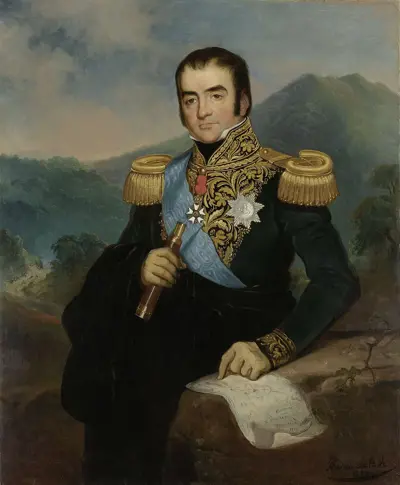
Herman Willem Daendels was a Dutch revolutionary, general and politician who served as the 36th Governor General of the Dutch East Indies between 1808 and 1811.
