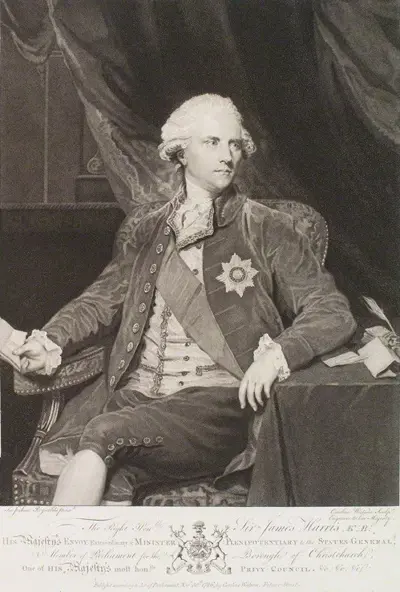
James Harris Quotes
They [the Patriots] mean to bring these charges forward with the publicity possible and to terrify him [the Monarch William V] with the idea that his conduct has been so highly criminal against the state that his head is liable to be brought to the block. His imagination is already strongly impressed with this dread and in convening with me, he has often said that the Patriots mean to treat him as the [English] Republicans did Charles I. [Beheaded him.]
Actually, these revolutionists were quite moderate and what they wanted was his abdication and for him to go to England but they used the fear of trial and beheading to induce him to leave rather than have a pitched battle. He did.
James Harris, 1746-1820, 1st Earl of Malmesbury, British Member of Parliament, Ambassador to Holland, Prussia, and Russia, Secret Report on Holland to Secretary of State Carmarthen, November 1785
Sourced by: Eigen's Political and Historical Quotations

The “Revolutionary Government” were the Patriot Coup leaders who had seized part of the country but the monarch still had many supporters including his soldiers. This proclamation, with the French troops to back it up, assured that the coup would succeed. Daendels had earlier fled to France when his first Dutch revolutionary efforts failed and he had a price on his head. He was in Paris during the French Revolution and was an enthusiastic supporter. For his support and with his military experience not associated with royalty, he was made a General of the Revolutionary French Army. When the Dutch Patriots tried again to revolt, the new French Government took their side and sent Daendels to Holland at the head of a small French Army to protect the Patriots. This was his position when he issued this proclamation to the great distress of William V and his supporters. William’s troops were particularly intimidated and many deserted and would not protect the monarch against the Patriots.

the Dutch monarchy supported by England The French fear of course was that the revolutionary fervor spreading to the bourgeois could easily spread to France, and that is exactly what happened 4 years later. See {639769} for more of his view on the Dutch revolutionary spirit that might infect France.

When Henry came to “George II” he was interrupted by the Speaker, John Robinson, who shouted “Treason!” Henry had been railing against the Stamp Act.


The king was found guilty and was decapitated, but not wearing a crown.

The Irish Priest was the Confessor to French King Louis XVI at his execution in the French Revolution


The revolution turned on many of its initiators including Vergniaud. He was guillotined along with other Girondists.

Prior to Cooke’s indictment of English King Charles I, there was a concept of Royal Impunity—that a sovereign could not legally be called to account for his actions as ruler of the state. The concept of “sovereign immunity” was a concept where the sovereign and his agents could be given immunity for specific actions, but they never would have impunity again where there were no limits to the crimes they might commit against their own people. Charles I refused to even recognize Cooke’s indictment and so have heads of state called to account for their major crimes since then all the way down to Saddam Hussein in 2006 who made the same argument. Cooke was himself hanged, drawn and quartered almost 20 years after the Charles I trial for his part in the “Regicide” so the concept of Royal Impunity did not die quickly.

The Regicide of Charles I was still a very sensitive subject with Englishmen loyal to the King in the Colonial era. So this was an incredibly radical and incendiary statement for an American minister to make. However, he did acknowledge that a people had a right to have a king {634001} unlike Thomas Paine who did not—see {634004}.

Many American colonists had relatives and friends in England, and Paine argued that American independence would help and not het the English people.

The Dutch Monarch William V, Prince of Orange, was in a very precarious position and might be deposed. Officially Harris and the British were supporting him and Harris was giving him money to firm up his regime, but their great fear was that the French would support and control the Patriot Revolutionary movement, then quite active or even intervene militarily to aid the Patriots.
The revolutionists were disorganized and unfocused after the Coup that brought them to power. This speech provided some focus for a while. Early in his career, as a Journalist working in Leiden, Holland, he was very active and helpful to the Dutch Patriots and Revolutionaries in their takeover of the government. He helped draft the New Dutch Constitution and participated in most of the new governments conventions.
Hunting and fishing had been much restricted to aristocrats for whom it was a sport. But for common people it was part of subsistence. Just like so many corporations and wealthy people end up paying lower tax rates than the average person in modern American society, in Holland then it was the aristocrats who paid little or no taxes. And much of the tax revenue went to provide them with an opulent lifestyle. Ending their tax exemptions and their subsidies, would lower taxes on everyone else. And democracy would give the people control over the government. Daendels had in earlier years fled to France when his first Dutch revolutionary efforts failed and he had a price on his head. He was in Paris during the French Revolution and was an enthusiastic supporter. For his support and with his military experience not associated with royalty, he was made a General of the Revolutionary French Army. When the Dutch Patriots tried again to revolt, the new French Government took their side and sent Daendels to Holland at the head of a small French Army to protect the Patriots. This was his position when he issued this proclamation to the great distress of William V and his supporters.
Daendels had in earlier years fled to France when his first Dutch revolutionary efforts failed and he had a price on his head. He was in Paris during the French Revolution and was an enthusiastic supporter. For his support and with his military experience not associated with royalty, he was made a General of the Revolutionary French Army. When the Dutch Patriots tried again to revolt, the new French Government took their side and sent Daendels to Holland at the head of a small French Army to protect the Patriots. This was his position when he issued this proclamation to the great distress of William V and his supporters.