Oliver Cromwell Quotes
We will cut off his head with the crown upon it.
The king was found guilty and was decapitated, but not wearing a crown.
Oliver Cromwell, 1599-1658, Revolutionist, Ruler, & Lord Protector of England, Statement to Algernon Sidney during the trial of King Charles I, December 1648
Sourced by: Eigen's Political and Historical Quotations

The Regicide of Charles I was still a very sensitive subject with Englishmen loyal to the King in the Colonial era. So this was an incredibly radical and incendiary statement for an American minister to make. However, he did acknowledge that a people had a right to have a king {634001} unlike Thomas Paine who did not—see {634004}.


Although Bolivar is generally seen as a great idealist and humanitarian, he had his brutal and immoral aspects. This quotation proves that Bolivar ordered the bloody massacre of helpless Spanish prisoners of war including those in the hospital. Also the beheading illustrates the bitterness and barbarity of the wars for independence from Spain. See {632671} for Bolivar’s rationale for massacring helpless prisoners of war.

The king would often walk alone or with only a few companions. His brother expressed concern about exposing the royal person to risk.


The revolution turned on many of its initiators including Vergniaud. He was guillotined along with other Girondists.
Nathaniel Bacon had led a rebellion in Virginia and had routed the Governor’s troops and caused him to flee leaving control of Virginia to Bacon and his followers who were far more democratic and advanced. However Bacon succumbed to swamp fever, and his followers could not hold the colony together giving the Governor a chance to establish his authority. He then went on a vengeful reign of terror, executing all of Bacon’s followers he could get his hands on. With no danger to the authority of the Crown, King Charles felt that Berkeley had gone too far. The King’s father Charles I had been executed in the aftermath of the English Civil War, but he had executed far fewer than Berkely had done in Virginia.

Actually, these revolutionists were quite moderate and what they wanted was his abdication and for him to go to England but they used the fear of trial and beheading to induce him to leave rather than have a pitched battle. He did.
The Irish Priest was the Confessor to French King Louis XVI at his execution in the French Revolution

A number of the American soldiers refused to obey Calley's illegal order. Some helped some villagers to escape, and a helicopter pilot landed betreen Callery's men and the villagers they were shooting at, and ordered his helicopter machine gun crew to fire on the soldiers if they did back off. The soldiers stopped firing at the civillians. However, his and other reports of the massacre were covered up by the military for a few years. Mai Lai was not the only major war crime perpetrated by Americans in the Vietnam War; there had been a few others. But given the years of fighting and the many opportunities war crimes violations under orders were quite rare. The Viet Cong had many more war crimes that they perpetrated, and our South Vietnamese allies repeatedly committed war crimes against their own people.


England had gone through a bloody Civil War with the Parliament on one side and the King on the other. The King lost and was beheaded later that year. See {597353}.

The association with a bag involves the hunting customs of the time. When small animals were killed or captured they would be put into a bag for transporting back. Hence the expression of someone “bagging” game. Politics was not a gentle activity amongst the “gentlemen” who then practiced it in England.

Reaction when the Dutch heard that the English King Charles I had been beheaded. The regicide was very shocking to most people in Europe—even in the Netherlands which then had a republic.


When Henry came to “George II” he was interrupted by the Speaker, John Robinson, who shouted “Treason!” Henry had been railing against the Stamp Act.

The quotation is text uttered by one of her characters.

Cromwell’s army of Parliament massacred all the town’s defender. Cromwell had issued an ultimatum to the town commander which had been refused. See {632367}.
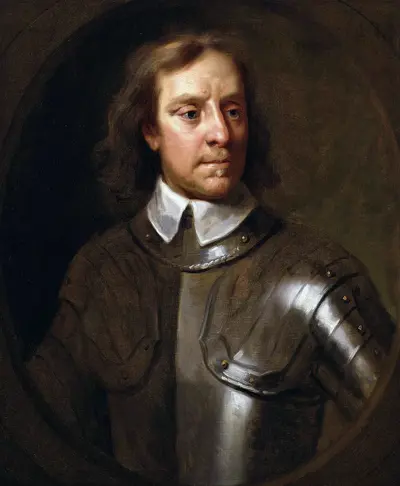
Oliver Cromwell was an English general and statesman who, first as a subordinate and later as Commander-in-Chief, led armies of the Parliament of England against King Charles I during the English Civil War, subsequently ruling the British Isles as Lord Protector from 1653 until his death in 1658. He acted simultaneously as head of state and head of government of the new republican commonwealth.
