Maximilien Robespierre Quotes
It is with regret that I pronounce the fatal truth: Louis must die that the country may live.
The King was beheaded.
Maximilien Robespierre, 1758-1794, French Jacobin Revolutionist, Member, National Assembly & Committee of Public Safety, speech to the National Convention on the judgment of King Louis XVI, December 3, 1792
Sourced by: Eigen's Political and Historical Quotations


The Irish Priest was the Confessor to French King Louis XVI at his execution in the French Revolution


While France was in the midst of a violent revolution, the American debate was on the power and prestige of the Presidency. Then Vice President John Adams was a proponent of a strong executive. Most others were not.

This newspaper was his communications outlet.


The king was found guilty and was decapitated, but not wearing a crown.

Actually, these revolutionists were quite moderate and what they wanted was his abdication and for him to go to England but they used the fear of trial and beheading to induce him to leave rather than have a pitched battle. He did.


Honore Gabriel Victor Requiti. The French King had just opened the French National Assembly which contained deputies (delegates) from the clergy, the nobility and the people. The King had made what some deputies thought was a very constructive and responsible speech opening the assembly. Mirabeau observed that as long as there was an absolute monarch in place, even a benign one. It was the presence of a monarch itself that was evil.


Constitutional Bishops in Revolutionary France were elected by the people, not appointed by a hierarchy. Upon hearing the motion, the assembly rose to its feet and passed it by acclamation. This was the end of the French Monarchy and the nobility—for a while.

the Dutch monarchy supported by England The French fear of course was that the revolutionary fervor spreading to the bourgeois could easily spread to France, and that is exactly what happened 4 years later. See {639769} for more of his view on the Dutch revolutionary spirit that might infect France.

William V, Prince of Orange, was a very hapless monarch of Holland who was ineffective in dealing with revolutionary discontent despite help and support of England. The King of England was resigned to Holland becoming, like France, a Republic. The English statesmen and diplomats, while aiding William, were also secretly providing money and other assistance to the Patriot rebels, to ensure good relations with the Dutch republican leaders.

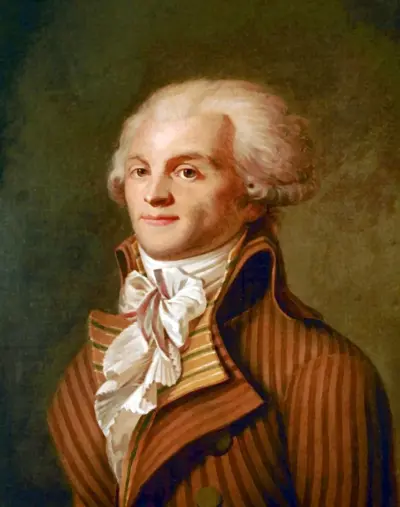
Maximilien François Marie Isidore de Robespierre was a French lawyer and statesman who was one of the best-known and most influential figures of the French Revolution. As a member of the Constituent Assembly and the Jacobin Club, he campaigned for universal manhood suffrage and the abolition both of celibacy for the clergy, and slavery. In 1791, Robespierre became an outspoken advocate for the citizens without a political voice, for their unrestricted admission to the National Guard, to public offices, and for the right to carry arms in self-defence. Robespierre played an important part in the agitation which brought about the fall of the French monarchy on 10 August 1792 and the summoning of a National Convention. His goal was to create a one and indivisible France, equality before the law, to abolish prerogatives and to defend the principles of direct democracy.
