Herman Willem Daendels Quotes
Every righteous Netherlander, like me, burns to take up arms in his hands to show that we are truly worthy of our French brothers and not as despicable as William of Orange [the Monarch William V] supposes.
Daendels had in earlier years fled to France when his first Dutch revolutionary efforts failed and he had a price on his head. He was in Paris during the French Revolution and was an enthusiastic supporter. For his support and with his military experience not associated with royalty, he was made a General of the Revolutionary French Army. When the Dutch Patriots tried again to revolt, the new French Government took their side and sent Daendels to Holland at the head of a small French Army to protect the Patriots. This was his position when he issued this proclamation to the great distress of William V and his supporters.
Herman Willem Daendels, 1762–1818, Dutch Politician & Military Leader, Patriot Revolutionary, General of the Revolutionary French Army, Governor General of the Dutch East Indies, Proclamation to the Citizens of Holland, 1794
Sourced by: Eigen's Political and Historical Quotations

The “Revolutionary Government” were the Patriot Coup leaders who had seized part of the country but the monarch still had many supporters including his soldiers. This proclamation, with the French troops to back it up, assured that the coup would succeed. Daendels had earlier fled to France when his first Dutch revolutionary efforts failed and he had a price on his head. He was in Paris during the French Revolution and was an enthusiastic supporter. For his support and with his military experience not associated with royalty, he was made a General of the Revolutionary French Army. When the Dutch Patriots tried again to revolt, the new French Government took their side and sent Daendels to Holland at the head of a small French Army to protect the Patriots. This was his position when he issued this proclamation to the great distress of William V and his supporters. William’s troops were particularly intimidated and many deserted and would not protect the monarch against the Patriots.
Hunting and fishing had been much restricted to aristocrats for whom it was a sport. But for common people it was part of subsistence. Just like so many corporations and wealthy people end up paying lower tax rates than the average person in modern American society, in Holland then it was the aristocrats who paid little or no taxes. And much of the tax revenue went to provide them with an opulent lifestyle. Ending their tax exemptions and their subsidies, would lower taxes on everyone else. And democracy would give the people control over the government. Daendels had in earlier years fled to France when his first Dutch revolutionary efforts failed and he had a price on his head. He was in Paris during the French Revolution and was an enthusiastic supporter. For his support and with his military experience not associated with royalty, he was made a General of the Revolutionary French Army. When the Dutch Patriots tried again to revolt, the new French Government took their side and sent Daendels to Holland at the head of a small French Army to protect the Patriots. This was his position when he issued this proclamation to the great distress of William V and his supporters.

the Dutch monarchy supported by England The French fear of course was that the revolutionary fervor spreading to the bourgeois could easily spread to France, and that is exactly what happened 4 years later. See {639769} for more of his view on the Dutch revolutionary spirit that might infect France.

The French had agreed that once the Dutch started the uprising, they would send French troops to support the revolution. The French Revolutionary government was ideologically opposed to the Dutch Monarchy of the House of Orange on their border nor did they want the British influence which existed by virtue of the support England gave to William V and the Orangists. When the uprising started, the French kept their word and sent in an army of invasion to support the revolutionary government. See {639776}.

Corsican independence was a cause taken up by liberals from France to Poland. Even America before its own revolution had supporters for Corsican Independence. See {612999}.

From the earliest formation of the United States, the issue of how much support to give to anti-authoritarian revolutionaries in Latin America has been contentious and difficult.
Claude-Henri de Rouvroy. He had married a Dutch Countess and settled in Utrecht so he knew the situation in Holland well. The Dutch Revolution was very much like the American Revolution in the it pitted one half of the establishment against the other.

Actually, these revolutionists were quite moderate and what they wanted was his abdication and for him to go to England but they used the fear of trial and beheading to induce him to leave rather than have a pitched battle. He did.
See {639757} for more of his view on the Dutch revolutionary spirit that might infect France. It did a few years later.
“The enemy were the Dutch revolutionists and the French who had sent a small army to assist the Dutch rebels. The Count had his Castle right near the border of Holland in the Austrian controlled part of the Netherlands.


The Emperor had made his brother King of Holland to function as a French military Governor. But Louis Napoleon. Who took an oath as the King of Holland, took his oath and responsibilities seriously and tried to serve Dutch interests which his brother cared for not at all. Louis Napoleon had an impossible situation with dual loyalty that was incompatible.

Explaining the reason for the Paris insurrection against the occupying Germans in World War II in contrast to the general French collaboration and capitulation. The French army, which was larger than the German, put up minor resistance and capitulated quickly when the Germans invaded. A number of French leaders formed a Nazi puppet government in Vichy. Many Frenchmen collaborated with the German Nazis. One of the main reasons for the formation of the French Resistance movement was for the French to have any honor after the war was over. They wanted the world to know that there were Frenchmen who valued freedom and justice and were not cowards--there were French who would risk their lives for freedom and justice. The French Resistance was extremely effective but very small, and to many Frenchman's embarrassment, the Communists were much more active in the Resistance than the conservatives. When the allies were closing in on Paris, and the German's were pulling out, the Parisians could just have waited until the Allied troops forced the Germans out. However, a small group of Parisians organized a major insurrection where Germans were attacked and sniped out while they were pulling out. When the Allies arrived, the Parisians had not been passive victims who had been freed by foreign troops, but had participated in their own fight for freedom and thus retained some honor and dignity. The insurrection was not without cost as many French men and women were killed in the insurrection, and many thought that the gesture of honor was an unnecessary risk and sacrifice. But the war ended in France with the French active in expelling the enemy with great bravery, something that had not generally happened at the beginning or in the midst of the war.


In one of the earliest calls to revolution, the adage of Aesop found a new expression.


Most Canadians supported the English despite the letter.


Caracas was destroyed in the Venezuelan War of Independence

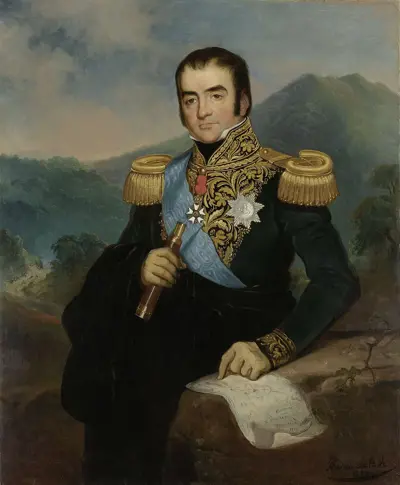
Herman Willem Daendels was a Dutch revolutionary, general and politician who served as the 36th Governor General of the Dutch East Indies between 1808 and 1811.
