ISAAC JAN ALEXANDER GOGEL
“Collegiate management” referred to a government central finance department that would be managed by committees of politicians and/or experts for the entire country. What Google feared was that elites like bankers and merchants would dominate and control the finances of the new government. He preferred to keep most of the financial management at the provincial and city governmental level. Further, that management by committee was inefficient and often produced gridlock. By the 21st century virtually every nation had a central bank or ministry that managed the nation’s finances in a globalized world. And there was a central banker in charge (although the amount of authority differs by nation.) However Gogel’s concern has never been abated. Virtually every country had evolved to where the nation’s finances were operated and/or controlled by elite minorities. The technical and educational requirements forced that to happen.
After the Dutch Revolution, there were many factions—all against the others in a hyperpartisanship that made constructive politics almost impossible.
Throughout most of the world, the rich and the aristocrats have been able to reduce or eliminate their tax obligations with the burden falling more heavily on the common people. Progressive taxation was thought to be a solution, but even in the United States by the 21st century many huge corporations paid little or no taxes while there was a heavy tax burden on small companies. Rich people generally paid a smaller percentage of their income than middle class people.
whether or not to buy luxuries This quotation and {639885} together illustrate why it is so difficult to classify historical politicians in the left-right categories of a future time. Here Gogel seems a strong liberal arguing for progressive taxation and luxury taxes, and tax relief for the poop, while in {639885} he sounds like a 21st century extreme conservative.
The French had agreed that once the Dutch started the uprising, they would send French troops to support the revolution. The French Revolutionary government was ideologically opposed to the Dutch Monarchy of the House of Orange on their border nor did they want the British influence which existed by virtue of the support England gave to William V and the Orangists. When the uprising started, the French kept their word and sent in an army of invasion to support the revolutionary government. See {639776}.
This statement by a Dutch politician at the beginning of the 19th century would have been a perfect statement of the conservative and cultural Republicans of the end of the 20th century ad beginning of the 21st. It includes the government overseeing of the morals of the society which most cries for minimal government do not have as an exception as herein. This quotation and {639886} together illustrate why it is so difficult to classify historical politicians in the left-right categories of a future time. Here Gogel seems a strong conservative arguing for minimal government , while in {639886} he sounds like a 21st century extreme liberal.
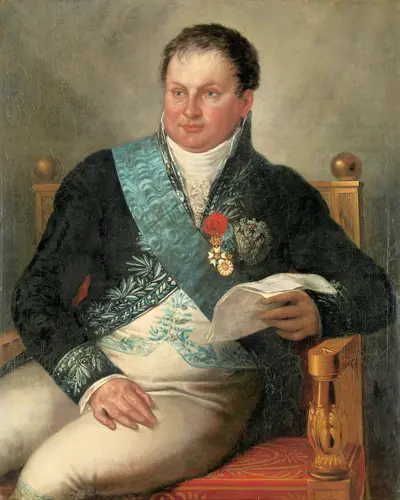
Isaac Jan Alexander Gogel was the first minister of finance of the Batavian Republic and the Kingdom of Holland. He married Catharina van Hasselt in 1800, and had three children.
