Jean-Jacques Rousseau Quotes
In the name of Almighty God and on the Holy Gospels, by this irrevocable and sacred oath I unite myself in body, in goods, in will and in my whole potential to the Corsican Nation, in such a way that I myself and everything that belongs to me shall belong to it without redemption. I swear to live and to die for it, to observe all its laws and to obey its legitimate leaders and magistrates in everything that is in conformity with the law.
Corsican independence was a cause taken up by liberals from France to Poland. Even America before its own revolution had supporters for Corsican Independence. See {612999}.
Jean Jacques Rousseau, 1712-1778, French Philosopher, Proposed oath to be taken by Corsicans, Early 1700s, Quoted by Adam Zamoyski in “Holy Madness: Romantics, Patriots, and Revolutionaries, 1776-1781”
Sourced by: Eigen's Political and Historical Quotations

The Emperor had made his brother King of Holland to function as a French military Governor. But Louis Napoleon. Who took an oath as the King of Holland, took his oath and responsibilities seriously and tried to serve Dutch interests which his brother cared for not at all. Louis Napoleon had an impossible situation with dual loyalty that was incompatible.


Most Canadians supported the English despite the letter.


Daendels had in earlier years fled to France when his first Dutch revolutionary efforts failed and he had a price on his head. He was in Paris during the French Revolution and was an enthusiastic supporter. For his support and with his military experience not associated with royalty, he was made a General of the Revolutionary French Army. When the Dutch Patriots tried again to revolt, the new French Government took their side and sent Daendels to Holland at the head of a small French Army to protect the Patriots. This was his position when he issued this proclamation to the great distress of William V and his supporters.
The revolutionary acts from some of the more radical colonists but the colonial power structure was trying to negotiate for changes from the taxation and rights-impinging laws that Parliament had passed. Within a year the Continental Congress would take a more revolutionary position when this petition yielded no betterment-- {636864} and {636958}.


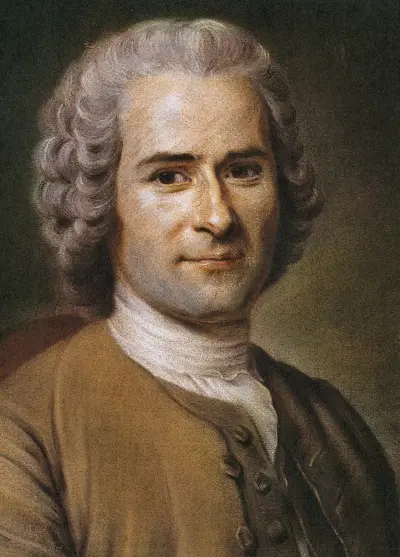
Jean-Jacques Rousseau was a Genevan philosopher, writer, and composer. His political philosophy influenced the progress of the Enlightenment throughout Europe, as well as aspects of the French Revolution and the development of modern political, economic and educational thought.
