Marquis de Lafayette Quotes
Our [the French] Revolution is getting on as well as it can with a nation that has attained its liberty at once, and is still liable to mistake licentiousness for freedom.
Marie Joseph Paul Yves Roch Gilbert du Motier
Marquis de Lafayette, 1757-1834, French Statesman & Major General in the American Revolutionary Continental Army, Member of the French Chamber of Deputies, Letter to George Washington, March 17, 1790
Sourced by: Eigen's Political and Historical Quotations


In the election of 1800, the Jeffersonian republicans were pitted against the John Adams Federalists. The latter had seen the revolution as against the excesses of England and King George and not necessarily against the notion of a class society where government served the interests of the upper class—a political battle that is still with us to some extent. The Jewish religion generally recognizes no right of theocratic authority of one man over others with all to follow the laws of God, was theologically very republican. Rabbis were teachers and had no theological or civil authority. To Nones and many other Jews the Jeffersonian ideals were very close to their religious and cultural tradition and to the extent that there has been a party of the classes and a party of the masses, most Jews had gravitated to the latter with the exception of merchants, bankers and others whose economic interests were with the right of center party.


Many of the French Revolutionists viewed the French Revolution as only the first step in a European revolution where all monarchies in Europe would be overthrown and popular rule installed throughout the continent. This obviously made the crowned heads of Europe and their governments very nervous. Other French Revolutionaries however, wanted to assure the rest of Europe that the revolution was only a French affair so that they should not send troops to overthrow the French Revolution. See {585773} for a foreign policy type statement. It is probable that Warville’s desire was shared by most French revolutionary leaders but they were more circumspect in their public and official statements.


In 1786, many veterans of the American Revolution had still not yet been paid the promised wages for their military service by the new national government. The States however had imposed taxes on farms to fund the new state governments and pay the state’s war debts mostly to rich merchants. Many veterans could not pay the taxes and some were thrown into debtors’ prison, and others had their farms foreclosed. Led by Daniel Shays, a small group of Massachusetts men conducted a mini rebellion by closing local court houses and tried to take over the local state armory. The Governor put down the rebellion by force and the rebels were jailed. Samuel Adams, the former governor, recommended the death penalty (see {630527}), and several of the rebels were executed. Thomas Jefferson disagreed, via this famous quotation. This was one of the early crises of the new country and it was handled very poorly and unfairly.

While France was in the midst of a violent revolution, the American debate was on the power and prestige of the Presidency. Then Vice President John Adams was a proponent of a strong executive. Most others were not.
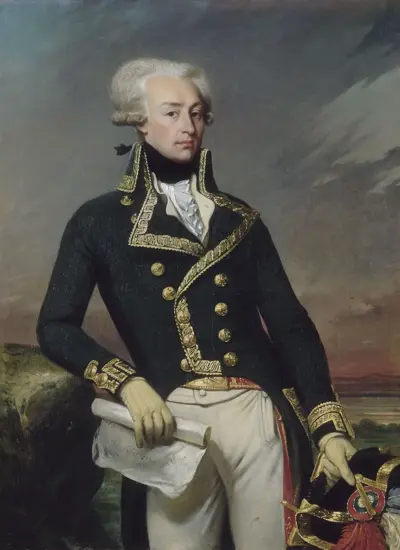
Marie-Joseph Paul Yves Roch Gilbert du Motier, Marquis de La Fayette, known in the United States as Lafayette (/ˌlɑːfiːˈɛt, ˌlæf-/, French: [lafajɛt]), was a French aristocrat and military officer who fought in the American Revolutionary War, commanding American troops in several battles, including the siege of Yorktown. After returning to France, he was a key figure in the French Revolution of 1789 and the July Revolution of 1830. He has been considered a national hero in both countries.
