Jean-Jacques Rousseau Quotes
Property, once recognized, gave rise to the first rules of justice; for, to secure each man his own, it had to be possible for each to have something. Besides, as men began to look forward to the future, and all had something to lose, every one had reason to apprehend that reprisals would follow any injury he might do to another.
Jean Jacques Rousseau, 1712-1778, French Philosopher, A Dissertation On the Origin and Foundation of the Inequality of Mankind, 1755
Sourced by: Eigen's Political and Historical Quotations


The right of vengeance was written into the first book of law for the Muslims. It was a very strong part of the culture long before Muhammad, amongst all the tribes. Before there were organized law enforcement agencies, family and tribal vengeance was the basic mechanism of law enforcement. Unfortunately for many cultures and people, it still is a legitimate method of law enforcement—even in many of the modern industrial democracies.


This proverb only makes sense in the light of understanding the Arab concept of revenge—“blood.” In a rural desert environment where little can be expected of government, the Arabs have developed a law enforcement and peace keeping mechanism which while primitive from modern standards, nevertheless worked to some degree. It is that revenge—“blood” is a moral necessity and obligation of all people, and revenge is not limited by time or to the individuals involved in the first incidence. The immediate family are the first to exact revenge, but the extended family follows and often the entire clan. Sometimes revenge is tribal or even national. Anyone who fails to revenge a member in his group is not only a disgrace, but is a clear and present danger to the group because then they can be attacked with impunity. So revenge is a strong obligation of the group members and blood must be paid with blood no matter how many generations it may take. The only thing that keeps me and my family safe, is the surety what whosoever kills one of us will themselves be killed or if they die a natural death we will take revenge on one of the evildoers relatives and no one is exempt. Crime must never pay!

It was the common practice in France to allow citizens to work in various occupations only if they received Royal permission. Some obtained monopolies in certain trades for certain areas. This is an excellent case of a reform which completely reversed previous policies. The authority doing the reform takes credit for it ignoring that the abuses and evils that it corrected were operated and maintained by them also. This quotation was also used in arguing the Slaughterhouse Cases before the Supreme Court in 1873.


The French had agreed that once the Dutch started the uprising, they would send French troops to support the revolution. The French Revolutionary government was ideologically opposed to the Dutch Monarchy of the House of Orange on their border nor did they want the British influence which existed by virtue of the support England gave to William V and the Orangists. When the uprising started, the French kept their word and sent in an army of invasion to support the revolutionary government. See {639776}.


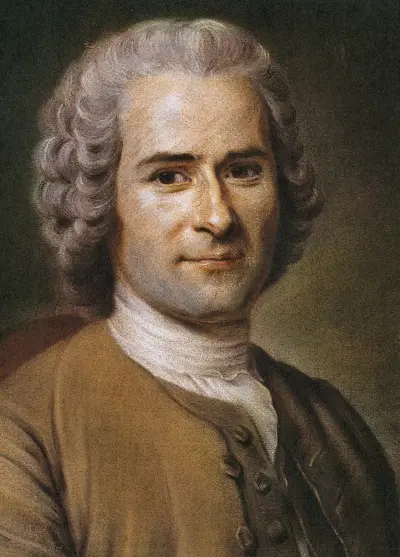
Jean-Jacques Rousseau was a Genevan philosopher, writer, and composer. His political philosophy influenced the progress of the Enlightenment throughout Europe, as well as aspects of the French Revolution and the development of modern political, economic and educational thought.
