Napoleon Bonaparte Quotes
I have no wish to interfere in the internal affairs of Holland …. If you cooperate, before a year is out we will take a stunning revenge on England …. Only by an invasion can we succeed in this …. I have no desire to burden Holland but I need her ports. It is therefore necessary that you cooperate loyally. Otherwise I will be forced to turn you into a French Department (annex Holland).
Napoleon Bonaparte, 1769-1821, [Napoleon Bonaparte], Military leader and Emperor of France, Statement to William Six and his Dutch Diplomats, June 15, 1803
Sourced by: Eigen's Political and Historical Quotations


The Dutch Monarch William V, Prince of Orange, was in a very precarious position and might be deposed. Officially Harris and the British were supporting him and Harris was giving him money to firm up his regime, but their great fear was that the French would support and control the Patriot Revolutionary movement, then quite active or even intervene militarily to aid the Patriots.


Hopkins was a social worker with no military of political experience. But the President trusted him implicitly. Most American military officers and Ambassador to England Joseph P. Kennedy, a Nazi sympathizer & father of JFK, believed that England could not stand up to Hitler. Any military aid we gave England would fall into the hands of the Germans. Everyone was shocked when Roosevelt sent Hopkins to England to make a military recommendation. To impress Hopkins with something he thought Hopkins would be interested in, Churchill led a tour of workers cottages built by the government. Hopkins surprised Churchill and his aids who would never forget this statement & then asked to see the military facilities. Hopkins distressed the American military by recommending that Britain could hold out against invasion if they received military aid. Despite the contrary military advice, FDR accepted Hopkins’ recommendations, and the rest is history. He had been right and much of the military wrong.

Holland was then a Republic and federation of the separate states. Each elected representatives to the ruling legislature, however, many states had not been pleased that their representatives did not reflect the desires and public opinion in the individual states and in some cases took bribes to vote in favor of special interests. The Dutch did NOT want their representatives to use their own judgment but wanted them to seek and follow the instructions of the legislatures of each state.

William V, Prince of Orange, was in a very precarious position and might be deposed. Officially Harris and the British were supporting him and Harris was giving him money to firm up his regime, but their great fear was that the French would support and control the Patriot Revolutionary movement, then quite active. And William was very tentative in dealing with the growing Patriot revolutionary movement. Actually, to cover all eventualities, Harris was secretly aiding the Patriots as well. See {639752}.


There was some fear in the North that the shots fired by the Southern rebels, might encourage one or more of the European Powers to start a war with the United States. And if the Rebellion turned into a full scale Civil War, the South would surely encourage such acts be promising trade concessions in the export of Southern cotton. Seward’s confident and bellicose statement distressed some Union colleagues who feared that Seward might anger and provoke one of more of the machismo and nationalistic European Powers. However, if Seward was bluffing, the bluff worked. No country encroached on American interests during the Civil War. If he was not bluffing, he certainly, along with many others, understated the difficulty that the North would have putting down the Southern rebellion.
At the time, the key British Ambassadors were diplomats and espionage agents at the same time. The Dutch Monarch William V, Prince of Orange, was in a very precarious position and might be deposed. Officially Harris and the British were supporting him and Harris was giving him money to firm up his regime, but their great fear was that the French would support and control the Patriot Revolutionary movement, then quite active. So, secretly, Harris was providing money to the patriots through a few leaders, to have a strong and influential relationship with the Republic if William were deposed. At the same time he was officially supporting William. The British wanted William to maintain his rule and were helping him to do so, but if he couldn’t, they wanted to keep the French out. It was this double dealing that prompted this quotation when Harris was asking the Prime Minister for more secret money for his covert operations.

The United States and England maintained officially that their stance was moral and ethical. And it was for most Americans and Britons. However, there were some, whose motivation was economically self-serving as this quotation suggests. The less control Japan had over China, the more other countries could freely trade with China.

They were both children of Queen Victoria of England.

The Republican controlled Senate had turned down the ratification of the League of Nations presented by Democratic President Wilson, and looked like they would turn down any international treaty even if presented by a Republican President. This statement allowed the treaty ratification by only a few votes. However, after that the Senate turned down our participation in the Permanent Court of Arbitration at the Hague. See {640099}.


The French had agreed that once the Dutch started the uprising, they would send French troops to support the revolution. The French Revolutionary government was ideologically opposed to the Dutch Monarchy of the House of Orange on their border nor did they want the British influence which existed by virtue of the support England gave to William V and the Orangists. When the uprising started, the French kept their word and sent in an army of invasion to support the revolutionary government. See {639776}.


See {636935}for the policy decision that triggered this order.
The British Troops in this situation were new recruits who had not been trained well and were under the command of poor officers who uncharacteristically did not control their troops.


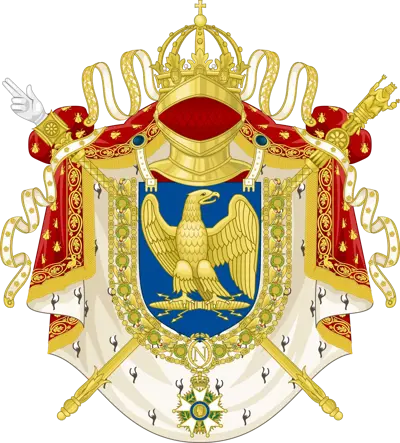
Napoléon Bonaparte was a French military and political leader of Corsican descent. He rose to prominence during the French Revolution and led several successful campaigns during the Revolutionary Wars. As Napoleon I, he was Emperor of the French from 1804 until 1814, and again in 1815. Napoleon dominated European and global affairs for more than a decade while leading France against a series of coalitions in the Napoleonic Wars. He won most of these wars and the vast majority of his battles, building a large empire that ruled over continental Europe before its final collapse in 1815. One of the greatest commanders in history, his wars and campaigns are studied at military schools worldwide. He remains one of the most celebrated and controversial political figures in human history.
