James Harris Quotes
I abhor this dirty work but when one is employed to sweep chimneys, one must black one’s fingers.
At the time, the key British Ambassadors were diplomats and espionage agents at the same time. The Dutch Monarch William V, Prince of Orange, was in a very precarious position and might be deposed. Officially Harris and the British were supporting him and Harris was giving him money to firm up his regime, but their great fear was that the French would support and control the Patriot Revolutionary movement, then quite active. So, secretly, Harris was providing money to the patriots through a few leaders, to have a strong and influential relationship with the Republic if William were deposed. At the same time he was officially supporting William. The British wanted William to maintain his rule and were helping him to do so, but if he couldn’t, they wanted to keep the French out. It was this double dealing that prompted this quotation when Harris was asking the Prime Minister for more secret money for his covert operations.
James Harris, 1746-1820, 1st Earl of Malmesbury, British Member of Parliament, Ambassador to Holland, Prussia, and Russia, Statement to British Prime Minister Pitt about his covert operations in Holland, Quoted in Simon Schama, Patriots & Liberators: Revolution in the Netherlands 1780-1813
Sourced by: Eigen's Political and Historical Quotations

William V, Prince of Orange, was in a very precarious position and might be deposed. Officially Harris and the British were supporting him and Harris was giving him money to firm up his regime, but their great fear was that the French would support and control the Patriot Revolutionary movement, then quite active. And William was very tentative in dealing with the growing Patriot revolutionary movement. Actually, to cover all eventualities, Harris was secretly aiding the Patriots as well. See {639752}.

Kennedy was a relatively new president and the Bay of Pigs Operation was prepared and planned by the CIA under the Eisenhower Administration. The president assumed that the intelligence was correct and there would be an uprising of the Cuban people when as soon as the landing took place. That was all wrong and the Cubans actually supported Castro and the operation was a disaster. Kennedy never trusted the CIA after that.
The Dutch Monarch William V, Prince of Orange, was in a very precarious position and might be deposed. Officially Harris and the British were supporting him and Harris was giving him money to firm up his regime, but their great fear was that the French would support and control the Patriot Revolutionary movement, then quite active or even intervene militarily to aid the Patriots.


Dulles lied to Congress. The CIA at the time was supplying planes and American pilots in support of an anti-Sukarno Government faction that was in armed revolt. It is not clear whether or not Dulles knew the truth when he had so testified.


Lenin and his wife were wanted in Russia and carried on their revolutionary activities from England:


The poet was a close friend of Iranian Principal Leader Ali Khamenei. See {637008} for an example of the lasting effect of this coup.


Mohammad Mosaddegh had been elected Prime Minister of Iraq. However, he was left leaning in the midst of the Cold War and some of our policy strategists thought that he could hurt the U. S. interests which were large there. Iran had huge oil reserves and American and British companies were active in operating the oil drilling and export. The new Prime Minister was threatening the British with oil nationalization to get a larger share of the oil revenue. The Shah, with CIA support, fired Mosaddegh, but that backfired and the Shah had to flee the country. This was when Smith sent this note to President Eisenhower. We were prepared to try and work with Mosaddegh. However, our chief ally did not agree and wanted to oust Mosaddegh. At the request of the British MI6 intelligence service, the CIA implemented a “spontaneous” coup d’etat to overthrow the popularly elected Iranian President Mohammad Mosaddegh. This enabled the Shah to return and take over. Ironically, although he was anti-Communist, he threatened the American and British Oil Companies and forced them to “renegotiate” their contracts with Iran and pay the Shah more money. The Shah was very unpopular with Iranians, and over the years the Iranians who opposed the Shah, blamed the United States for the fact that Mosaddegh had been overthrown and the Shah returned to power. See {637008} and {637007}.

The colonists did not have great support from England before the Revolution especially with science and technology were British policy was to keep the colonies dependent on the mother country. As a result many Americans had to be very ingenious in order to function and they invented many clever ways of doing things without the right tools and equipment. Under wartime conditions this served them well.


1st Earl of Beaconsfield

The Dutch Diplomats did not want to take sides or offend the English during the American Revolution. But the people, had little use for the English whose support they blamed for the past autocracy of William of Orange.
the Dutch monarchy supported by England The French fear of course was that the revolutionary fervor spreading to the bourgeois could easily spread to France, and that is exactly what happened 4 years later. See {639769} for more of his view on the Dutch revolutionary spirit that might infect France.

William V, Prince of Orange, was a very hapless monarch of Holland who was ineffective in dealing with revolutionary discontent despite help and support of England. The King of England was resigned to Holland becoming, like France, a Republic. The English statesmen and diplomats, while aiding William, were also secretly providing money and other assistance to the Patriot rebels, to ensure good relations with the Dutch republican leaders.

This quotation shows that the French revolutionaries wished for an invasion of England, even before Napoleon came to power. Part of the reason was the traditional enmity between France and England, even before the French Revolution, and the other part that England was covertly working against the French Revolution and ideologically stood for monarchy and inequality, while the French of the time were Republicans for whom equality was not only an ideal, but part of the law and much of post-revolutionary reality.
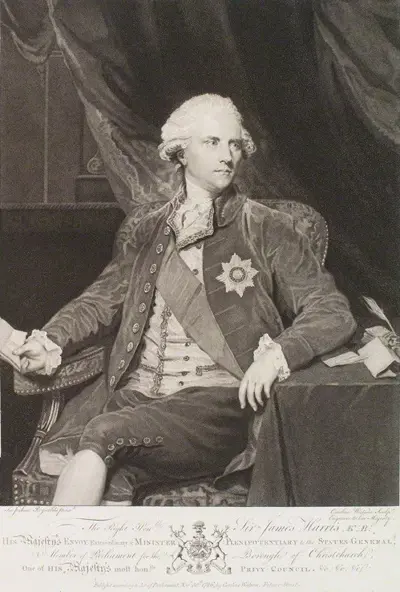
- Born: April 21, 1746
- Died: November 21, 1820
- Nationality:
- Profession:
