J. William Fulbright Quotes
To give this activity [the Bay of Pigs] even covert support is of a piece with the hypocrisy and cynicism for which the United States is constantly denouncing the Soviet Union in the United Nations and elsewhere. This point will not be lost on the rest of the world-nor on our own consciences
Kennedy was a relatively new president and the Bay of Pigs Operation was prepared and planned by the CIA under the Eisenhower Administration. The president assumed that the intelligence was correct and there would be an uprising of the Cuban people when as soon as the landing took place. That was all wrong and the Cubans actually supported Castro and the operation was a disaster. Kennedy never trusted the CIA after that.
J. William Fulbright, 1905-1995, U. S. Senator (Democrat, AR), Chairman, Senate Foreign Relations Committee, Secret Memorandum to President John F. Kennedy, urging against the proposed Bay of Pigs Operation, March 29, 1961
Sourced by: Eigen's Political and Historical Quotations

See {637464} for the trigger for the FBI to write this report. It was the report that verified that the CIA had hired the Mafia to assassinate Fidel Castro which President Johnson had heard but the CIA never revealed it to Johnson or the Warren Commission investigations JFK’s assassination. The full document was kept secret and was not yet declassified in 2014 when this quotation was entered in the collection.

This was one of the great blunders of the Central Intelligence Agency in American History. As the Central Intelligence Agency was writing this report the Russians were landing missile components in Cuba. Within days the Cuban Missile Crisis would erupt. The Central Intelligence Agency also missed the Communist Takeover in China, the fall of the Berlin wall, the implosion of the Soviet Union, the Hungarian Revolution, the Iran Revolution, the Russian invasion of Afghanistan, and the Arab Spring just to list a few of the most dramatic events about which they failed to have any information in advance. At the same time they claimed that there were nuclear weapons in Iraq leading to the Iraq war and claimed the Soviets were on a track to have a better military and stronger economy—see {635791}.


There was no national uprising. Not a single Cuban came to assist the Bay of Pigs invaders, nor was there even one sabotage action or other revolutionary action anywhere in Cuba. The conviction of the CIA that Castro was hated by the Cubans and the overwhelming majority of Cubans would welcome an invasion was so completely wrong that it was stunning. The assurances the CIA planners had received that there would be an uprising came from Cuban anti-Castro émigrés who were being paid by the CIA to organize the invasion force. They would only continue to get paid if the American authorities felt that there was a very good chance of success so they turned out to have a serious conflict of interest. But the CIA planners had been hearing this from Cuban exiles not involved with the invasion and they had a strong bias that no communist government could be a popular one. It was a great illustration of the fact that experienced professional intelligence analysts and operatives are susceptible to self-delusion and confusing wishful thinking with reality.


Kellis was the first of the Central Intelligence Agency whistle blowers. The President acted promptly on the letter and appointed General Jimmy Doolittle to conduct an investigation which confirmed the Kellis letter.
Actually the United States has a long history in interfering with foreign elections throughtout Latin American Countries, Europe, Asia,, and Africa. Russia also has been trying to tilt elections recently in Eastern Europe and befroe the COld War the International Communist Party was involved trying to swing elections since shortly after the Russin Revolution. Before that the Czars agents were involved in many foreign elections. But the United States and Russia historically are relative newcomers and rank amateurs in interering with foireign elections when compared with Germany and France and the Champion--Great Britain who controlled much of the world and very often promoting democratic values like elections throughtout the world and then workign to manipulate those elections. Japan and Chine did much less of this historically. Instead they just conquored other counties and placed their puppets in charge. What was new in teh 2016 Russian interference in the American Election was the fact that it was done by hacking computers. Putin had accused Hillary Clinton of Interfering with the Russian election when he last ran for President by funing Russian organziations that oppo

Johnson tasked Clark with finding out what the FBI knew of this story. The story was true. Worse, the CIA had hired members of the Mafia to do the assassination. (The Mafia resented Castro as he ended the Gambling Mecca that Cuba had been when his revolution succeeded. Before the Castro revolution, he Mafia got a “piece” of the profits from each Cuban casino for “protection.”) It might have been that the Kennedy Assassination was retaliation by Castro. However, the CIA withheld this from the Warren Commission and Robert Kennedy never revealed it even though he was a member of the Commission and the Commission had security clearance. See {637465}.

talks toward normalizing relations with Cuba One of the many alternative theories about the assassination of President Kennedy, was that it was done by fanatic Cubans who resented Kennedy for not sending more military assets to support the Bay of Pigs operation, for not supporting the Cuban militants to make another invasion attempt. If they had found out that Kennedy was secretly negotiating with Castro, they would have seen this as a betrayal. Attwood had secretly met with the Cuban Government Representatives and was to have briefed President Kennedy, but the president was assassinated first. His death ended the mission to normalize Cuban relations, so if that was the motivation for an assassination, the Cuban exiles might have been successful in derailing relations with Cuba. However, there has been no direct evidence found for this speculative theory.


When McNamara was itemizing the list of dangers with the Joint Chiefs’ Cuban invasion plan, McGeorge Bundy told the not to forget the possibility of a nuclear exchange. The Joint Chief’s plan and recommendation was to invade Cuba, which could have been accomplished with relative military ease they thought. However, they had not gone the next steps and had no planned responses to the various possible Russian responses. The Chiefs of Staff were senior battle hardened WWII and Korean War veterans whose tactical knowledge and leadership was as good as there was. However, none of the had any experience or training with the strategic aspects of military planning the way senior military officers did in the next generation of military leaders. The civilian leadership had to put the breaks on the Joint Chief’s notion of simplistic invading Cuba.
Dulles was a master at manipulating presidents. Instead of just presenting his Bay of Pigs plan to Kennedy and assuring him of his belief in its likely success, Dulles brought in the comparison with Eisenhower, a great general with extensive foreign policy experience. If Ike would give the go ahead with a lesser success probability plan, then it showed the confidence that Eisenhower had in Dulles and the Central Intelligence Agency staff. If Kennedy were to kill the Bay of Pigs plan, then either he did not have the courage that Ike had or he was substituting his military judgment for Eisenhower’s. Kennedy approved the operation which was a terrible example of military planning. Kennedy, after the Bay of Pigs Debacle, never again had great confidence in the professional military and espionage. Many political scientists and historians credit this negative experience with the Bay of Pigs with giving Kennedy the confidence to not follow the recommendations of the leading military and intelligence staff when faced with the Cuban Missile Crises—even when members of the Joint Chief’s of Staff (Curtis LeMay was the most forceful) told him unequivocally that his failure to act more forcefully would likely weaken if not destroy the independence of the country. President Kennedy and his brother, Bobby, took a much more proactive role in the Missile Crises than they did in the Bay of Pigs.
Mohammad Mosaddegh had been elected Prime Minister of Iraq. However, he was left leaning in the midst of the Cold War and some of our policy strategists thought that he could hurt the U. S. interests which were large there. Iran had huge oil reserves and American and British companies were active in operating the oil drilling and export. The new Prime Minister was threatening the British with oil nationalization to get a larger share of the oil revenue. The Shah, with CIA support, fired Mosaddegh, but that backfired and the Shah had to flee the country. This was when Smith sent this note to President Eisenhower. We were prepared to try and work with Mosaddegh. However, our chief ally did not agree and wanted to oust Mosaddegh. At the request of the British MI6 intelligence service, the CIA implemented a “spontaneous” coup d’etat to overthrow the popularly elected Iranian President Mohammad Mosaddegh. This enabled the Shah to return and take over. Ironically, although he was anti-Communist, he threatened the American and British Oil Companies and forced them to “renegotiate” their contracts with Iran and pay the Shah more money. The Shah was very unpopular with Iranians, and over the years the Iranians who opposed the Shah, blamed the United States for the fact that Mosaddegh had been overthrown and the Shah returned to power. See {637008} and {637007}.


Hunt was being questioned about his forgery of a State Department cable linking the Kennedy administration to the assassination of President Ngo Dinh Diem of South Vietnam:
Mykola Lebed was of inestimable value to this agency…. He assisted in operations of great importance
This is a noteworthy quotation as it shows the nasty side of American intelligence activity in the aftermath of WWII. Mykola Lebed, 1909-1998 was a Ukrainian Nationalist war criminal working with the Nazis who was responsible for the murder and ethnic cleansing of Poles in Volhynia and Eastern Galicia, He was convicted, and imprisoned for the murder, in 1936, of Polish Interior Minister Bronislaw Pieracki but was released when the Nazis occupied Poland. However, he was anti-Russian and our CIA enlisd his “services” to spy on the Soviets in the Ukraine. Then in 1949 he emigrated to the United States. As a war criminal, the law required that he be sent back to Europe, but this letter from the CIA Director “persuaded” the immigration authorities to not only allow him into the country, but the CIA paid him and he lived until in New York City until his death. There was no legal basis for his entry into the United States but the arrangements were made in secret. Polish patriots who had greatly assisted the Allies in fighting the Germans in WWII with great losses, did not even know that the war criminal that had tortured and murdered so many Poles was not only alive and well and living in New York, but was being paid by the United States government. The issue of what criteria are used for American intelligence agencies to use agents and what “rewards” can be given has been in controversy ever since. In one case in the late 20th century, the CIA actually employed an agent in South America who murdered and raped American nuns doing humanitarian work. The argument on the other side is that for espionage one wants terrible people with no moral compunctions as they make good agents. The question has always been at what moral cost and does a sociopath really make a good agent. See {633239}.

At the time the USSR was our ally. Neither the military or the state department focused in gaining intelligence on any ally and J. Edgar Hoover had for years focused on intelligence about communists in the United States but not in Russia and the rest of the world. These other agencies treated Souers with disdain or ignored him, but this memo showed the importance of Truman’s idea of having an independent intelligence agency to inform the President.

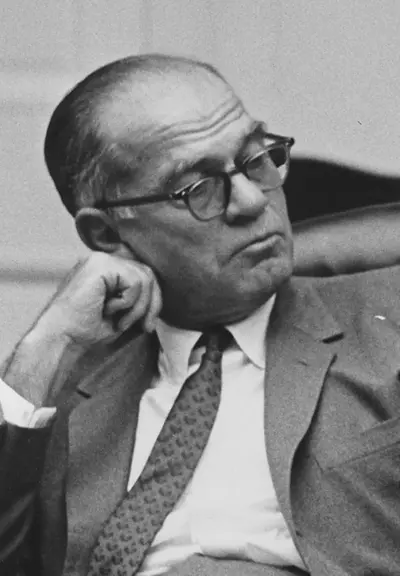
James William Fulbright was an American politician, academic, and statesman who represented Arkansas in the United States Senate from 1945 until his resignation in 1974. As of 2021, Fulbright is the longest serving chairman in the history of the United States Senate Committee on Foreign Relations. He is best known for his staunch multilateralist positions on international issues, opposition to American involvement in the Vietnam War, and the creation of the international fellowship program bearing his name, the Fulbright Program.
