Lyndon B. Johnson Quotes
This story going around about the CIA … sending in folks to get Castro, It’s incredible. They have a man that was involved that was brought into the CIA, with a number of others, and instructed by the CIA and the Attorney General [then Robert F. Kennedy] to assassinate Castro after the Bay of Pigs.
Johnson tasked Clark with finding out what the FBI knew of this story. The story was true. Worse, the CIA had hired members of the Mafia to do the assassination. (The Mafia resented Castro as he ended the Gambling Mecca that Cuba had been when his revolution succeeded. Before the Castro revolution, he Mafia got a “piece” of the profits from each Cuban casino for “protection.”) It might have been that the Kennedy Assassination was retaliation by Castro. However, the CIA withheld this from the Warren Commission and Robert Kennedy never revealed it even though he was a member of the Commission and the Commission had security clearance. See {637465}.
Lyndon Baines Johnson, 1908-1973, 36th President of the United States (Democrat, TX), Statement to Ramsey Clark during the investigation of the Assassination of JFK, 1964
Sourced by: Eigen's Political and Historical Quotations

See {637464} for the trigger for the FBI to write this report. It was the report that verified that the CIA had hired the Mafia to assassinate Fidel Castro which President Johnson had heard but the CIA never revealed it to Johnson or the Warren Commission investigations JFK’s assassination. The full document was kept secret and was not yet declassified in 2014 when this quotation was entered in the collection.

talks toward normalizing relations with Cuba One of the many alternative theories about the assassination of President Kennedy, was that it was done by fanatic Cubans who resented Kennedy for not sending more military assets to support the Bay of Pigs operation, for not supporting the Cuban militants to make another invasion attempt. If they had found out that Kennedy was secretly negotiating with Castro, they would have seen this as a betrayal. Attwood had secretly met with the Cuban Government Representatives and was to have briefed President Kennedy, but the president was assassinated first. His death ended the mission to normalize Cuban relations, so if that was the motivation for an assassination, the Cuban exiles might have been successful in derailing relations with Cuba. However, there has been no direct evidence found for this speculative theory.


The CIA had attempted to employ the Mafia to assassinate Fidel Castro, the strongman of Cuba, and Castro found out about it. He then warned that U. S. leaders could be assassinated in retaliation. Although LBJ appointed the Warren Commission to investigate the JFK assassination and the commission concluded that Castro and Cuba had nothing to do with it—Oswald was a gunman acting alone. Johnson privately never believed that but only confided his believes to his closest confidants lest there would be public pressure to retaliate against Cuba and Johnson had no hard proof—just a suspicion.


Kennedy was a relatively new president and the Bay of Pigs Operation was prepared and planned by the CIA under the Eisenhower Administration. The president assumed that the intelligence was correct and there would be an uprising of the Cuban people when as soon as the landing took place. That was all wrong and the Cubans actually supported Castro and the operation was a disaster. Kennedy never trusted the CIA after that.

It was later disclosed that some in the CIA had, working with some Cuban exiles, arranged with American organized crime for them to assassinate Fidel Castro. They failed, and the CIA then tried to cover up the truth. They even lied to the Warren Commission investigating John F. Kennedy’s murder. See {642341}.


The meeting was about the Congo. Patrice Lumumba was an extremely popular Congo leader who had just led the independence fight against Belgium and been elected Prime Minister and one of the few African leaders at the time who was not corrupt but he was a socialist. The mineral rich Katanga Province then seceded just a few weeks after Independence. Lumumba asked the UN. for supplies and trucks to allow him to keep the country together but the UN was bogged down in debate where the US thought that he might become, Russia then unilaterally offered the aid. Thinking that the Congo might become part of the Soviet Bloc, President Eisenhower called the meeting. Lumumba had not only claimed that he was not a communist but stated that Communism was just as bad as colonialism. A few weeks later the CIA engineered a coup of the Congo Military which had previously been organized and led by Colonial Belgium. The coup deposed Lumumba in favor of a corrupt incompetent Army Officer, Joseph Mobuto. Lumumba was arrested, and the UN Secretary General demanded that he be treated properly while Russia demanded that he be released as he could not have committed any crimes as he had been in office such a short time. While under "arrest" Lumumba was mysteriously murdered. The United States denied that America had anything to do with the murder. Johnson gave similar testimony under oath before the Senate Church Committee Investigating the Intelligence Agencies.
This was the reason that the FBI withheld information from the Warren Commission investigating JFK’s assassination. J. Edgar Hoover, the FBI Director was concerned that some people might conclude that the FBI bore some of the responsibility for the assassination for losing track of him. The CIA also withheld information to the commission to cover some of their misdeeds.

Dulles was a master at manipulating presidents. Instead of just presenting his Bay of Pigs plan to Kennedy and assuring him of his belief in its likely success, Dulles brought in the comparison with Eisenhower, a great general with extensive foreign policy experience. If Ike would give the go ahead with a lesser success probability plan, then it showed the confidence that Eisenhower had in Dulles and the Central Intelligence Agency staff. If Kennedy were to kill the Bay of Pigs plan, then either he did not have the courage that Ike had or he was substituting his military judgment for Eisenhower’s. Kennedy approved the operation which was a terrible example of military planning. Kennedy, after the Bay of Pigs Debacle, never again had great confidence in the professional military and espionage. Many political scientists and historians credit this negative experience with the Bay of Pigs with giving Kennedy the confidence to not follow the recommendations of the leading military and intelligence staff when faced with the Cuban Missile Crises—even when members of the Joint Chief’s of Staff (Curtis LeMay was the most forceful) told him unequivocally that his failure to act more forcefully would likely weaken if not destroy the independence of the country. President Kennedy and his brother, Bobby, took a much more proactive role in the Missile Crises than they did in the Bay of Pigs.
In April of 1962, President Kennedy convened a meeting of top advisors at the State Department to discuss the proposed CIA plan for the invasion of Cuba at the Bay of Pigs. The senator was the lone dissenter from the plan:
_0_PostageStamp_47x47.jpg "Chairman of the Joint Chiefs of Staff Navy Adm. Mike Mullen gives an interview to John Dickerson during the CBS news program Face the Nation in Washington, D.C., July 5, 2009. During the interview, Mullen discussed the wars in Iraq and Afghanistan, North Korea's recent missile tests and his recent visit to Russia. (DoD photo by Mass Communication Specialist 1st Class Chad J. McNeeley, U.S. Navy/Released)")


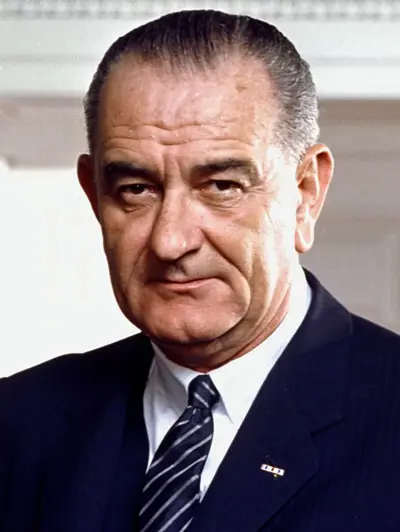
- Born: August 27, 1908
- Died: January 22, 1973
- Nationality: American
- Profession: President
Lyndon Baines Johnson, often referred to by his initials LBJ, was the 36th president of the United States, in office from 1963 to 1969. He served as the 37th vice president from 1961 to 1963 and assumed the presidency following the assassination of President John F. Kennedy. A Democrat from Texas, Johnson was also a United States representative and later majority leader in the United States Senate. Johnson is one of only four people to have served, at various times, in all four federal elected positions.
