Lyndon B. Johnson Quotes
Kennedy tried to kill Castro. Castro got Kennedy first.
The CIA had attempted to employ the Mafia to assassinate Fidel Castro, the strongman of Cuba, and Castro found out about it. He then warned that U. S. leaders could be assassinated in retaliation. Although LBJ appointed the Warren Commission to investigate the JFK assassination and the commission concluded that Castro and Cuba had nothing to do with it—Oswald was a gunman acting alone. Johnson privately never believed that but only confided his believes to his closest confidants lest there would be public pressure to retaliate against Cuba and Johnson had no hard proof—just a suspicion.
Lyndon Baines Johnson, 1908-1973, 36th President of the United States (Democrat, TX), Statement to DHHS Secretary Joseph Califano, Quoted by LBJ Assistant, Joseph Califano, The History Channel, The Kennedy Assassination, June 30, 2007
Sourced by: Eigen's Political and Historical Quotations


Johnson tasked Clark with finding out what the FBI knew of this story. The story was true. Worse, the CIA had hired members of the Mafia to do the assassination. (The Mafia resented Castro as he ended the Gambling Mecca that Cuba had been when his revolution succeeded. Before the Castro revolution, he Mafia got a “piece” of the profits from each Cuban casino for “protection.”) It might have been that the Kennedy Assassination was retaliation by Castro. However, the CIA withheld this from the Warren Commission and Robert Kennedy never revealed it even though he was a member of the Commission and the Commission had security clearance. See {637465}.

See {637464} for the trigger for the FBI to write this report. It was the report that verified that the CIA had hired the Mafia to assassinate Fidel Castro which President Johnson had heard but the CIA never revealed it to Johnson or the Warren Commission investigations JFK’s assassination. The full document was kept secret and was not yet declassified in 2014 when this quotation was entered in the collection.


This quotation was used by the Goldwater campaign in 1964 to make the point that Fidel Castro was an evil and that the Democrats had not done anything about him. Four decades later Castro was still in place but neither party would chastise the other on this issue since both had their chance and neither succeeded.

His debating opponent, Dan Quayle, compared himself to John F. Kennedy:

Most Americans do not believe the official explanation of the Warren Commission that Oswald acted alone. However, Kerry was the first of very few high government officials who would express this opinion in public. The fact that Oswald himself was then assassinated in the Dallas Police Station denied any information from him. Then were many foul ups of the investigations that most analysts of the assassination believe were foul ups or cover-ups of other wrong doing. Examples were: Parts of Kennedy’s brain was missing and the autopsy notes were burned by the naval physician who did the autopsy before anyone could see them; the FBI and CIA both lied to the Warren Commission, President Johnson, and Attorney General Robert Kennedy; Both the FBI and the CIA had files on Oswald; the CIA had tried to assassinate Fidel Castro before including paying the Mafia to do it (The efforts were bungled and Castro found out about most; Oswald had w few weeks earlier tried to assassinate the right wing John Birch Society fanatic, General Edwin Walker and the CIA and FBI missed that.); Shortly before the assassination Walker and his fanatics printed and distributed a “Wanted for Treason” poster accusing President Kennedy of selling out America. (See {635732}.)


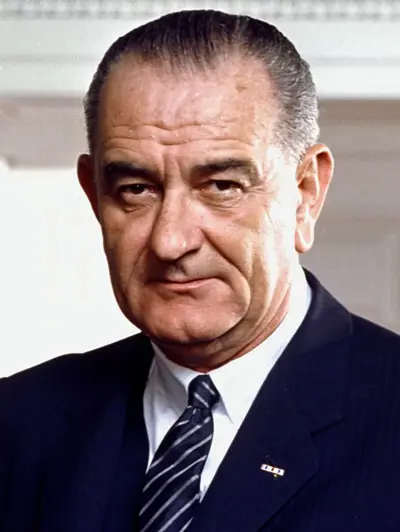
Lyndon Baines Johnson, often referred to by his initials LBJ, was the 36th president of the United States, in office from 1963 to 1969. He served as the 37th vice president from 1961 to 1963 and assumed the presidency following the assassination of President John F. Kennedy. A Democrat from Texas, Johnson was also a United States representative and later majority leader in the United States Senate. Johnson is one of only four people to have served, at various times, in all four federal elected positions.
