Robert Kennedy Quotes
Despite the President's orders that no American forces be used, the first two people who landed in the Bay of Pigs [in 1961] were Americans. The CIA sent them in.
Robert F. Kennedy, 1925-1968, U.S. Senator (Democrat, NY), U.S. Attorney General, Interviews March-May, 1964
Sourced by: Eigen's Political and Historical Quotations

talks toward normalizing relations with Cuba One of the many alternative theories about the assassination of President Kennedy, was that it was done by fanatic Cubans who resented Kennedy for not sending more military assets to support the Bay of Pigs operation, for not supporting the Cuban militants to make another invasion attempt. If they had found out that Kennedy was secretly negotiating with Castro, they would have seen this as a betrayal. Attwood had secretly met with the Cuban Government Representatives and was to have briefed President Kennedy, but the president was assassinated first. His death ended the mission to normalize Cuban relations, so if that was the motivation for an assassination, the Cuban exiles might have been successful in derailing relations with Cuba. However, there has been no direct evidence found for this speculative theory.


Johnson tasked Clark with finding out what the FBI knew of this story. The story was true. Worse, the CIA had hired members of the Mafia to do the assassination. (The Mafia resented Castro as he ended the Gambling Mecca that Cuba had been when his revolution succeeded. Before the Castro revolution, he Mafia got a “piece” of the profits from each Cuban casino for “protection.”) It might have been that the Kennedy Assassination was retaliation by Castro. However, the CIA withheld this from the Warren Commission and Robert Kennedy never revealed it even though he was a member of the Commission and the Commission had security clearance. See {637465}.


Dulles was a master at manipulating presidents. Instead of just presenting his Bay of Pigs plan to Kennedy and assuring him of his belief in its likely success, Dulles brought in the comparison with Eisenhower, a great general with extensive foreign policy experience. If Ike would give the go ahead with a lesser success probability plan, then it showed the confidence that Eisenhower had in Dulles and the Central Intelligence Agency staff. If Kennedy were to kill the Bay of Pigs plan, then either he did not have the courage that Ike had or he was substituting his military judgment for Eisenhower’s. Kennedy approved the operation which was a terrible example of military planning. Kennedy, after the Bay of Pigs Debacle, never again had great confidence in the professional military and espionage. Many political scientists and historians credit this negative experience with the Bay of Pigs with giving Kennedy the confidence to not follow the recommendations of the leading military and intelligence staff when faced with the Cuban Missile Crises—even when members of the Joint Chief’s of Staff (Curtis LeMay was the most forceful) told him unequivocally that his failure to act more forcefully would likely weaken if not destroy the independence of the country. President Kennedy and his brother, Bobby, took a much more proactive role in the Missile Crises than they did in the Bay of Pigs.

See {637464} for the trigger for the FBI to write this report. It was the report that verified that the CIA had hired the Mafia to assassinate Fidel Castro which President Johnson had heard but the CIA never revealed it to Johnson or the Warren Commission investigations JFK’s assassination. The full document was kept secret and was not yet declassified in 2014 when this quotation was entered in the collection.


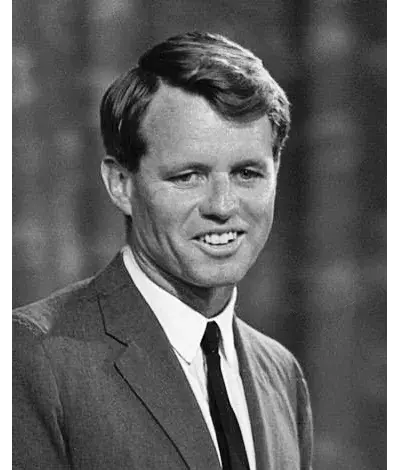
Robert Francis Kennedy, also referred to by his initials RFK or by the nickname Bobby, was an American politician and lawyer who served as the 64th United States Attorney General from January 1961 to September 1964, and as a U.S. Senator from New York from January 1965 until his assassination in June 1968. He was, like his brothers John and Edward, a prominent member of the Democratic Party and has come to be viewed by some historians as an icon of modern American liberalism.
