Noam Chomsky Quotes
We have to remember that literally within months after Castro's taking office the planes from Florida were beginning to bomb Cuba. Within a year, the Eisenhower administration secretly, but formally, decided to overthrow the government. Then came the Bay of Pigs invasion. The Kennedy administration was furious about the failure of the invasion and immediately launched a major terrorist war and economic war that got harsher through the years. Under these conditions it is kind of amazing that Cuba survived.
Chomsky, Noam. Hegemony or Survival: America's Quest for Global Dominance. Metropolitan Books, 2003.

In his early days as a revolutionary he was tried and jailed for an unsuccessful attempt to overthrow the Batista dictatorship of Cuba:


talks toward normalizing relations with Cuba One of the many alternative theories about the assassination of President Kennedy, was that it was done by fanatic Cubans who resented Kennedy for not sending more military assets to support the Bay of Pigs operation, for not supporting the Cuban militants to make another invasion attempt. If they had found out that Kennedy was secretly negotiating with Castro, they would have seen this as a betrayal. Attwood had secretly met with the Cuban Government Representatives and was to have briefed President Kennedy, but the president was assassinated first. His death ended the mission to normalize Cuban relations, so if that was the motivation for an assassination, the Cuban exiles might have been successful in derailing relations with Cuba. However, there has been no direct evidence found for this speculative theory.


This was the first American initiative for the assassination of Fidel Castro.

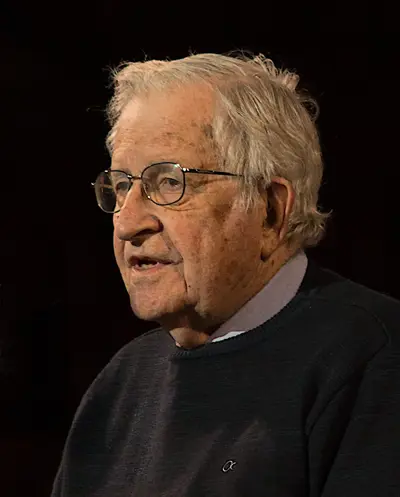
Avram Noam Chomsky is an American linguist, philosopher, cognitive scientist, historian, social critic, and political activist. Sometimes called "the father of modern linguistics", Chomsky is also a major figure in analytic philosophy and one of the founders of the field of cognitive science. He is Laureate Professor of Linguistics at the University of Arizona and Institute Professor Emeritus at the Massachusetts Institute of Technology (MIT), and is the author of more than 150 books on topics such as linguistics, war, politics, and mass media. Ideologically, he aligns with anarcho-syndicalism and libertarian socialism.
