Jonathan Swift Quotes
… let a firm Resolution be taken, by Male and Female, never to appear with one single Shred that comes from England, and let all the People say AMEN!
He wrote this anonymously as calling for a boycott of English manufactured clothing might have gotten him into much difficulty.
Jonathan Swift, 1667-1745, Irish Satirist and Protestant Cleric, Dean, Dublin Cathedral, A Proposal for the Universal Use of Irish Manufacture – Utterly Rejecting and Renouncing Everything Wearable That Comes From England, 1720
Sourced by: Eigen's Political and Historical Quotations


He advocated no cooperation with the British Colonial Administration which depended on Indian officials, administrators, clerks and other workers. The boycott strategy never worked in this case, but civil disobedience did. Boycott did work against the apartheid regime in South Africa a half century later however.

The Chief Secretary, Lord Castleregh, had put forward a resolution to bring about the unification of Great Britain and Ireland under the single British Parliament at Westminster. He and his allies had bribed a number of the Irish MPs to support the union. With Union some Irish MPs would then be able to win seats representing Ireland in the British Parliament. Although Grattan and most of the Orangemen opposed the Union, 4 months later, the bill passed comfortably. Ironically, Grattan was one of the Irish MPs whose popularity won a seat in the unified British Parliament.

The boycott had been triggered by a breakup of a mixed marriage where the Protestant wife took her two children to Belfast and would only reunite with her husband if he agreed to bring up the children as Protestants. This brought Catholic accusations of a Protestant conspiracy and plot to kidnap Catholic Children and take them to Northern Island to be brought up as Protestants. The boycott soon ended as it was too unfair for all but the most rabid Anti-protestants.


Some Indians were engaged in a massive program of non-violent passive resistance, but were brutally beaten. Even the Viceroy was outraged. The quotation illustrates the limited power that even the Viceroy of India had as there was a bureaucratic, decentralized government in each state of India which reported to its own administrators and legislatures.

France had been hit with repeated riots of Muslim and African French citizens and immigrants. Thousands of cars were burned, property damaged and violence of the protesters had injured and killed bystanders. The major complaint was that they were not really accepted as equals in French society. Chirac tried to calm the rioters and prevent a backlash. Although France was a pioneering country in acceptance and tolerance of people of different races and religions, there has always been a strong intolerant segment of French Society that were racist, anti-Semitic and Fascist leaning. Because of the French concept of equality, affirmative action was not legally possible in France so that there was heavy discrimination and even segregation in housing, schools, occupations, and socially. Further, one of the traditional expectations of all immigrants who become French is that they adopt the French language and culture. Like immigrants throughout the world at the end of the 20th century, French immigrants often wanted to maintain their own customs, culture and language—a practice which set them at odds even with otherwise nondiscriminatory Frenchmen and women.


This was King’s first appearance on the nation’s most prestigious news show.

In August 1819 there was a reform political rally in St. Peter’s Field of Manchester. The authorities wanting to censor the reform contents sent the police to break up the meeting. The police killed 11 people and wounded hundreds more in what became known as the “Peterloo Massacre”. Carlile, who publicly condemned the massacre, was one of the heroes of freedom of the press. He was jailed frequently for publishing anti government or anti Church of England criticisms, as were his wife and sister. The government grew so desperate trying to censor his publications that they placed a high minimum price on the sale of all newspapers assuring that the average citizen could not afford to buy the “seditious and blasphemous material.” In addition to press freedom he was an early reformer for birth control, religious freedom, women's suffrage and rights (which he called for in the 1820s), and against child labor.

This agreement was not a law as an English colony like South Carolina could not pass a law that prohibited buying English merchandise. It was unofficial and great pressure was put on any citizen who would not sign it. The merchants that did import goods other than those allowed in the agreement were boycotted by most of the signers. This quotation illustrates what may have been the first organized protectionist actions to assist domestic producers and manufacturers. It is valuable for another reason. The quotation lists goods that are exempted from the boycott. These were goods that were not made in South Carolina or nearby states at the time since if they were, they would have been protected, So we can learn what was manufactured in the colony or nearby at the time—that which is nit on the list but was important to colonial life. The list tells us what was not manufactured locally, and one of the most important were firearms and ammunition. The inability to manufacture armaments plagued the colonies and early America after the revolution. One of the major public expenditures was to create and subsidize domestic arms manufacture.

He had just spent 15 months in Italy and did not admire Italian symphonic abilities. The English Chartists wanted to organize demonstrations and protests but had little experience and know how.

There was a planned boycott of the Olympics protesting three factors: Avery Brundage, the long serving head of the American Olympic Committee was a notorious racist and anti-Semite, Apartheid South Africa and Rhodesia had been invited to the Olympics, and there were almost no Black coaches of the American Olympic team while the majority of the athletes were Black. Dr. King met with the organizing athletes. The boycott did not get organized soon enough and did not materialize. However, Carlos and Tommy Smith made the famous raised fist gesture during the Olympic victory ceremony, and the third medal winner Australian Peter Norman wore a button supporting the protest at the ceremony. All 3 athletes faced serious retribution afterwards.

He was arguing that the government should be able to prohibit public demonstrations on the grounds that the protesters are “irresponsible power.” This position has been taken sometimes by the American right, and is common in all totalitarian states.

at the fall of the Soviet Union

Brandt was released shortly thereafter. Russell was considered a trouble maker by the Americans and England as well as by the Communist leaders.

As a result was in 1799 he was indicted, convicted, and fined $480 and sentenced to 18 months in jail. In 1801, newly elected President Thomas Jefferson pardoned Brown along with all violators of the act.

The IRA had just murdered Lord Mountbatten with a bomb on his small boat. Mountbattten, then a 79 year old, elderly man in retirement was a member of the Royal Family. His grandson was also murdered. Mountbatten had not had anything to do with Ireland but to the IRA he was a symbol of British imperialism since he had been the British Viceroy of India. Actually, it was he who had organized and presided over Indian Independence.
The King was concerned because many of the English living in Ireland were “going native” and he also thought that if the Irish could become more civilized they could be assimilated instead of having to control them with expensive troops. To some extent this actually worked, especially in speaking English, but the entire law was very difficult to enforce. It did however, keep the Englishmen from departing from English dress, speech and household arrangements.
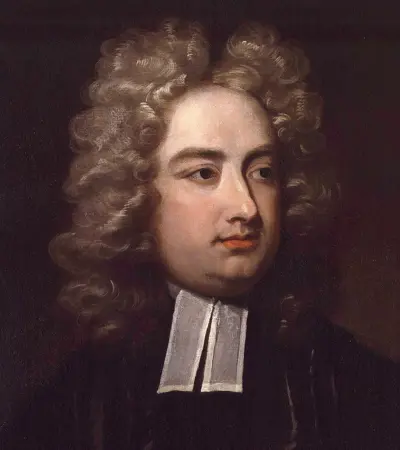
Jonathan Swift was an Anglo-Irish satirist, essayist, political pamphleteer (first for the Whigs, then for the Tories), poet and Anglican cleric who became Dean of St Patrick's Cathedral, Dublin, hence his common sobriquet, "Dean Swift".
