Wole Soyinka Quotes
The man dies in all who keep silent in the face of tyranny.
Wole Soyinka, Nigerian Poet, Playwright & Nobel Laureate, The Man Died, 1972
Sourced by: Eigen's Political and Historical Quotations


In November of each year protesters gather at Fort Benning, the site of the U. S. Army School of the Americas. The School provides training for Latin American Military Officers in Counter-Insurgency Training. The graduates of the school have included some of the worst Latin American killers and torturers (See {41061} for example) who rose to positions of power in their lands. It has also included many leaders who did not ever resort to war crimes and atrocities and also became leaders of their countries. It has been an institution of great controversy since it was discovered that the school at one point taught methods of interrogating insurgents that were tantamount to torture. Defenders of the school claim that but for the school, the military atrocities would have been worse and that it contributed to more human and democratic governments in the Americas. The annual protest has attracted more than 16,000 protesters, some of whom—like Bourgeois—have been guilty of trespass and interfering with a government facility and have served jail terms for those violations.


The benefit concert had been organized by a musical group called The People's Artists and it featured baritone Paul Robeson and folk singer Pete Seeger both great musicians with leftist political views. The beneficiary organization was The Civil Rights Congress which was fighting for a stay of execution for six African-American youths sentenced to death in New Jersey. Peekskill, only 25 miles from New York City had 3 major demographic groups: Lower and middle class white workers, middle class blacks who vacationed in the area, and liberal white intellectuals many of whom were Jewish who also vacationed in the area. Robeson had given a speech on Paris a few weeks earlier that was misquoted and the American Legion and others who had been fired up by this editorial and other anti-Communist, anti-Black and anti-Semitic rhetoric. The Concert was attacked by an organized white group who beat ticket holders and staff. The local police did not intervene, and in the aftermath of what had turned into an assault over 700 whites from the Peekskill area applied for membership in the KKK (Klu Klux Klan). See {72167} for Robeson's misquoted statement which was one of the triggers for this assault. The attack galvanized many groups of the area who were not going to let the thugs deny free speech and the following month the concert was performed. The concert itself was free from violence, though marred by the presence of a police helicopter overhead and the flushing out of at least one sniper's nest. An incredible Twenty thousand people showed up. Security, organized by labor unions, was tight with union men standing in a protective circle around the entire concert grounds and sitting with Robeson on the stage. The Musicians performed without incident.


She had been jailed for “inciting to riot.” As she was released from prison thousands of well wishers greeted her.

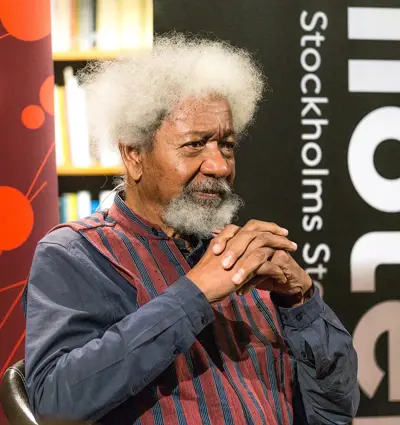
Akinwande Oluwole Babatunde Soyinka, known as Wole Soyinka (pronounced [wɔlé ʃójĩnká]), is a Nigerian playwright, novelist, poet, and essayist in the English language. He was awarded the 1986 Nobel Prize in Literature, the first sub-Saharan African to be honoured in that category. Soyinka was born into a Yoruba family in Abeokuta. In 1954, he attended Government College in Ibadan, and subsequently University College Ibadan and the University of Leeds in England. After studying in Nigeria and the UK, he worked with the Royal Court Theatre in London. He went on to write plays that were produced in both countries, in theatres and on radio. He took an active role in Nigeria's political history and its struggle for independence from Great Britain. In 1965, he seized the Western Nigeria Broadcasting Service studio and broadcast a demand for the cancellation of the Western Nigeria Regional Elections. In 1967, during the Nigerian Civil War, he was arrested by the federal government of General Yakubu Gowon and put in solitary confinement for two years.
