Edward Grey Quotes
If Germany wins, she will dominate France; the independence of Belgium, Holland, Denmark, and perhaps of Norway and Sweden, will be a mere shadow; their separate existence as nations will be fiction; all their harbours will be at Germany's disposal; she will dominate the whole of Western Europe, and this will make our position quite impossible. We could not exist as a first class State under such circumstances.
Edward Grey [Viscount Fallodon], 1862-1933, British Foreign Secretary (Liberal), Letter to the American Ambassador in London, August 4, 1914
Sourced by: Eigen's Political and Historical Quotations

England had made diplomatic inroads in Holland and was with most Dutch more popular than France. There was also a lot of trade between Holland and England. Napoleon wanted to break the English-Dutch relationships.

A few months later, that is exactly what Germany did. She was hoping that England would not enter the war despite her treaty obligations, but she was willing to risk the possibility. The Czar had a strong espionage and intelligence service active in Germany, but, like so many other intelligence failures, the intelligence operatives and analysts had military and economic facts but had little understanding of the German culture which propelled Germany to what to most other cultures was “irrational policy making.” People and nations often engage in irrational activities, even against their own self-interest.

Leval was an appeaser and a collaborator with the Nazi’s. He led the government in name but the Germans really controlled the country. His actions killed tens of thousands of French men and women by turning them over to the Germans. After the Germans were defeated in WWII, Leval was shot as a traitor by the Free French forces.

1st Viscount Grey of Fallodon. He was advocating British entry into WWI in defense of the Neutrality of Belgium as was their treaty obligation.

In both the First and Second World Wars the Western nations had a multilateral defense pact which did little good in the face of German aggression.

This was sent in response to the German invasion threat {613864}. It did no good as the Germans had already decided to invade Belgium which they did the next day.


This is the kind of threat that was used by Germany before the First World War. It worked with Turkey, but King Albert realized that being an “ally” of Germany meant losing independence anyway. Belgium would not join Germany, so the Germans invaded Belgium in 1914. Belgians fought with the allies and at the end of WWI, they were able to rebuild their independent state and thrive until they were again invaded by Germany in WWII. Turkey, in contrast, lost their entire empire, as a result of their fighting as German allies in WWI.

The “proofs” were diplomatic assurances—treaties—that England would guarantee the territorial integrity of Belgium. The British made strong diplomatic efforts to persuade Germany not to occupy Belgium. The German’s none the less send armies in under the excuse that if they did not, the French would occupy the country and have a strategic advantage over them. Diplomacy could do no more good. England had to send troops or renege on its obligations. So England was in WWI.

This was the classic German method of invading a neutral country. First they claim that they have good information that their enemy, in this case France, is going to March through Belgium to attack Germany. Then they state that the Belgians are too weak to prevent this breach of their neutrality. Therefore, Germany as an act of “self defense” must send troops into Belgium to repel the French. The Belgians of course objected and stated that they would maintain their neutrality (see {613959} ) but the Germans then invaded the next day and could not understand why the world considered it aggression.
Dreadnoughts were huge battleships. Britain had the dominant navy of the world and controlled the seas. A European war would be a land war where a navy would be of little use. Hence, Britain would not want to get involved in such a war where she could not use her greatest military strength. He was wrong about this and so much else. Britain entered WWI when Germany invaded Belgium fulfilling her treaty obligations. The Germans intelligence operators and analysts were well aware of the treaty obligations, but had little understanding of English culture and tradition. The German aggression against a small power like Belgium was morally offensive to many in Great Britain, and Britain had a tradition of fighting for moral principles. The Germans would never militarily disadvantage themselves for the sake of a treaty obligation to a small nation, and they did not believe that the British would be so different and fulfill their treaty obligations even though their strongest military asset—their navy would not be very helpful.

His appeal was also in the name of concurring heads of state of Finland, Holland, Denmark, Norway, Luxemburg, and Sweden.

The Hapsburgs were the ruling family of the Austrian Empire who wanted to invade Serbia in retaliation for their complicity in the assassination of the Austrian Archduke. This would likely bring Russia in the war in support of Serbia. The editor thought that there was no obligation to support Austria when they were planning a war of choice. What the editor did not know was that the German leadership very much wanted war at the time and supporting Austria was the perfect excuse to fight without them starting the conflict. However, the evidence became clear later than it was German aggression that turned the dispute into a World War.

At the time France and Germany controlled different parts of the Ruhr Valley. Each believed that they should control it all and the other had no right to control any of it. This never did get settled and was one of the justifications Germany gave in WWII for invading the area. Haskins was one of only three assistants who were part of Woodrow Wilson’s team that negotiated the Treaty of Versailles ending WWI.


See the American ambassador’s assessment after the war began {41089}


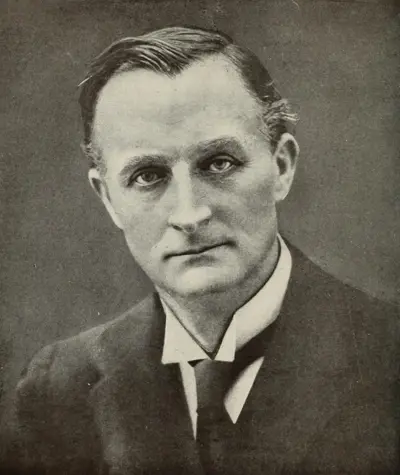
Edward Grey, 1st Viscount Grey of Fallodon, KG, PC, DL, FZS, better known as Sir Edward Grey, was a British Liberal statesman and the main force behind British foreign policy in the era of the First World War.
