Winston Churchill Quotes
We are going to liberate Europe, but that’s because the Americans are with us to do it. For, understand this, every time we must choose between Europe and the open sea, we will always choose the open sea. Every time that I have to choose between you and Roosevelt, I will always choose Roosevelt.
Winston Churchill, 1874-1965, British Prime Minister (Conservative), Statement to Charles de Gaulle, June 1944, Quoted in The Wilson Quarterly, Autumn 2003
Sourced by: Eigen's Political and Historical Quotations

Leval was an appeaser and a collaborator with the Nazi’s. He led the government in name but the Germans really controlled the country. His actions killed tens of thousands of French men and women by turning them over to the Germans. After the Germans were defeated in WWII, Leval was shot as a traitor by the Free French forces.


Poland and most other European Governments and their people were very fearful of a strong Germany with WWII always present in their memories. However, at this time the Conservative German government had very passive policies with respect to the European Community and some German leadership and activism was thought necessary by many leaders of Europe. Germany was one of the strongest economies in Europe and without the WWII legacy of aggression would normally be expected to be more of a European leader.

De Gaulle tended to see world affairs in terms of extreme, simplistic, and dramatic alternatives when reality is much more complex the truth was turned out to be for England a much more favorable outcome without either of these extremes.

England had made diplomatic inroads in Holland and was with most Dutch more popular than France. There was also a lot of trade between Holland and England. Napoleon wanted to break the English-Dutch relationships.

He used the “united nations” as a general description as the UN had not been created or named yet, However, as this quotation demonstrates, the President was already thinking about a UN idea, but as a realist, he explained that the great powers had to come to some agreement of interests. Actually China and France, at the time, would go along with whatever the United States and Britain wanted to do and had a great common interest, and there was already a strong association of interests between Britain and America. Russia was to be the problem and a complete common interest was never to be, but there was enough to get the United Nations started.


Roosevelt had withdrawn his Ambassador to Berlin, publicly reprimanded Joseph P. Kennedy, his Ambassador to England who was pro Fascist and who had said complementary things about Hitler and Mussolini. FDR made anti-German statements to a degree unknown for a country not at war. Hitler publically stated that the Germans would not be pressured. Dictators who U. S. leaders have tried to isolate and pressure, have made similar statements ever since. The American intervention was certainly effective against Hitler.


He was shot as a traitor when de Gaulle returned. See {587231} and {587230}.

The only soldier ever so honored. Marshall was then Chief of Staff of the Army. This quotation is historically very important in that it refutes the accusation made by some FDR and New Deal enemies that Roosevelt was very naïve about the importance of capturing Berlin and ceded control over the invasion and capture of Berlin to Stalin and the Soviet Union. Marshall, one of the most upright of politicians in American history, was not a FDR apologist and few doubted his word or judgment. (Senator Joseph McCarthy and other right wingers however falsely accused him of harboring communists in the Army and working against America’s interest against Russia.


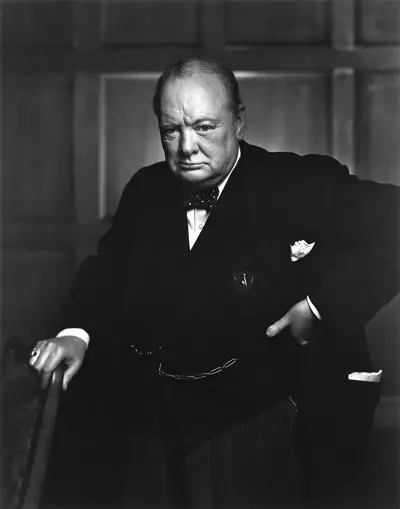
Sir Winston Leonard Spencer Churchill, KG, OM, CH, TD, DL, FRS, RA was the Prime Minister of the United Kingdom from 1940 to 1945, during the Second World War, and again from 1951 to 1955. Apart from two years between 1922 and 1924, Churchill was a Member of Parliament (MP) from 1900 to 1964 and represented a total of five constituencies. Ideologically an economic liberal and imperialist, he was for most of his career a member of the Conservative Party, as leader from 1940 to 1955. He was a member of the Liberal Party from 1904 to 1924. Churchill was also well known for his military career and as a historian, painter and writer, and among his many awards was the Nobel Prize in Literature.
