Townsend Harris Quotes
If Japan had been near to either England or France, war would have broken out long ago.
Harris, Townsend. The Complete Journal of Townsend Harris, First American Consul General and Minister to Japan. Edited by Mario Emilio Cosenza, Doubleday, Doran & Company, 1930, pp. 484-488.

2nd Earl of Guilford. Britain had a double standard of how they would fight wars and battles. If the contention was a rebellion, more mild military means would be used. But if a foreign war, they would use all means. For example, the use of mercenaries would not be used in most rebellions. With this letter, Lord North was escalating the American Revolution into a “foreign war”. As a result, not only would mercenaries be used, but so would Indian allies whose mode of war was not as restrained as the British troops. It also allowed for emancipating slaves and inviting them to take up arms. With this quotation, the American Revolution was raised to a new and more serious military level. See {634115} for the instructions to implement this policy.


President Polk and General Zachary Taylor will not He was the last President before Texas became a State. Most of us are surprised that the Texas President opposed the Mexican War.


Nasser was indeed planning an attack. Israeli intelligence had discovered it, and the Israeli’s informed President Lyndon Johnson who in turn called Kosygin. Nasser and the Arabs had miscalculated again and ended up being not only defeated in the war they wanted but totally embarrassed by the incredibly poor performance of the Arab armies who greatly outnumbered the Israelis but had no stomach for a fight.


The Falkland Islands were very close to Argentina and far from England. The Argentineans had offered the few Islanders large sums of money to become part of Argentina, but this was rejected. Argentina was a military dictatorship with a terrible record of human rights abuses. The Falklanders preferred their traditional British style of government and affiliation. The Argentinean generals assumed that if they invaded, once they controlled the Falkland Islands, they could negotiate with the British over issues of sovereignty. They misinterpreted the American UN Delegate and concluded that America would not support Britain in a military response; they also assumed that while the British would complain in the UN, they would never go halfway around the world to invade the islands, now occupied and reinforced by Argentina. Thatcher would not negotiate unless the invaders left the islands. They did not do so voluntarily. The Argentinian military had been abusing their own citizens for so long that they had an inflated concept of their fighting ability. Britain freed the islands militarily, and Argentina was humiliated. The military government fell bringing democracy to Argentina—the only good that came out of the Faulklands War.


King George did not want to give up the American Colonies and claimed the loss at Yorktown was just a loss of a single battle. The English soldiers had controlled New York, Charlestown and other places and American Tories wanted to fighting to continue. The French were having major problems elsewhere and the states were all broke from the war effort. Hamilton urged Clinton to offer all the New York offers and soldiers half pay tp be available to fight against the other ex-colonies represented in the Continental Congress.


At first glance, the reader might think that this quotation in a leading university newspaper was from the Vietnam War era. However, it was argument against U. S. involvement in World War II. There was a very negative reaction to Wilson’s visions and claims for the First World War which never did come to pass that stuck with many.


The Dutch Monarch William V, Prince of Orange, was in a very precarious position and might be deposed. Officially Harris and the British were supporting him and Harris was giving him money to firm up his regime, but their great fear was that the French would support and control the Patriot Revolutionary movement, then quite active or even intervene militarily to aid the Patriots.

Although Great Britain had abolished slavery, British economic interests during the Civil War suffered because of the northern blockade of the South. Much political opinion in England was hostile to the blockade policies of the Union. Bright, a great admirer and supporter of the United Sates and the Union cause was concerned that the United States might drift into War with Great Britain. His letter to Senator Sumner was written with the understanding that it would be in shared with President Lincoln, and it was actually read at a cabinet meeting.

German ally, the Austro-Hungarian Empire had declared war on Serbia. See {642085}. The Russian Czar was under great pressure because a large Roman Catholic Empire was warring against a small Orthodox co-religionist of Russia and Russians of all classes wanted Russia to defend Serbia. The Czar was making a good faith effort to stave off the war. What he did not realize was that Germany had actually planned for war against Russia and France and was using the alliance with Austria as an excuse.


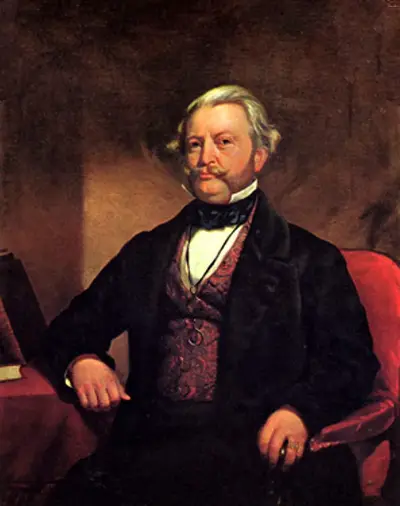
Townsend Harris was an American merchant and minor politician, and the first United States Consul General to Japan. He negotiated the "Harris Treaty" between the US and Japan and is credited as the diplomat who first opened Shogunate Japan to foreign trade and culture in the Edo period.
