Charles Homer Haskins Quotes
There is, however, much to be said for the division of this great area [the Ruhr valley], as at present, rather than its union under a single state which would have, in war and peace, a practical monopoly of iron and steel on the Continent.
At the time France and Germany controlled different parts of the Ruhr Valley. Each believed that they should control it all and the other had no right to control any of it. This never did get settled and was one of the justifications Germany gave in WWII for invading the area. Haskins was one of only three assistants who were part of Woodrow Wilson’s team that negotiated the Treaty of Versailles ending WWI.
Charles Homer Haskins, 1870–1937, Historian, Advisor & Assistant to President Woodrow Wilson, “Franco-German Frontiers”, Foreign Affairs, December 1924
Sourced by: Eigen's Political and Historical Quotations


Leval was an appeaser and a collaborator with the Nazi’s. He led the government in name but the Germans really controlled the country. His actions killed tens of thousands of French men and women by turning them over to the Germans. After the Germans were defeated in WWII, Leval was shot as a traitor by the Free French forces.

He was shot as a traitor when de Gaulle returned. See {587231} and {587230}.

He served as one of Napoleon’s Generals


The Spanish had been beaten and bloodied by England, but no one else until Napoleon would come along later. So it was easy for Spain to bully and dominate the non-English countries.

She had gone to Europe where the 2nd World War was raging.

He was exactly right. Two decades later Germany had started WWII.

He had given a speech and then was accused by several representatives He then returned to the podium with this denial. Throughout history many political leaders have started wars to distract the public from the poor economy of other domestic failures. Many others would never do so. All the former, claim that they are the latter.
At the time, the major European countries were in a competitive scramble for colonies in Africa—so much so that there were very few independent territories left. The maps and borders of Africa were really decided by the Europeans.


Every major Western power and Japan were looking to control parts of China for their own mercantile advantage. The Emperor, her adopted son, had stated that under no circumstances would the Chinese fight, but Cixi issued this decree, in effect, overruling the Emperor—a remarkable occurrence.

A few months later, that is exactly what Germany did. She was hoping that England would not enter the war despite her treaty obligations, but she was willing to risk the possibility. The Czar had a strong espionage and intelligence service active in Germany, but, like so many other intelligence failures, the intelligence operatives and analysts had military and economic facts but had little understanding of the German culture which propelled Germany to what to most other cultures was “irrational policy making.” People and nations often engage in irrational activities, even against their own self-interest.
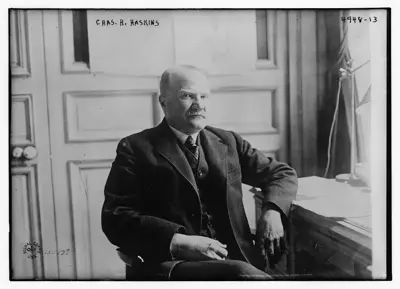
Charles Homer Haskins was a history professor at Harvard University. He was an American historian of the Middle Ages, and advisor to U.S. President Woodrow Wilson. He is widely recognized as the first academic medieval historian in the United States.
