Norman Schwarzkopf Quotes
Generals aren't in the business of commenting on the correctness or incorrectness of the President's decisions. Anybody who thinks he should be able to do that ought to be fired on the spot.
Schwarzkopf, H. Norman, and Peter Petre. It Doesn't Take a Hero. Bantam Books, 1992.


This quotation was an attack on President George W. Bush who had argued to a nation hostile about the Iraq War that the decision on whether to continue the war should be determined in large part by the report that was to be given by the commander of our forces In Iraq, General David Petraeus. He reported that he thought we should give the situation some more time and effort, and that was the policy decision. Clark and others thought this was not fair to Petraeus whose job it was not to make the policy but to implement it. It was perhaps the only time in history where a President abdicated a major war policy decision to a field officer. The President even argued to Congress that they should all wait for the General to return to Washington. He argued that he made the decision; he just wanted to hear the General’s recommendation. Most believed that he could have obtained that without the General returning to Washington to talk to Congress and the American people.


MacArthur had been the Commander of our Military Forces in Korea. He had a huge ego, and he wanted to cross the border and attack China since Chinese Troops were aiding the North Vietnamese. He had previously assured the Joint Chiefs of Staff and the President that the Chinese would not send troops into Korea, but he was then wrong. And when they had attacked, they had erased the territorial gains that MacArthur had previously gained. The Joint Chief’s of Staff, the Secretary of Defense and the Secretary of State had decided upon a strategy which this time did not follow MacArthur’s strategic advice. The President approved the strategy, but MacArthur spoke and acted contrary. The President met with MacArthur and reiterated the strategy that the President approved. But MacArthur did not follow the orders of the Joint Chiefs. At the time, he and Eisenhower were America’s two most famous military leaders, and of the two MacArthur was senior and thought that he should be President. After he was fired, MacArthur addressed a Joint Session of Congress and gave his "Old Soldiers Never Die" speech which was his first active step towards the Presidency. It was a very sentimental speech with little content and nothing about why he had disobeyed orders. He was totally shocked when it was Eisenhower who was selected to run for President and not him.


In Japan at that time there was no civilian control of the military and the military resented any attempt at the civilian government to influence military affairs in any way whatsoever. At the same time the military often tried to influence the politics of civilian government. The Emperor made this feeble effort to inhibit that, but as World War II proved, he had not tried very hard to prevent the military from dominating the country.

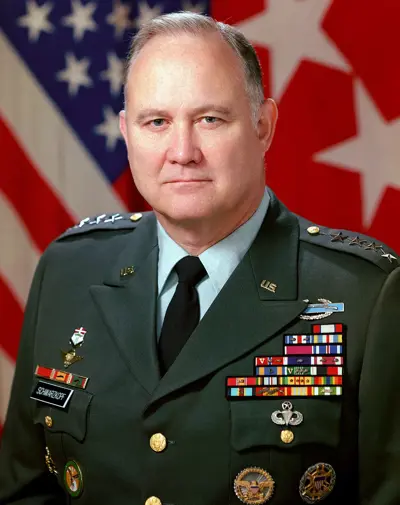
Herbert Norman Schwarzkopf Jr. was a United States Army general. While serving as the commander of United States Central Command, he led all coalition forces in the Gulf War.
