Harry S. Truman Quotes
I fired him because he wouldn't respect the authority of the president … I didn't fire him because he was a dumb son of a bitch, although he was, but that's not against the law for generals. If it was, half to three-quarters of them would be in jail.
MacArthur had been the Commander of our Military Forces in Korea. He had a huge ego, and he wanted to cross the border and attack China since Chinese Troops were aiding the North Vietnamese. He had previously assured the Joint Chiefs of Staff and the President that the Chinese would not send troops into Korea, but he was then wrong. And when they had attacked, they had erased the territorial gains that MacArthur had previously gained. The Joint Chief’s of Staff, the Secretary of Defense and the Secretary of State had decided upon a strategy which this time did not follow MacArthur’s strategic advice. The President approved the strategy, but MacArthur spoke and acted contrary. The President met with MacArthur and reiterated the strategy that the President approved. But MacArthur did not follow the orders of the Joint Chiefs. At the time, he and Eisenhower were America’s two most famous military leaders, and of the two MacArthur was senior and thought that he should be President. After he was fired, MacArthur addressed a Joint Session of Congress and gave his "Old Soldiers Never Die" speech which was his first active step towards the Presidency. It was a very sentimental speech with little content and nothing about why he had disobeyed orders. He was totally shocked when it was Eisenhower who was selected to run for President and not him.
Harry S Truman, 1884-1972, 33rd President of the United States (Democrat, MO), On Why he Fired General Douglas MacArthur During the Korean War, Quoted in Merle Miller, Plain Speaking : An Oral Biography of Harry S Truman, 1974
Sourced by: Eigen's Political and Historical Quotations

The President told McNamara that if the administration does not send the troops the Generals want, they will be blamed for any military failures that occur. If they do send all the troops that the Joint Chiefs wanted, they would be going far beyond the limits that the Defense Secretary recommended and the President would have preferred. JBJ felt he really had no political choice. He authorized the wanted troops further escalating the war. See his special assistant’s question about that decision in {617151}.

During the Korean War Secretary of State John Foster Dulles sent instructions to the United Nations Ambassador as to how to vote in a UN debate. Lodge voted to the contrary. The Assistant Secretary of State called to inquire why the instructions were not followed.

This quotation was an attack on President George W. Bush who had argued to a nation hostile about the Iraq War that the decision on whether to continue the war should be determined in large part by the report that was to be given by the commander of our forces In Iraq, General David Petraeus. He reported that he thought we should give the situation some more time and effort, and that was the policy decision. Clark and others thought this was not fair to Petraeus whose job it was not to make the policy but to implement it. It was perhaps the only time in history where a President abdicated a major war policy decision to a field officer. The President even argued to Congress that they should all wait for the General to return to Washington. He argued that he made the decision; he just wanted to hear the General’s recommendation. Most believed that he could have obtained that without the General returning to Washington to talk to Congress and the American people.

The only soldier ever so honored


He was then a senator. The General would not follow the President’s policy of limiting the Korean war to Korea and publicly advocated and threatened to expand the war to China. See {41470} for President Truman’s policy explanation.


Washington, though a military officer at the time, was very concerned with protecting the rights of citizens from abuse by the military for he had seen much of the abuse. The third amendment for example was later written to protect people from the military. The Constitution also requires that Congress make such rules for the military. Note that Washington, our first senior military officer at the time, wanted Congress to make detailed rules for the conduct of soldiers. In the 20th and 21st century, as the imperial presidency developed, there was a political view that only the military officers and the Commander in Chief should make the rules and regulations for the soldiers. However, there was no question but that the Founding Fathers saw this as a legislative branch function. Congress and Presidents have contested for this power every since.

Miles, a hero of the Indian Campaigns (although he led the atrocities at the massacre at Wounded Knee) and then the leading military figure in America was an opponent of the policies of the new young President and had political aspirations of his own for the Presidency. Miles’ opinions were printed in the press. He maintained that he was not speaking as the Commanding General of the Army but personally as a citizen. The President surprised almost all by publicly scolding and reprimanding Miles when he next came to the White House. Five days later Roosevelt made the reprimand official, effectively ending Miles career. The issue of when senior military officers can criticize the administration has been debated ever since. Roosevelt was also a war hero himself, and although the military was shocked by such “savage” treatment of a senior officer, the President had public opinion on his side. Every decade or so there is a military official who does not care for the administration’s policies and expresses himself publicly. President Truman’s firing to General Douglas Macarthur was the most dramatic case, but Truman was well aware of the Miles and TR precedent.


Taken from the Nixon Tapes of June 14, 1971. This quotation illustrates the mental set of the Nixon White House where the President must be seen as infallible and obeyed without much questioning. After Nixon, that view did not surface again in American politics until the George W. Bush Presidency. The Federal Courts were not very sympathetic to the Haldeman assertion and allowed the publication.

This seemingly prosaic quotation is one of the most significant quotations in history. At the outbreak of the Civil War, the telegraph was rapidly developing as a communications technology. One of Lincoln’s greatest achievements was the appreciation of the new technology and the deployment of it to gain an immense strategic advantage which was a major factor in all warfare thereafter. Lincoln placed ALL telegraphy of the North under the control of the military. He then had a telegraph terminal installed in the War Department right next to the White House. He would spend many hours in the Telegraph Room reading dispatches as they were coming in. To the distress of some of his military commanders, the Commander in Chief actually, for the first time in history, received virtually real time intelligence about a battle, and issued orders to the commanders in the field in real time. The quotation is one of the early examples. Ironically, Lincoln had more real time battlefields information in the Civil War than most of our Presidents did until the Vietnam War when digital, radio communications were exploited for the purpose.

He was Chief of Staff and was trying to calm the nation. However, he created a real problem. By saying he was in control, he alarmed many people as the Constitution did not give him any authority to be in control of anything. Many people saw this as a sign of his extreme personal ambition. Others, that he had just made a mistake.
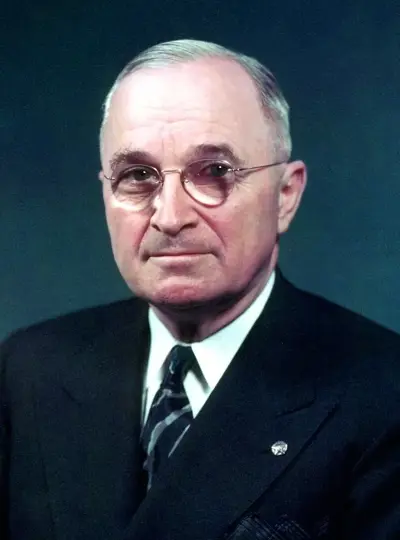
Harry S. Truman was an American politician who served as the 33rd President of the United States (1945–53). He served as a United States Senator from Missouri (1935–45) and briefly as Vice President (1945) before he succeeded to the presidency on April 12, 1945 upon the death of Franklin D. Roosevelt. He was president during the final months of World War II, and approved the plan to drop atomic bombs on Hiroshima and Nagasaki. Truman was elected in his own right in 1948. He presided over an uncertain domestic scene as America sought its path after the war and tensions with the Soviet Union increased, marking the start of the Cold War.
