Walworth Barbour Quotes
I go back to Washington every year to see the President and I get my orders directly from him—not from those pipsqueaks [at the State Department.]
Walworth Barbour, 1908-1982, U. S. Ambassador to Israel, Quoted in Seymour M. Hersh, The Sampson Option
Sourced by: Eigen's Political and Historical Quotations

During the Korean War Secretary of State John Foster Dulles sent instructions to the United Nations Ambassador as to how to vote in a UN debate. Lodge voted to the contrary. The Assistant Secretary of State called to inquire why the instructions were not followed.


Before assuming the presidency in 1933, Franklin Delano Roosevelt and his wife called on President and Mrs. Hoover in the White House. Social custom required that the call be returned, but Roosevelt told the outgoing President, "I realize, Mr. President, that you are extremely busy, so I will understand if you do not return the call." Hoover responded:


He was Chief of Staff and was trying to calm the nation. However, he created a real problem. By saying he was in control, he alarmed many people as the Constitution did not give him any authority to be in control of anything. Many people saw this as a sign of his extreme personal ambition. Others, that he had just made a mistake.

MacArthur had been the Commander of our Military Forces in Korea. He had a huge ego, and he wanted to cross the border and attack China since Chinese Troops were aiding the North Vietnamese. He had previously assured the Joint Chiefs of Staff and the President that the Chinese would not send troops into Korea, but he was then wrong. And when they had attacked, they had erased the territorial gains that MacArthur had previously gained. The Joint Chief’s of Staff, the Secretary of Defense and the Secretary of State had decided upon a strategy which this time did not follow MacArthur’s strategic advice. The President approved the strategy, but MacArthur spoke and acted contrary. The President met with MacArthur and reiterated the strategy that the President approved. But MacArthur did not follow the orders of the Joint Chiefs. At the time, he and Eisenhower were America’s two most famous military leaders, and of the two MacArthur was senior and thought that he should be President. After he was fired, MacArthur addressed a Joint Session of Congress and gave his "Old Soldiers Never Die" speech which was his first active step towards the Presidency. It was a very sentimental speech with little content and nothing about why he had disobeyed orders. He was totally shocked when it was Eisenhower who was selected to run for President and not him.


That is one view—the one tried the most frequently by Presidents who by their own estimates didn’t get a responsive civil service working to his priorities. Presidents like Teddy Roosevelt, Franklin Roosevelt, and Dwight Eisenhower and Lyndon Johnson had great cooperation from their civil servants; they instead appointed very competent people with strong senses of fairness and leading personnel. Ronald Regan tried both techniques. He used Wilson’s technique in his Education and Justice Department where there was slow-rolling and dissonance when his appointees tended to be ideologues with little or no outstanding professional competence in the fields they supervised. However, his military and State Department bureaucracies was very responsive to his appointees who were excellent leaders.


Though the Communist Party was trying to organize and gain support from the unemployed, it was difficult due to the bureaucracy.


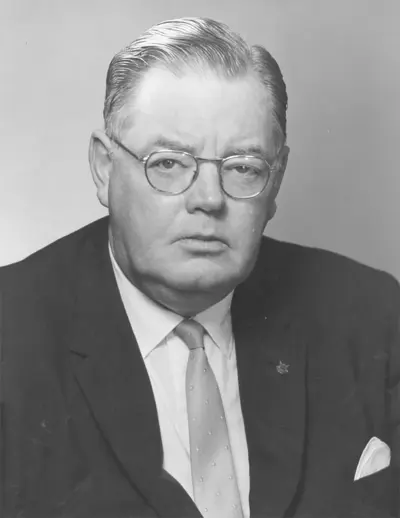
Walworth "Wally" Barbour was the United States Ambassador to Israel from 1961 to 1973.
