George C. Marshall Quotes
Mr. President. You ought to fire him [General Douglas MacArthur.]
The only soldier ever so honored
George C. Marshall, 1880-1959, General & U. S. Army Chief of Staff, U. S. Secretary of State, U. S. Secretary of Defense, Nobel Peace Prize Winner Advice to President Harry S Truman
Sourced by: Eigen's Political and Historical Quotations


MacArthur had been the Commander of our Military Forces in Korea. He had a huge ego, and he wanted to cross the border and attack China since Chinese Troops were aiding the North Vietnamese. He had previously assured the Joint Chiefs of Staff and the President that the Chinese would not send troops into Korea, but he was then wrong. And when they had attacked, they had erased the territorial gains that MacArthur had previously gained. The Joint Chief’s of Staff, the Secretary of Defense and the Secretary of State had decided upon a strategy which this time did not follow MacArthur’s strategic advice. The President approved the strategy, but MacArthur spoke and acted contrary. The President met with MacArthur and reiterated the strategy that the President approved. But MacArthur did not follow the orders of the Joint Chiefs. At the time, he and Eisenhower were America’s two most famous military leaders, and of the two MacArthur was senior and thought that he should be President. After he was fired, MacArthur addressed a Joint Session of Congress and gave his "Old Soldiers Never Die" speech which was his first active step towards the Presidency. It was a very sentimental speech with little content and nothing about why he had disobeyed orders. He was totally shocked when it was Eisenhower who was selected to run for President and not him.

This quotation was an attack on President George W. Bush who had argued to a nation hostile about the Iraq War that the decision on whether to continue the war should be determined in large part by the report that was to be given by the commander of our forces In Iraq, General David Petraeus. He reported that he thought we should give the situation some more time and effort, and that was the policy decision. Clark and others thought this was not fair to Petraeus whose job it was not to make the policy but to implement it. It was perhaps the only time in history where a President abdicated a major war policy decision to a field officer. The President even argued to Congress that they should all wait for the General to return to Washington. He argued that he made the decision; he just wanted to hear the General’s recommendation. Most believed that he could have obtained that without the General returning to Washington to talk to Congress and the American people.

When George B. McClellan was commander of the Union army, he maintained a very conservative military strategy and would not initiate any attacks. Lincoln wrote:

George Washington had been appointed by the Continental Congress as Commander in Chief of the Continental Army but was politic about keeping Congress informed and not appear to be usurping authority. He asked Adams for an opinion of whether his authority reached beyond Boston to include the defense of New York City. Adams had been a member of the Congress that appointed Washington. Adams reply has been used as precedent for the broad authority of the President as Commander in Chief by those claiming broad Presidential power since.


As in almost every war, there were disagreements between the Confederate Generals and the civilian authorities. See {633934} for another Civil War Southern example.

Actually, there are many in politics who to this day castigate Truman for his decision, but for Bloomberg’s generation and before, anyone would have pushed the button. And there are some who still fault Obama as technically, the U. S. had no right to violate Pakistani airspace and kill a resident of their state without any due process in the U. S. or Pakistan. Bloomberg would have easily pushed that button, but there are many officials who warned against it, and earlier Presidents—George W. Bush and Bill Clinton who did not authorize assassinations in foreign (allies) countries.


Ivan Khrfistoforovich Bagramyan. Mikhailovich was looking for military scapegoats for the very unsuccessful defense of Russian Soil against the onslaught of the invading Nazis in WWII. He was given command of a combat division and became one of the Russian heroes in slowing the German Forces, taking enormous losses, and finally repulsing the Germans.


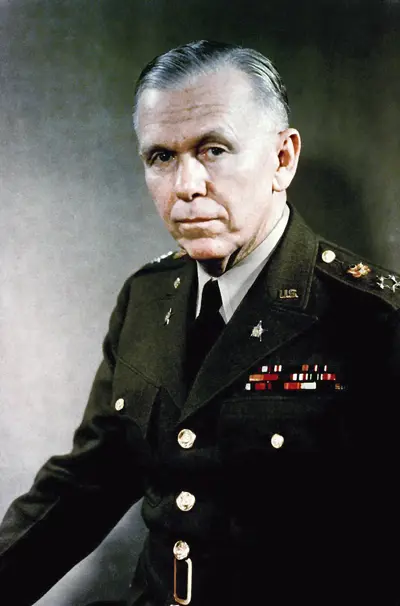
George Catlett Marshall Jr. was an American soldier and statesman. He rose through the United States Army to become Chief of Staff under presidents Franklin D. Roosevelt and Harry S. Truman, then served as Secretary of State and Secretary of Defense under Truman. Winston Churchill lauded Marshall as the "organizer of victory" for his leadership of the Allied victory in World War II. After the war, he spent a frustrating year trying and failing to avoid the impending civil war in China. As Secretary of State, Marshall advocated a U.S. economic and political commitment to post-war European recovery, including the Marshall Plan that bore his name. In recognition of this work, he was awarded the Nobel Peace Prize in 1953.
