Walter Russell Mead Quotes
The important decisions of the country are being made by a smaller and smaller group in the White House…. The Executive Branch has lost the ability to use the resources that are there [The Civil Servants].
Mead argues that this is a trend that has been operating over many administrations. It could be argued that modern communications and the media have been significant drivers of this phenomenon along with the desire for White House staff to have as much control as they can obtain. Before modern communications, an Ambassador, or a Secretary of Commerce had to make decisions within the philosophical and political umbrella of the President’s general policies. They could not communicate immediately with the President or his staff. But once everyone in the government was connected, the President’s staff could make every important decision. However, with the many different major issues and emergencies of the modern era, the small group in the What House have not been able to deal with them all and the bureaucracy has been instructed not to decide big things without going through the White House. See {642086}.
Walter Russell Mead, Editor-at-Large of The American Interest, Co-founder of the New America Foundation, Senior Fellow, Council on Foreign Relations, CNN The Global Public Square, October 12, 2014
Sourced by: Eigen's Political and Historical Quotations


Mrs. Nixon put her foot down and the West Wing did not thereafter control and manage the affairs and staff of the First Lady.


This was one of the critical quotes from the handling of the Great Depression. The President had a series of radio talks to the people in which he addressed them directly and explained things as he then understood them. In this particular quotation he was trying to manage the public’s expectation and told them quite candidly that he and his administration would make some mistakes—some Presidents like Hoover, his predecessor, rarely ever admitted error.

See {626594} for Polk’s negative view of delegation of any authority or responsibility.


During the Korean War Secretary of State John Foster Dulles sent instructions to the United Nations Ambassador as to how to vote in a UN debate. Lodge voted to the contrary. The Assistant Secretary of State called to inquire why the instructions were not followed.


The president had the 113th Congress—the most unproductive congress in American history. The Democrats controlled the House and the Republicans controlled the House of Representatives. But the Republicans were badly split between the regular Republicans and the Tea Party republicans who did not want to pass any legislation that would cost money or would make the President look good. The Republican Speaker of the House was not very strong and could not control or even coordinate his own party. So Obama did what Abraham Lincoln and Theodore Roosevelt had done with difficult Congresses, and found as much as he could do by issuing executive orders which did not need Congressional approval. Some of the Republicans were outraged that he was doing what the great Republican Presidents had done earlier and end-running Congress.


MacArthur had been the Commander of our Military Forces in Korea. He had a huge ego, and he wanted to cross the border and attack China since Chinese Troops were aiding the North Vietnamese. He had previously assured the Joint Chiefs of Staff and the President that the Chinese would not send troops into Korea, but he was then wrong. And when they had attacked, they had erased the territorial gains that MacArthur had previously gained. The Joint Chief’s of Staff, the Secretary of Defense and the Secretary of State had decided upon a strategy which this time did not follow MacArthur’s strategic advice. The President approved the strategy, but MacArthur spoke and acted contrary. The President met with MacArthur and reiterated the strategy that the President approved. But MacArthur did not follow the orders of the Joint Chiefs. At the time, he and Eisenhower were America’s two most famous military leaders, and of the two MacArthur was senior and thought that he should be President. After he was fired, MacArthur addressed a Joint Session of Congress and gave his "Old Soldiers Never Die" speech which was his first active step towards the Presidency. It was a very sentimental speech with little content and nothing about why he had disobeyed orders. He was totally shocked when it was Eisenhower who was selected to run for President and not him.


Alberto Gonzalez, White House Counsel and later Attorney General who was forced to resign and David S. Addington, Counsel to the Vice President, had come up with a novel view of the powers of the presidency. They argued that since the President is the Commander in Chief, in a war situation or intelligence gathering thereto, has the Constitutional responsibility for that function, he need not obey any laws of Congress as in the conduct of the war Congress would be impinging on the Constitutional separation of powers which itself was prohibited by the Constitution. The argument did not find any significant legal support but for a while the George W. Bush White House behaved as if this were the law, despite the fact that even in the American Revolution and the War of 1812 Congress passed laws regulating the conduct of the armed forces as is provided for in other parts of the Constitution. Yet even Goldsmith would allow the President some powers that many think are unconstitutional and/or belong to Congress. See {32436}.


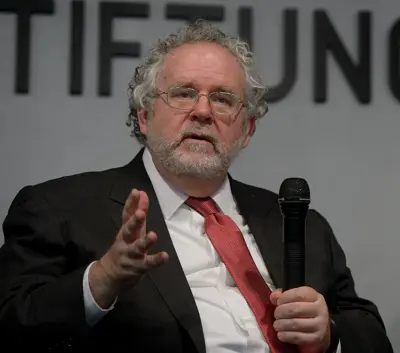
- Born: June 12, 1952
- Nationality: American
- Profession: Academic
Walter Russell Mead is an American academic. He is the James Clarke Chace Professor of Foreign Affairs and Humanities at Bard College and taught American foreign policy at Yale University. He was also the editor-at-large of The American Interest magazine. Mead is a columnist for The Wall Street Journal and a scholar at the Hudson Institute.
