Robert M. Gates Quotes
The Chinese military is on a different page from the Chinese civilian leadership.
Robert M. Gates, U. S. Secretary of Defense (Republican), Director of the CIA, Interview, PBS The Charlie Rose Show, May 16, 2012
Sourced by: Eigen's Political and Historical Quotations


There is frequently a disagreement between the military and civilian leaders just as there are disagreements among most political personnel. Hawks, and people who have had experience in the military tend to think that military advice on military matters should be determinative with the President and Congress. Others tend to believe that military advice should be considered, but if it were always adhered to, there would be no point in having civilian control over the military. See {639667} for an example of when military leadership advice prevailed and it was a mistake.

The only soldier ever so honored


After American troops were deployed to Saudi Arabia following Iraq's invasion of Kuwait:

America is almost unique among nations where the military has never been a force that either dominated or controlled the government or acted independently from it. The Founding Fathers knew well the history of Europe and other nations, and built many checks into our Constitution and our traditions with George Washington, setting the example for American military men forever after.


Every major Western power and Japan were looking to control parts of China for their own mercantile advantage. The Emperor, her adopted son, had stated that under no circumstances would the Chinese fight, but Cixi issued this decree, in effect, overruling the Emperor—a remarkable occurrence.


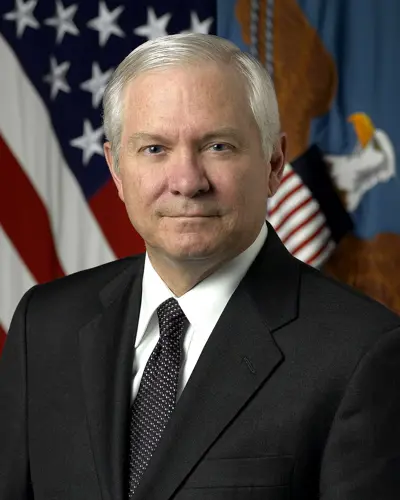
Robert Michael Gates is an American intelligence analyst, and university president who served as the 22nd United States secretary of defense from 2006 to 2011. He was originally appointed by President George W. Bush and was retained for service by President Barack Obama. Gates began his career serving as an officer in the United States Air Force but was quickly recruited by the Central Intelligence Agency (CIA). Gates served for 26 years in the CIA and the National Security Council, and was Director of Central Intelligence under President George H. W. Bush. After leaving the CIA, Gates became president of Texas A&M University and was a member of several corporate boards. Gates served as a member of the Iraq Study Group, the bipartisan commission co-chaired by James A. Baker III and Lee H. Hamilton, that studied the lessons of the Iraq War.
