Benito Mussolini Quotes
Before God and his Holy Gospels I swear and promise on becoming a Bishop, fidelity to the Italian State. I swear and promise to respect and make respected by my clergy the King and the Government established according to the constitutional laws of the State. I swear and promise moreover that I shall not participate in any agreement or any counsel that can damage the Italian State and the public order and I shall not allow to my clergy such participation. I shall concern myself with the well-being and interests of the Italian State and endeavour to avert any danger that can possibly menace it.
The Fascist Dictator hinted at all the Church property that the State might seize and began to place taxes on the Church and in a brilliant political stroke actually negotiated the Lateran Pacts of 1929 with the Church whereby the Dictator would guarantee all the churches property and protect its officials end exempt the church from taxation and all the Church had to do was have all their Italian Bishops swear to this oath of political support for the dictatorial fascist state and its outrages and aggression and denial of rights. He actually have the church more religious power than they had enjoyed in Italy for years. For example he turned over the public school curriculum to the church with no other religion considered. Despite thus oath of the Italian bishops, there were a number of individual Catholic priests who aided the anti-Fascist resistance, but for the most part Mussolini bought the political and moral support of the Catholic Church. Apologists for the Church at the time point out that the entire Vatican and the Pope was totally within the dictator’s span of control, and he could jail any of the Holy see who criticized him or have them executed as he did so many others. He could also loot the Vatican and sell off holy relics and other object to finance his wars of aggression and his alliance with Hitler. They argue that there was nothing any priests could say that would break the iron hold Mussolini had on Italy and at least, the priests could perform their pastoral functions so long as they supported the Fascists. The debate continues to this day. However, after WWII Italians left the Catholic Church in droves and it is one of the least religious states in Europe.
Benito Mussolini, 1883-1945, Italian Fascist Dictator, Pietro Gasparri, 1852-1934, Roman Catholic Italian Cardinal, Oath taken by all Italian Catholic Bishops to support and be loyal to the brutal Fascist government of the dictator Mussolini, Concordat, Lateran Pacts of 1929
Sourced by: Eigen's Political and Historical Quotations

All foreign immigrants were welcome provided they would “renounce” their allegiance to an foreign ruler or religious leader. The latter was really directed at Roman Catholics. European history had many instances where the Pope and the Vatican plotted with different forces to produce armed rebellion in various states to maintain a Catholic Establishment. England and Ireland were both the subjects of Papal revolutionary initiatives and the Americans were well aware of it. Popes and cardinals had ordered good Catholics to take various political positions including what was treason and sedition. The fear of political control of American Catholics motivated the inclusion of Ecclesiastical renouncement to become a naturalized citizen. Also note that it was the States who controlled citizenship at that time and not the Federal Government.

The Emperor had made his brother King of Holland, thinking of it as an unimportant backwater of the French Empire. But Louis took his oath and job very seriously, and although he did not have the great talent of his brother, he made a serious effort to be a good king.

Spinoza’s ideas were considered so radical and dangerous that he was the only man in history who was excommunicated by the Catholics, the Jews and the Muslims. This quotation, in the 17th century outraged almost every cleric. This is one of the strongest and unequivocal statements about the desirability of separation of church and state. Interestingly, as early as this statement was, Spinoza believed that harm extended to both religion and government.


The main purpose of the oath was to eliminate Roman Catholics who recognized the Pope as the Supreme Ecclesiastical authority. The subtlety evaporated by 1640 when the official oath actually named Rome as the target. See {617547}.

This oath was required of Southern Rebels who wanted obtain amnesty from treason which they had committed by engaging in the Civil War. See {623307} for the Presidential Proclamation.


In his Senate confirmation hearings Frankfurter was repeatedly asked about his association with the ACLU and his views on Communism by conservative Senator Pat McCarran:


Gregory the Great. “Emoluments” included the income from all lands and other church property, gifts and tithes, and income of any sort. This formula characterized the division of resources for the better part of Christian history. By today’s standard, the proportion for these Bishops (there were those who chose poverty) and his household seems astoundingly high—his income and sustenance was the equal of all the priests in the bishopric. It illustrates the affluence of the bishops who were major forces in their territories. One of the rationales for such an affluent bishop (the assets were not all personal but he had control of them) was that he should be at least the equal of any in the area including kings and nobles for he was to have as much influence as they. It is difficult today to look at modern bishops and realize how their role, power, relative wealth, and influence has changed. Bishops had their own armies, judiciary, accountants, attorneys and were a government unto themselves.

See {610517} for the Papal Bull which “gave” Ireland to England. There has been some dispute over whether this was a forgery to support the authenticity of the Papal Bull which itself was questioned.


In modern times this would appear to be a most reasonable approach to quality and doctrinal control within a church. But keep in mind that these were to be promulgated by Catholic Kings and become the civil law of the land as well as the religious. So the Catholic Bishops were granted control of who could preach in any church in the Bishopric. The power of the state was there to back up the Bishops with criminal laws and law enforcement. This together with the Inquisition would counter the forces of Reformation—Protestants.
Jesuits were leading the “covert action” efforts to destabilize the Elizabethan kingdom.

In Supremo {617632} condemning slavery

He lists a number of employees including his own wife. The foundation was the L. Ron Hubbard Dianetic Research Foundation Inc. In this case a religious leader was asking the government for assistance in determining who was and was not fit to be a member and an associate of his organization. The FBI apparently ignored his accusations, and there was no government action though he continued to accuse associates throughout his life. The FBI agent who met with Hubbard to investigate his charges wrote “mental case” on the file.

See {617354} for what stimulated the issue.
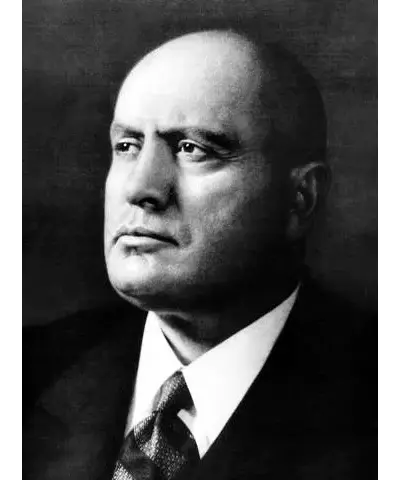
Benito Amilcare Andrea Mussolini was an Italian politician and journalist who founded and led the National Fascist Party. He was Prime Minister of Italy from the Fascist coup d'état in 1922 until his deposition in 1943, and Duce ("Leader") of Italian Fascism from the establishment of the Italian Fasces of Combat in 1919 until his execution in 1945 during the Italian Civil War. As dictator of Italy and founder of the fascist movement, Mussolini inspired other far right rulers such as Adolf Hitler, Francisco Franco, and António de Oliveira Salazar.
