Elizabeth I Quotes
Diverse persons called or professed Jesuits, seminary priests, and other priests, which have been, and from time to time are made in the parts beyond the seas, by or according to the order and rites of the Romish Church, have of late years come and been sent, and daily do come and are sent, into this realm of England and other the queen's majesty's dominions, of purpose (as has appeared, as well by sundry of their own examinations and confessions, as by divers other manifest means and proofs) not only to withdraw her highness's subjects from their due obedience to her majesty, but also to stir up and move sedition, rebellion, and open hostility within the same her highness's realms and dominions, to the great endangering of the safety of her most royal person, and to the utter ruin, desolation, and overthrow of the whole realm, if the same be not the sooner by some good means foreseen and prevented
Jesuits were leading the “covert action” efforts to destabilize the Elizabethan kingdom.
Elizabeth I, 1533-1603, Queen of England, An Act Against Jesuits and Seminarists, 1585
Sourced by: Eigen's Political and Historical Quotations


In April of 1689, Protestant William of Orange landed in England against Catholic King James I, in a Catholic-Protestant civil conflict which not only affected England but its colonies as well. The Governor and Lieutenant Governor of New York City were confused and wary as to taking immediate sides, but there was a strong anti-Catholic movement in New York City. This group, functioning as “The General Convention for the Province of New-York,” elected Leysler, its leader—later appointing him Lieutenant Governor of New York. Leysler’s forces seized the government and imprisoned the King James Appointed Officials who would not turn against James. Leysler actually governed New York for almost two years. The old guard of New York, after William had been crowned King, attempted to regain the status quo ante. Leysler and his extremist followers saw them as traitors and Papal supporters although they themselves were English Protestants. But their appointment, loyalty and wavering regarding James I made them traitors in the view of Leysler. When initial troops tried to regain power for the original governor and council Leysler, he simply dismissed them as Papists. Finally, in March of 1691 Governor Slaughter, arrived with more troops, and after a significant Battle for New York, captured Leysler and his major followers where were executed shortly thereafter. This incident, sometimes referred to as “Leysler's Rebellion,” represents these American “firsts.” First successful revolution in America; First military coup; First military dictator. First successful counter-revolution. There were some contemporary critics who thought Leysler as interested in custom duties as Papists.

Italy was in the midst of civil war with the rebels in Emila wanting its independence from the civil authority of the Pope who then controlled virtually all of Italy. The French emperor, Napoleon BonaparteII, advised that the only way to produce peace was to allow Emila to have its independence. He was the last Pope to hold temporal power. While it should not be surprising, the Pope’s statement is essentially the same position that every autocratic authority has taken when there has been some local success of the rebels.
There was no Catholic university in Ireland at the time. Unlike England where Catholic students attended both Catholic and Protestant schools, the Irish Priests were opposed to Catholic young men attending Protestant schools. See {617782} for the view of a leading academic of the era.

King Henry VIII had left the Roman Catholic church and taken England and Ireland out also. He replaced the Pope as the head of the English and Irish churches. There was much opposition in Ireland and the priests were the most assertive opponents to the change and were still loyal to the Pope. Queen Elizabeth continued to have problems with the Priests. James I, Elizabeth’s successor, became fed up by the Roman Catholic Priests and therefor issued this Proclamation.
Kahn was killed by an American Drone Strike in Yemen in 2011. Inspire Magazine was an Online Magazine Al Qaeda produced.

Under this law Kamal Sayid Qadir who had posted material of the on the internet was accused action “defamatory of government leadership” and given a 30 year jail sentence. See {589505}.


Referring to Mohandas K. Gandhi, 1869-1948:

Warning to John Calhoun and other South Carolinians about the implications of their nullification of the Tariff Act of 1832:

1st Baron Macaulay


See {610517} for the Papal Bull which “gave” Ireland to England. There has been some dispute over whether this was a forgery to support the authenticity of the Papal Bull which itself was questioned.

With martial law came the authority to seize ALL guns in the colony for the emergency. This was not to disarm the general populace. It reflected the fact that there were relatively few colonists who owned guns as they were very expensive. The Governor could take those that existed and use them to defend against the rebels or whatever. There were more gun owners in the Revolution but still a minority. Even after the War of 1812 only 30% of Americans were armed, and that shortly decreased to 10% as there was no real culture of gun ownership in early America. This would come around the Civil War.
Browne, an Englishman by birth, was the instrument of the Protestant Reformation in Ireland.

He was particularly referring to the reigns of Queen Elizabeth I and James I.
After he wrote that there was no such thing as witches he was imprisoned.

In 1956, Democratic presidential candidate, Adlai Stevenson, had suggested a nuclear testing ban. The then Vice President made his extreme accusation. See {619523} for another Nixon smear of Stevenson.
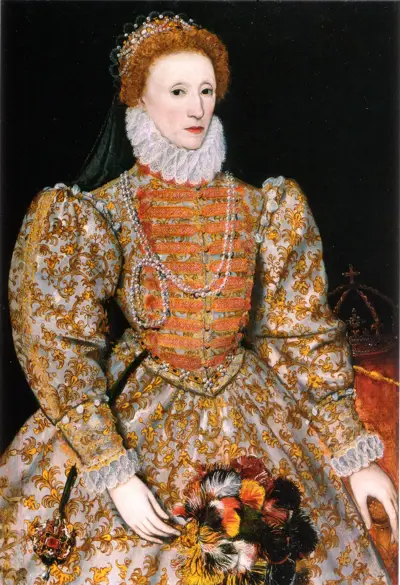
Elizabeth I was Queen of England and Ireland from 17 November 1558 until her death in 1603. Sometimes called the Virgin Queen, Gloriana or Good Queen Bess, Elizabeth was the last of the five monarchs of the House of Tudor.
