Saddam Hussein Quotes
Anyone, who intentionally takes part in an action intended to harm the state government, the unity of the state or the security of its territory, will be hanged
Saddam Hussein, Iraqi President, Remark to April Glaspie, U. S. Ambassador to Iraq, Iraq Law He Promulgated and Enforced
Sourced by: Eigen's Political and Historical Quotations

Under this law Kamal Sayid Qadir who had posted material of the on the internet was accused action “defamatory of government leadership” and given a 30 year jail sentence. See {589505}.


Member of the Triumvirate. This was the set of laws for the Roman colony in Urso, Spain. It is much like Roman law and it is very valuable because so much of it has been preserved whereas the laws of Rome itself comes to us in fragments and from secondary sources. There was no right of assembly in the dictatorial Roman Empire and a person needed approval even to stage a play. This law was actually drafted by Julius Caesar. Antony later issued it.

Although it seems incredible to us today, thousands of people were arrested and prosecuted under the Espionage Act. The government particularly targeted leftists such as Eugene V. Debs, Bill Haywood, J. Philip Randolph, Victor Berger, John Reed, Max Eastman, and Emma Goldman. Debs was sentenced to 20 years in prison for criticizing the Act itself.


With martial law came the authority to seize ALL guns in the colony for the emergency. This was not to disarm the general populace. It reflected the fact that there were relatively few colonists who owned guns as they were very expensive. The Governor could take those that existed and use them to defend against the rebels or whatever. There were more gun owners in the Revolution but still a minority. Even after the War of 1812 only 30% of Americans were armed, and that shortly decreased to 10% as there was no real culture of gun ownership in early America. This would come around the Civil War.

Italy was in the midst of civil war with the rebels in Emila wanting its independence from the civil authority of the Pope who then controlled virtually all of Italy. The French emperor, Napoleon BonaparteII, advised that the only way to produce peace was to allow Emila to have its independence. He was the last Pope to hold temporal power. While it should not be surprising, the Pope’s statement is essentially the same position that every autocratic authority has taken when there has been some local success of the rebels.

the assassination of John Kennedy 3 days earlier


In 1956, Democratic presidential candidate, Adlai Stevenson, had suggested a nuclear testing ban. The then Vice President made his extreme accusation. See {619523} for another Nixon smear of Stevenson.


He was shot in 1944 for his involvement in an attempt to kill Hitler

There was much similarity between the methods of the Nazis in Germany and the IRA in Ireland at that time. However, their objectives and philosophies were totally different. Like the Nazis, political opponents were “traitors”.

He was of course not the President then. But the stands that politicians took with respect to the rebellion of the South often determined their political futures. See {640751} for another future President’s quotation on the subject.
She was a nondescript minor functionary in a Tea Party Active Southern County, and her hatred of the Black president was hardly noteworthy. What makes this an important quotation is that it was frequently shown to foreigners who really did not understand the great degree of freedom of speech. Here a public official being paid by the government, not only calls for the removal of a sitting president, but also openly asked the army to rebel against their commander in chief. She was not punished, nor even arrested or tried. She was not even dismissed from her elected government job. That was up to the voters in the next election. There likely is no other country in the world where that can happen.

This was his name for the wealthy slaveowners in Tennessee. He was the military governor of Tennessee when he so labeled the secessionists.


Referring to Mohandas K. Gandhi, 1869-1948:

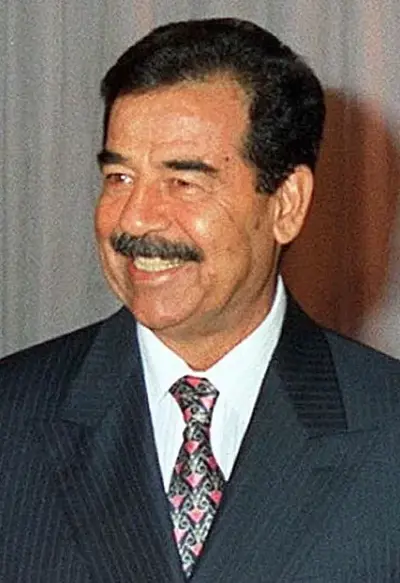
Saddam Hussein Abd al-Majid al-Tikriti was an Iraqi politician who served as the fifth President of Iraq from 16 July 1979 until 9 April 2003. A leading member of the revolutionary Arab Socialist Ba'ath Party, and later, the Baghdad-based Ba'ath Party and its regional organization, the Iraqi Ba'ath Party—which espoused Ba'athism, a mix of Arab nationalism and Arab socialism—Saddam played a key role in the 1968 coup (later referred to as the 17 July Revolution) that brought the party to power in Iraq.
