John Foxe Quotes
Ireland was almost constantly agitated by rebellions and insurrections, which, although not always taking their rise from the difference of religious opinions, between the English and Irish, were aggravated and rendered more bitter and irreconcilable from that cause.
He was particularly referring to the reigns of Queen Elizabeth I and James I.
John Foxe, 1517-1587, English Historian, Book of Martyrs
Sourced by: Eigen's Political and Historical Quotations

A force of 4,000 Spaniards, aided by Irish Catholics attempted to thwart the English Protestant Reformation forces in Ireland. They were defeated in their war by Lord Mountjoy. This is one of the many wars in history that was described as “holy” by one or both of its participants.


There was an hatred of the English—especially for displacing the Roman Catholic Church in Ireland as well as England. See {639436} and {639434}.
a lower class Catholic area of Ireland
Many Protestant Englishmen were shocked to hear this, having little familiarity with the details of the functioning of the Church of England—the Established Church of Great Britain—in Ireland and the contribution of the Church to the discrimination against Irish Catholics and the poverty of Ireland.
He was acting as French Foreign Secretary at the time.

The Muslim League was demanding that the Punjab become a part of Pakistan when independence was granted later. However, the Hindus, Sikhs, Buddhists, and Christians were all adamant that they would not live in a Muslim nation which would soon become a de facto theocracy if the British could not control them. The Punjab was divided between India and Pakistan, and hundreds of thousands died in Sikh-Muslim attacks and then Hindu-Muslim conflict in the Punjab.

This quotation shows that the dissent leading to the American Revolution did not emerge suddenly in 1776 after the Battle of Bunker Hill. Dissent, sedition and even violence was documented here in 1774. Salem at the time was the second largest port in the colony and the customs tax collectors—Loyalist Americans—were run out of Salem.
In the history of America

China had learned to grow new crops from the Americas and their greater ability to produce food led to large population growth which was straining the other national resources and the economy, technology and government could not handle the growth, producing much unhappiness and discontent.
As a result of Henry VIII establishing himself as the head of the Church in England and Ireland in place of the Pope, Henry’s heirs also became head of the Church. And that was the role that Queen Elisabeth had inherited in addition to the Crown. Many of those loyal to the Pope found most offensive the fact that a woman was making decisions for men and women on matters of faith. A Papal representative travelled with FitzGerald and probably helped him compose this document of which this is but 2 sentences. He may have drafted it completely. The Pope was a factor in many of the Irish rebellions against the English, and this caused great suspicion of all English Catholics whose loyalty to the Queen was in conflict with their loyalty to the Pope who was plotting for a Catholic takeover of England and Ireland.


The “Defenders” were the Catholic terrorists who along with their Protestant Orange Order counterpart were in sporadic acts of violence and terrorism with no military objective. The French Army was not to sail for Ireland where they would link up with The Defenders and take Ireland from the English. The invasion failed when terrible weather forced the French troop ships carrying more than 45,000 invading soldiers to cut their anchor cables and return to France.


He had broken formation in the 1588 Great Armada defeat by England and was ordered onboard another ship of officers to be disciplined (scapegoats for the defeat). His ship was severely damaged, blown off course, and wrecked on the Irish coast. Note that he refers to the Irish as “savages” which was in comportment with the English perception of the Irish at the time—see {639438}. When shipwrecked the Irish robbed and stripped the Spaniards of every shred of their clothing, but they did not kill the few Spaniards who were left alive. They lived off roots and plants until they ran into other Irish who saw them as allied Catholics against the hated English. These Irish assisted them from being captured by the English and helped the escape back to Spain in a small boat.


He later settled for Home Rule in the Irish Treaty of 1922

In 1848 a number of revolutions flared throughout Europe with a call for democracy rather than monarchy. The Prussian king was one of those who really believed that he was selected by God to rule, was very frightened and tried to enlist the Queen and England to present a united front against the revolutionaries. England, which had already had a strong functioning parliament and extensive voting suffrage, protected most of the rights of its citizens and was a Constitutional Monarchy where there were limits to the power of the monarch. Further, Victoria was extremely popular and in many ways was far ahead of the electorate in terms of modern democratic reforms. So she was not in the panic of many of the other crowned heads of Europe were in. Somewhat following the example of England, King William IV allowed a parliament and minimized the strong military role that characterized Prussia. Most of the 1848 revolutions failed to sieze governments but, as with Prussia, forced reforms in what was a long movement to European democracy that would take another 150 years. Note also the logic about religion. Since the revolutionists did not believe in the divine right of kings, they opposed God’s will on earth. Therefore, they opposed God and must be atheists. Almost all counter revolutionary accusations included the claim—often not true—that the revolutionaries were atheists.

Vladimir Lenin. This galvanized the October Revolution which put the Bolsheviks in power ousting the Kerensky government.
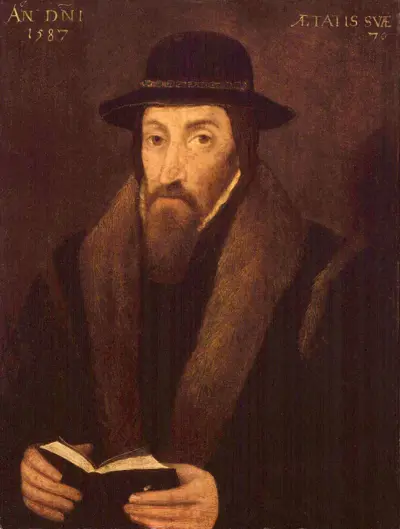
John Foxe, an English historian and martyrologist, was the author of Actes and Monuments (otherwise Foxe's Book of Martyrs), telling of Christian martyrs throughout Western history, but particularly the sufferings of English Protestants and proto-Protestants from the 14th century and in the reign of Mary I. The book was widely owned and read by English Puritans and helped to mould British opinion on the Catholic Church for several centuries.
