Francisco de Cuellar Quotes
The savages are well affected to us Spaniards, because they realize that we are attacking the heretics [the English] and are their great enemies. If it were not for those people who kept us as if belonging to themselves, not one of our people would have escaped. We owe them a good turn for that, though they were the first to rob us and strip us when we were cast on shore.
He had broken formation in the 1588 Great Armada defeat by England and was ordered onboard another ship of officers to be disciplined (scapegoats for the defeat). His ship was severely damaged, blown off course, and wrecked on the Irish coast. Note that he refers to the Irish as “savages” which was in comportment with the English perception of the Irish at the time—see {639438}. When shipwrecked the Irish robbed and stripped the Spaniards of every shred of their clothing, but they did not kill the few Spaniards who were left alive. They lived off roots and plants until they ran into other Irish who saw them as allied Catholics against the hated English. These Irish assisted them from being captured by the English and helped the escape back to Spain in a small boat.
Francisco de Cuellar, 16th Century, Spanish Sea Captain in the Armada, Memoir of his experience being shipwrecked on the Irish Coast
Sourced by: Eigen's Political and Historical Quotations

This was the at the time, a typical assessment of the English, Welsh and Scotts about the Irish who were perceived as a lower class of nation. Most interesting was the irreligious perception of a people who would become the most faithful and orthodox of Roman Catholics.

The Netherlands and Belgium then belonged to Spain. However, Protestantism was spreading to the Netherlands. The Duke of Alva was a Catholic fanatic and advised the King to send him and an army into the Lowlands to root out and kill the heretics. In contrast, the Duke of Feria counseled allowing the lowlands tolerance and warned that if the Inquisition and Alva’s army were introduced and would be feared as Alva wanted, the might get desperate and do unexpected things like revolt. The King, a Catholic fanatic himself, sent Alva and the Inquisition. In the next 12 years, fear spread throughout the lowlands. Finally, the people became so desperate that they did revolt and the lowlands gained their independence and Spain lost their most important and European possessions.

1st Earl of Beaconsfield

This quotation is an excellent example of the early, militant Gandhi. It is typical of militant theocracies of the Islamic world today.
Browne, an Englishman by birth, was the instrument of the Protestant Reformation in Ireland.

He was particularly referring to the reigns of Queen Elizabeth I and James I.

King Henry VIII had left the Roman Catholic church and taken England and Ireland out also. He replaced the Pope as the head of the English and Irish churches. There was much opposition in Ireland and the priests were the most assertive opponents to the change and were still loyal to the Pope. Queen Elizabeth continued to have problems with the Priests. James I, Elizabeth’s successor, became fed up by the Roman Catholic Priests and therefor issued this Proclamation.

In effect, the English Parliament replaced the Pope as head of the Catholic church in Ireland with King Henry the VIII. He had already become the head of the Church in England when the Pope refused to grant him the right of divorce so that he could marry Anne Boleyn, The Irish clergy and many Irishman were aghast. They were instructed to erase the Pope from their literature {639436}. They were even more distressed when the English Royal Commission recommended the closing of all Irish monasteries. See {639434}.

The Netherlands and Belgium then belonged to Spain. However, Protestantism was spreading to the Netherlands. The Duke was a Catholic fanatic and advised the King to send him and an army into the Lowlands to root out and kill the heretics. In contrast, the Duke of Feria counseled allowing the lowlands tolerance. The King, himself a bloody fanatic sent Alba with the army. Over the next decade he murdered and executed thousands of Protestants and many Catholics who were more tolerant and thought Alba, who was given the derogatory nickname of “The Iron Duke. Ironically, this led to the Lowlands revolting and gaining independence from Spain.

The violent IRA logic had always been a little tortured. At the time, the claim was that the British were not wanted in Ireland but were there only by force of arms. However, the British administration of Ireland at the time was not forceful or violent at all. Few others had the freedom and democracy of Ireland as a part of Great Britain. De Valera’s logic was that if the British in Ireland were subjected to violent, terrorist attacks, they would respond with force of arms, and thus show that they held Ireland by force. Most of the Catholics of Ireland preferred independence while most of the Protestants preferred the relationship with England.


Note the fact that the Vatican received a “fee” for in effect giving Ireland to Heny II. There are some people who doubt the authenticity of this particular bull. They argue that the English domination of Ireland was never sanctioned by the Church. Supporters of the authenticity however have the majority of the arguments. There are several Papal documents that refer to a Papal Bull sent to England’s king on the subject of Ireland. The “deal” with the cut for the church and the guarantee of church property was typical of deals made at the time. And there are copies of the bull that have been preserved (the original has never been found.)

He was one of the strongest English advocates of colonization of the New World

A force of 4,000 Spaniards, aided by Irish Catholics attempted to thwart the English Protestant Reformation forces in Ireland. They were defeated in their war by Lord Mountjoy. This is one of the many wars in history that was described as “holy” by one or both of its participants.

He also had harsh words for the American Fenians which he published and these attacks were answered with his murder in Montreal in 1868. The Fenians assumed that since he had been an Irish radical patriot he would support their cause. However their indiscriminate violence and terror against anything British including Canada turned McGee’s pen against them. The American Fenians actually tried to mount an invasion of Canada in 1868 and a pitched battle ensued. They dealt with McGee in their classic manner.
There was no Catholic university in Ireland at the time. Unlike England where Catholic students attended both Catholic and Protestant schools, the Irish Priests were opposed to Catholic young men attending Protestant schools. See {617782} for the view of a leading academic of the era.

This is a very interesting historical and psychological hypothesis, but it is supported by very few especially English and Anglo Americans. They find it absurd that they would ever feel guilty and lawless for not following a treaty between two enemies—Spain and Portugal and formalized by the Pope whose authority they had rejected. What Lopez Tijerina refers to as “piracy” was privateering which most countries engaged in with no guilt whatsoever. There is guilt for the Anglo discrimination against the Hispanics of the new world on the part of many Anglos but it is for their past discriminatory behavior not for opposing the Spanish or the Catholic countries.


This was before the state had officially sanctioned and accepted the church. Most of the institutions were pagan and the kings had subjects of both religions with Christianity not yet dominant. Yet among Christians, the Church had government temporal power, even before the church was allied with the state.

New Ross was under siege by Cromwell and his English Parliamentarian troops. After two days, the town tried to negotiate terms of surrender and one of the main things they asked for was freedom of religion to practice Roman Catholicism. This famous response set the stage for religious bigotry over the next years. Cromwell’s reasons for not allowing Catholicism to be practiced was not only one of religious zeal. At the time, the Roman Catholic Church was a major geopolitical power under a Pope who commonly supported or even dispatched troops for geopolitical and religious ends. The Vatican was particularly resentful of England for separating from the Church and asserting that the King of England was the head of the Church and not the Pope. Therefore Cromwell and many Englishmen had to deal with the reality that every practicing Catholic in the realm was a potential spy, traitor, and/or rebel. This fear of control of countries by the Pope strongly affected America, and was responsible for the defeat of the first Catholic Presidential Candidate, Al Smith. It was also a major factor in the election of John F. Kennedy so he dealt with it head on.
The King had earlier replaced the Pope as the head of the English church. The references to money referred to a then common corruption of the Church whereby people could buy indulgences—religious papal pardons of past or future sins. This was a major revenue source for the Vatican and a major issue for Martin Luther and the Protestant Reformers some of who saw the pope as the Devil incarnate See {623153}. For Martin Luther’s view pf the practice and {626720}, {595195}, and {639436} for other contemporary views.
Cromwell’s motivation for Empire was different from most other English leaders, but defeating the Catholic Spanish in the New World would be another of God’s victories over the Catholics which Cromwell and many of his Puritan followers thought was the desire and will of God.
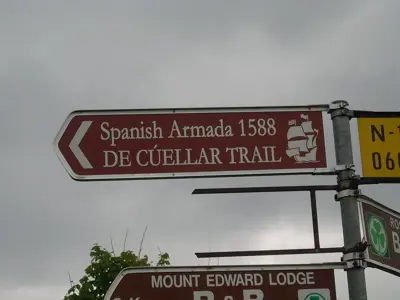
Francisco de Cuéllar was a Spanish sea captain who sailed with the Spanish Armada in 1588 and was wrecked on the coast of Ireland. He gave a remarkable account of his experiences in the fleet and on the run in Ireland.
