William Petty Quotes
The cause of the rebellion [Irish Rebellion of 1641] was the desire of the Romanists to recover the Church Revenues, worth about 110,000 per annum, and of the common Irish to get back all the Englishmen's estates, and of the ten or twelve grandees to get the empire of the whole.
William Petty, 1623-1687, English Economist & Demographer, Quoted in Ernest Hamilton, The Irish Rising Of 1641, With A Detailed Account Of The Massacres, [http://www.cristoraul.com/ENGLISH/readinghall/1641-Irish-Rebellion/10.html]
Sourced by: Eigen's Political and Historical Quotations


At this point in the convoluted history of Irish-English politics, the majority of the Irish upper class and members of Parliament were large landholders whose estates had been accumulated and legalized under English

This was a rebellion of the Irish natives of Ulster against the English Protestants land owners and the English settlers. In addition to the desire for liberty as this proclamation formally states, the rebels were mostly Roman Catholics whose religion had been almost destroyed the thought by the English component of the Protestant Reformation. 12 years after this proclamation, he was executed.


He was particularly referring to the reigns of Queen Elizabeth I and James I.

The “Defenders” were the Catholic terrorists who along with their Protestant Orange Order counterpart were in sporadic acts of violence and terrorism with no military objective. The French Army was not to sail for Ireland where they would link up with The Defenders and take Ireland from the English. The invasion failed when terrible weather forced the French troop ships carrying more than 45,000 invading soldiers to cut their anchor cables and return to France.

In most revolutionary settings leaders have to persuade people who have voted with no success to turn to the rifle. In Ireland at this point, almost all the nationalsits knew that the rifle would help them but they were not sure that a vote would have the effect of a bullet.


Executed by the English for his part in the Easter Uprising.
Executed by the English for his part in the Easter Uprising.


He had been exiled to the United States.


1st Earl of Strafford

There was an hatred of the English—especially for displacing the Roman Catholic Church in Ireland as well as England. See {639436} and {639434}.
The Irish Rebellion of 1641 The Rebels wanted to take control of the government and expel the English. However, the Irish rebels got out of control of their leadership and embarked on a number of bloody massacres of what they regarded as English usurpers and destroyers of their Catholic religion. It was the policy of the rebel leadership not to even disturb Scotts. They used the technique to tell the difference between English whose homes should be seized and Scotts who should be undisturbed that the ancient Jews used on the Exodus from Egypt: Marking the lintels of their doorway. The rebels who were so full f hate and demanding of vengeance did not always discriminate and many Scotts were massacred along with the English.
As a result of Henry VIII establishing himself as the head of the Church in England and Ireland in place of the Pope, Henry’s heirs also became head of the Church. And that was the role that Queen Elisabeth had inherited in addition to the Crown. Many of those loyal to the Pope found most offensive the fact that a woman was making decisions for men and women on matters of faith. A Papal representative travelled with FitzGerald and probably helped him compose this document of which this is but 2 sentences. He may have drafted it completely. The Pope was a factor in many of the Irish rebellions against the English, and this caused great suspicion of all English Catholics whose loyalty to the Queen was in conflict with their loyalty to the Pope who was plotting for a Catholic takeover of England and Ireland.
Irish efforts for independence from England was not only a 19th century and 20th century phenomenon. Here in the 14th century, there was already a war against England. “Lieges” were the nobles loyal to the King.
The Daily Mail was a very conservative newspaper which supported English Fascist Oswald Mosley and his Blackshirts and wrote articles favorable to Mussolini and Hitler before the war. There was a small but powerful part of English Aristocracy who were pro German and pro Fascist including the King, Edward, Duke of Windsor {584507} who was persuaded to abdicate and relegated to the Bahamas where his views were not so public. The Daily Mail catered to that part of the English Aristocracy. See also {623171}
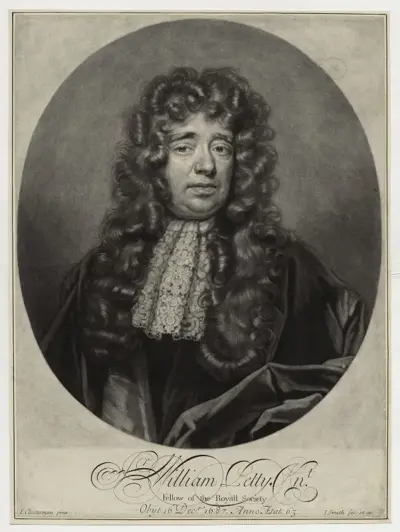
Sir William Petty FRS was an English economist, physician, scientist and philosopher. He first became prominent serving Oliver Cromwell and the Commonwealth in Ireland. He developed efficient methods to survey the land that was to be confiscated and given to Cromwell's soldiers. He also remained a significant figure under King Charles II and King James II, as did many others who had served Cromwell.
