Nathaniel Hawthorne Quotes
At no great distance from the Minnesota lay the strangest-looking craft I ever saw. It was a platform of iron, so nearly on a level with the water that the swash of the waves broke over it, under the impulse of a very moderate breeze; and on this platform was raised a circular structure, likewise of iron, and rather broad and capacious, but of no great height. It could not be called a vessel at all; it was a machine,—and I have seen one of somewhat similar appearance employed in cleaning out the docks; or, for lack of a better similitude, it looked like a gigantic rat-trap. It was ugly, questionable, suspicious, evidently mischievous,—nay, I will allow myself to call it devilish; for this was the new war-fiend, destined, along with others of the same breed, to annihilate whole navies and batter down old supremacies…. A storm of cannon shots damages them no more than a handful of dried peas. We saw the shot marks made by the great artillery of the Merrimack on the outer casing of the iron tower; they were about the breadth and depth of shallow saucers, almost imperceptible dents, with no corresponding bulge on the interior surface…. Nothing, however, can exceed the confidence of the officers in this new craft. It was pleasant to see their benign exultation in her powers of mischief, and the delight with which they exhibited the circumvolutory movement of the tower, the quick thrusting forth of the immense guns to deliver their ponderous missiles and then the immediate recoil, and the security behind the closed port-holes.
This quotation not only gives us an interesting description and reaction to the first generation of ironclad ships, but we get an insight into the amazingly open access that was available to the most important new weapon of the Union. Apparently, there was still hope of a Southern cessation of fighting and rejoining the Union, and the aim was to get as much publicity about the new weapon as possible to the Confederates to persuade them of the futility of their situation. The North could manufacture as many of these vessels as they needed, while Confederates could only refit wooden ships with metal siding. There were few ships that were suitable for such refitting and the ironworks of the South were limited and needed for cannon, railroad tracks and other uses all competing for limited production capacity. Hawthorne went on board the Monitor without making any special arrangements at all. He just showed up and went aboard.
Nathaniel Hawthorne, 1804-1864, Writer, Description of the new Union ironclad ship, the Monitor, “Chiefly About War Matters”, The Atlantic Monthly, July 1862
Sourced by: Eigen's Political and Historical Quotations

As in modern times the Navy encouraged the media and leading writers to promote their latest weaponry. Hawthorne however shortly after the Monitor and the Merrimac battle saw the future in terms even more dramatic than most of the military.

David Bushnell, 1740–1824, was a student at Yale University where he developed the first submarine used in warfare. While at Yale, Bushnell proved that gunpowder could be exploded under water. He also made the first time bomb. He combined these ideas by building the Turtle which was designed to attack ships by attaching a time bomb to their hulls, while using a hand powered drill and ship auger bit to penetrate the hulls. He used the Turtle in attempts to attack British ships which were blockading New York Harbor in the summer of 1776. His efforts failed every time because the Turtle's boring device was unable to penetrate the copper sheeting lining in the ships' hulls which was designed to protect against parasites in their previous station, the Caribbean. (From Wikipedia)

He was not aware of it but the Union War Department had prepared well and additional ironclad ships under construction of which the Monitor was just the first. Lincoln had approved the construction of ironclads on October 4, 1861. The Confederate Merrimack was larger and to the layman was the stronger ship but the Monitor did some damage and drove the Confederate Merrimac from the field to make repairs. The Confederacy, with minimal industrial steel-making capacity could not produce enough steel to protect more ships than the one ironclad Merrimack. The Union Navy, not only were building more Monitor class ships, but also, had a few Merrimack type wooden ships being iron clad as well as their Monitors as Strong had called for. The Union soon totally dominated the seas and as important, the rivers with which they could supply Union troops and bombard Confederate cities built thereupon.

There were few military thinkers at that time who would agree with Goebbels on this point.


Dreadnoughts were huge battleships. Britain had the dominant navy of the world and controlled the seas. A European war would be a land war where a navy would be of little use. Hence, Britain would not want to get involved in such a war where she could not use her greatest military strength. He was wrong about this and so much else. Britain entered WWI when Germany invaded Belgium fulfilling her treaty obligations. The Germans intelligence operators and analysts were well aware of the treaty obligations, but had little understanding of English culture and tradition. The German aggression against a small power like Belgium was morally offensive to many in Great Britain, and Britain had a tradition of fighting for moral principles. The Germans would never militarily disadvantage themselves for the sake of a treaty obligation to a small nation, and they did not believe that the British would be so different and fulfill their treaty obligations even though their strongest military asset—their navy would not be very helpful.
He had just seen demonstrations of new military technology at the German War Games.


This is the first mention of a flame thrower in the history of warfare. The ancient Greeks had developed “Greek Fire” which was a type of naphtha tar that could be launched with a sling or trebuchet at enemy ships, but they never developed both the liquid form and the pumping and pressure device to send it over a distance. But apparently the Byzantines did develop the technology. However, it was likely that it was almost as much danger to the Byzantines who manned the equipment as it was to the enemy against whom they used it. However, they were not able to deploy enough of the weapons to have made a material difference in the outcome of any large battles as none of the military leaders and observers made any significant mention of it.


This quotation is important for two reasons: First, it illustrates Churchill’s brusque, businesslike manner and his singular focus when he had an objective to accomplish. The British navy used enormous quantities of gunpowder that did not give off smoke—cordite. However, in the 1st World War, the British supply of ingredients for gunpowder in South America were threatened by the German U-boats. With acetone, cordite could be made without the South American nitrates. Weizmann, a Jewish immigrant, had studied the properties of acetone, so Churchill summoned him to the admiralty and without any small talk simply asked him. The Second reason is historical. Weizmann then invented ways to make acetone on a large scale and gave the patent to the British Government at no charge. That cemented a friendship between Weizmann and Churchill as well as Churchill’s successor Arthur Balfour. Weizmann was also the head of the World Zionist Movement to enable the Jews to return to Palestine and create a Jewish State. He was able to persuade Churchill and Balfour, and 11 years after this meeting, the British Government—legally in control of Palestine under the League of Nations mandate--issued the “Balfour Declaration” establishing the right of the Jews to emigrate to Palestine and establish a new nation. When Israel was created in 1949, Weizmann was its first President.

Most Americans do not realize that our naval forces were disbanded after the Revolution and even the Constitution did not require a navy. We had some Federal revenue cutters to interdict smugglers but no warships and no permanent sailors or officers. The Barbary Pirates had an incredible extortion racket going in the Mediterranean. If nations would pay them an annual sum each year, they would not attack and seize merchant ships of that country and sell the ships and goods while holding the sailors for ransom. See {640850},86703,{640846} & {640848}


He was the author of the first “spy novel” and one of the first English writers to use his art and craft to promote public opinion to support more military spending to defend against Germany.


Without much fanfare, the United States was beginning to deploy naval power internationally.

Israel is the most notable example. It was they who developed much of the basic drone technology.

He was arguing against the point of view that military success in the future will depend on technology.
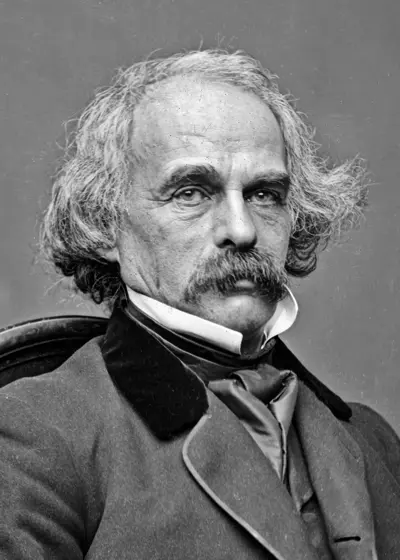
Nathaniel Hawthorne was an American novelist, dark romantic, and short story writer. His works often focus on history, morality, and religion.
