Winston Churchill Quotes
Well Dr. Weizmann, we need 30 thousand tons of acetone. Can you make it?.
This quotation is important for two reasons: First, it illustrates Churchill’s brusque, businesslike manner and his singular focus when he had an objective to accomplish. The British navy used enormous quantities of gunpowder that did not give off smoke—cordite. However, in the 1st World War, the British supply of ingredients for gunpowder in South America were threatened by the German U-boats. With acetone, cordite could be made without the South American nitrates. Weizmann, a Jewish immigrant, had studied the properties of acetone, so Churchill summoned him to the admiralty and without any small talk simply asked him. The Second reason is historical. Weizmann then invented ways to make acetone on a large scale and gave the patent to the British Government at no charge. That cemented a friendship between Weizmann and Churchill as well as Churchill’s successor Arthur Balfour. Weizmann was also the head of the World Zionist Movement to enable the Jews to return to Palestine and create a Jewish State. He was able to persuade Churchill and Balfour, and 11 years after this meeting, the British Government—legally in control of Palestine under the League of Nations mandate--issued the “Balfour Declaration” establishing the right of the Jews to emigrate to Palestine and establish a new nation. When Israel was created in 1949, Weizmann was its first President.
Winston Churchill, 1874-1965, British Prime Minister (Conservative), First thing said to the young chemist, Chaim Weizmann when Churchill was First Lord of the Admiralty, March 1915
Sourced by: Eigen's Political and Historical Quotations


The King was asking for volunteers for the British Army. What is particularly interesting about this quote is the overt appeal to “men of all classes.” This illustrates that there was an extensive class system then operational in Britain. Almost all people knew to which class they belonged. A very popular King could then make a statement like this and no one was critical of his referring to citizens by class distinctions. Even in modern times, Britain is a more class conscious society than America. The response to this appeal was very good, but the First World War developed in such a way that huge manpower resources were needed and the King had to reluctantly assent to a military draft 7 months later.
Just 7 months earlier the King had made a direct appeal to the people for enlistment in the military—See {587166}. The response was very good, but the First World War developed in such a way that huge manpower resources were needed and the King had to reluctantly assent to a military draft.


The Bay of Pigs

The French and English, with larger numbers and more experienced troops and officers, wanted the American units to come under the command or their officers and be integrated into the allied army. However Wilson established the tradition that American troops fighting abroad most always fight as an American Army under American Command. Although resented then and into the 21st century by America’s allies who are expected to fight under American command, it is a tradition that no American major politician has seriously challenged since then.


This article reached America where the insult proved a patriotic rallying point.


FDR was hoping to defeat or at least stop Hitler and Germany by arming England and Russia and thus avoid having American troops committed. However. when the Japanese launched their sneak attack on Pearl Harbor, Hitler immediately declared war on the United States, and our troops were suddenly in a two continent war.

Like many of the leading right wing hawks of his era, he was a hawk who had never served in the military. In addition they accused the lft wing draft dodgers as being unpatriotic.
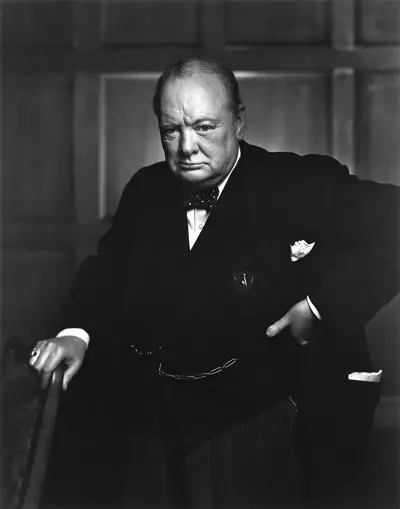
Sir Winston Leonard Spencer Churchill, KG, OM, CH, TD, DL, FRS, RA was the Prime Minister of the United Kingdom from 1940 to 1945, during the Second World War, and again from 1951 to 1955. Apart from two years between 1922 and 1924, Churchill was a Member of Parliament (MP) from 1900 to 1964 and represented a total of five constituencies. Ideologically an economic liberal and imperialist, he was for most of his career a member of the Conservative Party, as leader from 1940 to 1955. He was a member of the Liberal Party from 1904 to 1924. Churchill was also well known for his military career and as a historian, painter and writer, and among his many awards was the Nobel Prize in Literature.
