Ashton B. Carter Quotes
Other countries were using drones before the United States was using them..
Israel is the most notable example. It was they who developed much of the basic drone technology.
Ashton B. Carter, United States Deputy Secretary of Defense (Democrat), Member of the Defense Science Board, Interview, PBS The Charlie Rose Show, July 3, 2014
Sourced by: Eigen's Political and Historical Quotations

We face that situation now. Tesla was one of the great American immigrant scientists. He found in America the kind of intellectual and operational freedom that did not exist in the rigid, monarch-controlled, Austro-Hungarian Empire. He developed patents and techniques that formed the technological bases of radio, telephone long distance, TV, cell phones, Wi Fi, just to name a few. Most important he was Thomas Edison’s great nemesis. Edison invented DC electric generators that could power factories or entire streets in a neighborhood. Tesler invented and developed AC electrical technology which could power entire cities and he could move electricity over long distances which Edison could not. Tesler was one of the first scientists to conceive of and try to implement “Big Science” where there were huge capital investments to develop machines and systems to do what had never been done before—philosophically like the CERN Hadron Collider. Tesler even convinced a large corporation to finance the construction of a massive building and tower so he could experiment with the wireless transmission of electricity. However, as the industrial democracies have learned, Big Science can only be funded by governments and it often takes sever working in consort to afford the huge investment that is required. In Tesler’s era, the federal and state governments did not fund scientific research so his work was not only technically ahead of his time but also conceptually. He anticipated most of the problems and need for a national power grid that was challenging America even at the beginning of the 21st century.


He was the author of the first “spy novel” and one of the first English writers to use his art and craft to promote public opinion to support more military spending to defend against Germany.


Later, he felt that the offense had become almost invincible. See {626741}. Tesla was one of the great American immigrant scientists. He found in America the kind of intellectual and operational freedom that did not exist in the rigid, monarch-controlled, Austro-Hungarian Empire. He developed patents and techniques that formed the technological bases of radio, telephone long distance, TV, cell phones, Wi Fi, just to name a few. Most important he was Thomas Edison’s great nemesis. Edison invented DC electric generators that could power factories or entire streets in a neighborhood. Tesler invented and developed AC electrical technology which could power entire cities and he could move electricity over long distances which Edison could not. Tesler was one of the first scientists to conceive of and try to implement “Big Science” where there were huge capital investments to develop machines and systems to do what had never been done before—philosophically like the CERN Hadron Collider. Tesler even convinced a large corporation to finance the construction of a massive building and tower so he could experiment with the wireless transmission of electricity. However, as the industrial democracies have learned, Big Science can only be funded by governments and it often takes sever working in consort to afford the huge investment that is required. In Tesler’s era, the federal and state governments did not fund scientific research so his work was not only technically ahead of his time but also conceptually. He anticipated most of the problems and need for a national power grid that was challenging America even at the beginning of the 21st century.

The most important weapons of the time involved gunpowder or other explosives, and the chemist was the most important weapons maker until the middle of the 20th century when a weapons system was first designed that did not use chemical explosives—nuclear weapons. Then the physicists became predominant.

He wrote this essay anonymously and signed it as “A Lover Of Peace”

This quotation not only gives us an interesting description and reaction to the first generation of ironclad ships, but we get an insight into the amazingly open access that was available to the most important new weapon of the Union. Apparently, there was still hope of a Southern cessation of fighting and rejoining the Union, and the aim was to get as much publicity about the new weapon as possible to the Confederates to persuade them of the futility of their situation. The North could manufacture as many of these vessels as they needed, while Confederates could only refit wooden ships with metal siding. There were few ships that were suitable for such refitting and the ironworks of the South were limited and needed for cannon, railroad tracks and other uses all competing for limited production capacity. Hawthorne went on board the Monitor without making any special arrangements at all. He just showed up and went aboard.


See {635101} for a much ealier view of war’s uncertainty.

FDR, Eleanor and lost liberals of the time were advocates of a strong military, and unlike after the 2nd Word War, most of the Republicans were conservative isolationists who were opposed to spending much public money for the armed services or weapons.

While some Pakistani officials were publicly condemning the U. S. Drone Program, others privately asked for more use of the drones for intelligence purposes. This was provided. The Pakistan military was split. The regular army leaders saw the Taliban as a danger to the state; the ISI (intelligence service) supported the Taliban as they saw them as an ally against India.

David Bushnell, 1740–1824, was a student at Yale University where he developed the first submarine used in warfare. While at Yale, Bushnell proved that gunpowder could be exploded under water. He also made the first time bomb. He combined these ideas by building the Turtle which was designed to attack ships by attaching a time bomb to their hulls, while using a hand powered drill and ship auger bit to penetrate the hulls. He used the Turtle in attempts to attack British ships which were blockading New York Harbor in the summer of 1776. His efforts failed every time because the Turtle's boring device was unable to penetrate the copper sheeting lining in the ships' hulls which was designed to protect against parasites in their previous station, the Caribbean. (From Wikipedia)
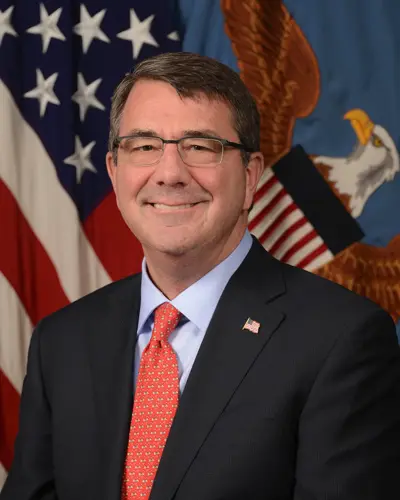
Ashton Baldwin Carter is an American public policy professor who served as the 25th secretary of defense from February 2015 to January 2017. He is currently Director of the Belfer Center for Science & International Affairs at Harvard Kennedy School.
