David Hume Quotes
All kings of England had ever, in cases of necessity or expediency, been accustomed, at intervals, to elude them [the laws.]
David Hume, 1711-1776, Scottish Philosopher & Historian, The History of Great Britain, 1780
Sourced by: Eigen's Political and Historical Quotations

The statement so offended the Lords—the highest court of England—that he was imprisoned by the Lords and not released until he had recanted the position. The argument goes on today in many countries incuding the United States.

Some of the Patriots of Early America realized that the oppressions of British rule were coming from Parliament and initially took the position that only the King could make laws for the colonies and not Parliament. Therefore, they were as Englishmen challenging illegal English laws. Most American hostility was directed at Parliament and not the King. However, once there was any physical resistance, King George came down with such a heavy hand that American hatred transferred to him. For related quotes on the King/Parliament issue, see {639145}, {639143}, {639142}, {639141}, {639140}, & {639137}

The issues of check and balances in the American constitution were radical by world standards of the day. However, it was by no means an new concept and as this quotation illustrates was discussed and debated in England, but although England was far ahead of almost all other countries with respect to eliminating absolute power, they never took it as far as the Americans did. That took a revolution.

James just before he became king was very much aware of the unpopularity of the concept of sovereign immunity and the danger of an English King acting against traditional law of the land however, James did not wish to set at precedent that the king was bound by any way and subject the law of his inferiors. He seemed to find a brilliant solution:


This is the most formalized and sophisticated compendium of laws of the so-called “barbaric peoples” of Europe. The compilation was in many ways a documentation of the traditional laws of the Visigoths that had evolved over hundreds of years.

Prior to Cooke’s indictment of English King Charles I, there was a concept of Royal Impunity—that a sovereign could not legally be called to account for his actions as ruler of the state. The concept of “sovereign immunity” was a concept where the sovereign and his agents could be given immunity for specific actions, but they never would have impunity again where there were no limits to the crimes they might commit against their own people. Charles I refused to even recognize Cooke’s indictment and so have heads of state called to account for their major crimes since then all the way down to Saddam Hussein in 2006 who made the same argument. Cooke was himself hanged, drawn and quartered almost 20 years after the Charles I trial for his part in the “Regicide” so the concept of Royal Impunity did not die quickly.


Many American colonists had relatives and friends in England, and Paine argued that American independence would help and not het the English people.

The Continental Congress told each colony should establish its own republican government quickly so that the people did not have to depend on England for anything, and that the English Monarchy be opposed and supplanted anywhere where they wanted to exercise authority.

Lotario de' Conti. The Pope did not want anything to diminish the absolute power of Kings as Popes might be next to lose their absolute authority. Despite the Pope’s nullification, Magna Carta had huge influence in England and the world. Note that the Pope actually called the agreement “unjust”, which gives us an excellent idea of the concept of justice amongst the power elites of the 13th century.
Some of the Patriots of Early America realized that the oppressions of British rule were coming from Parliament and initially took the position that only the King could make laws for the colonies and not Parliament. Therefore, they were as Englishmen challenging illegal English laws. Most American hostility was directed at Parliament and not the King. However, once there was any physical resistance, King George came down with such a heavy hand that American hatred transferred to him. For related quotes on the King/Parliament issue, see {639145}, {639144}, {639142}, {639141}, {639140}, & {639137}

Referring to the totally inadequate diplomatic communications in the political confusion and crises that led up to the First World War. None of the countries really wanted a large war, but the diplomatic communications were so bad that all operated on the assumption that the others were moving against them and they had to defend themselves or their treaty allies and there were very few opportunities to discern what other countries would do and all of Europe and much else of the world slipped out of control.


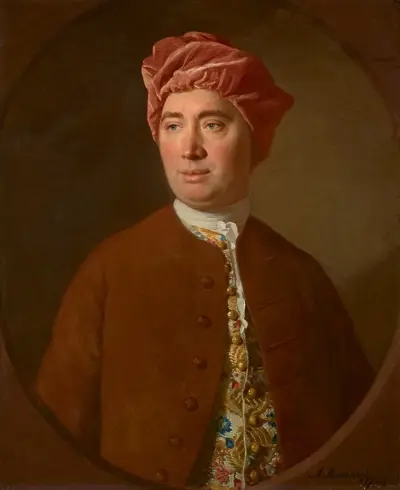
David Hume, Hume strove to create a naturalistic science of man that examined the psychological basis of human nature. Hume argued against the existence of innate ideas, positing that all human knowledge derives solely from experience. This places him with Francis Bacon, Thomas Hobbes, John Locke, and George Berkeley as a British Empiricist.
