King James I Quotes
A good king although he be above the law, will subject and frame his actions thereto, for examples sake to his subjects … [He ended up setting a precedent and duty of the crown that has been even harder for some royal family members to keep up with: the setting of example for the subjects sake. Sovereign acts that had been contrary to law had previously been good of bad for the realm as the case would be, but after James' statement, all were bad as they had set poor example for the common folk who must always obey.
James just before he became king was very much aware of the unpopularity of the concept of sovereign immunity and the danger of an English King acting against traditional law of the land however, James did not wish to set at precedent that the king was bound by any way and subject the law of his inferiors. He seemed to find a brilliant solution:
James I, 1566-1625, King of Great Britain & Scotland, The True Laws of Free Monarchies
Sourced by: Eigen's Political and Historical Quotations


Prior to Cooke’s indictment of English King Charles I, there was a concept of Royal Impunity—that a sovereign could not legally be called to account for his actions as ruler of the state. The concept of “sovereign immunity” was a concept where the sovereign and his agents could be given immunity for specific actions, but they never would have impunity again where there were no limits to the crimes they might commit against their own people. Charles I refused to even recognize Cooke’s indictment and so have heads of state called to account for their major crimes since then all the way down to Saddam Hussein in 2006 who made the same argument. Cooke was himself hanged, drawn and quartered almost 20 years after the Charles I trial for his part in the “Regicide” so the concept of Royal Impunity did not die quickly.


The statement so offended the Lords—the highest court of England—that he was imprisoned by the Lords and not released until he had recanted the position. The argument goes on today in many countries incuding the United States.


Typical of the times, the king was accountable to no one for anything. 200 years later, most of the world have accepted the principle that no one is above the law and that every leader is accountable to the people.


The issues of check and balances in the American constitution were radical by world standards of the day. However, it was by no means an new concept and as this quotation illustrates was discussed and debated in England, but although England was far ahead of almost all other countries with respect to eliminating absolute power, they never took it as far as the Americans did. That took a revolution.

This Cahier was the consensus of the Clergy of Blois in 1789. There were cahiers of several provinces of France—some by the clergy, some by the nobles. What is fascinating is the emergence of many of the pre-revolutionary French concepts. The example of the American revolution and its principles was known throughout the educated classes of France.

This principle has been in force since the beginning of our republic. However, there was a suggested challenge to it by President Richard M. Nixon, and a substantial challenge by the George W. Bush Administration which took the position that as long as the President was engaged in carrying out a Constitutionally mandated function, like war or foreign policy, the President did not have to obey the existing laws and could direct his subordinates to violate the law. Bush lost in those areas which came to the courts and the Supreme Court made it clear that even the President, carry out his official duties, had no immunity from the laws of the nation.


Beaumarchais served the French King Louis XVI as a spy and advisor on foreign affairs. He was instrumental in influencing the French King and his government to tilt in favor of the American Revolutionaries. Beaumarchais’s reaction to the English was typical of European royalists who saw the political infighting and turmoil of a parliamentary government as frantic and destabilizing. Ironically, most Frenchman preferred it and that led to the French Revolution.
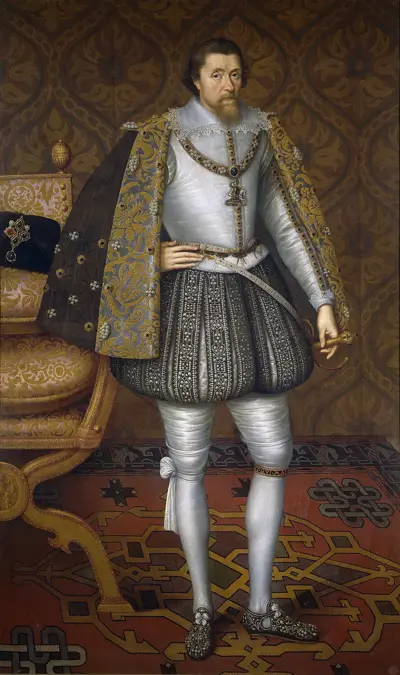
James VI and I was King of Scotland as James VI from 24 July 1567 and King of England and Ireland as James I from the union of the Scottish and English crowns on 24 March 1603 until his death in 1625. The kingdoms of Scotland and England were individual sovereign states, with their own parliaments, judiciaries, and laws, though both were ruled by James in personal union.
