Visigoths Quotes
An Unjust Decree, or an Unjust Interpretation of the Law, Prompted by Fear of the Throne, or Made by Order of the King, shall be Invalid.
This is the most formalized and sophisticated compendium of laws of the so-called “barbaric peoples” of Europe. The compilation was in many ways a documentation of the traditional laws of the Visigoths that had evolved over hundreds of years.
Visigothic Code, Section XXVII, Book II, Forum Judicum, Legal Compilation of the laws of the Spanish Visigoths, ~650
Sourced by: Eigen's Political and Historical Quotations


The Visigoth king was, like other kings all powerful but within certain traditions. Whereas other kings were crowned with a concept of Divine Right, the Visigoth king’s reign was formally contingent on his performance.


The government of Pakistan regarded this as seditious. The Government can fire judges at will and the military has the right to convene its own courts and try Pakistani civilians for certain alleged crimes by removing their cases from the civilian courts. Even when a Pakistani judge is not intimidated by the government or the military, the Islamic extremist fanatics often assassinate any public official who any one of thousands of fanatics feels is anti-Islamic.


The separation of powers concept was adopted from the American Constitution of the previous year. See {585394}.


The statement so offended the Lords—the highest court of England—that he was imprisoned by the Lords and not released until he had recanted the position. The argument goes on today in many countries incuding the United States.


Prior to Cooke’s indictment of English King Charles I, there was a concept of Royal Impunity—that a sovereign could not legally be called to account for his actions as ruler of the state. The concept of “sovereign immunity” was a concept where the sovereign and his agents could be given immunity for specific actions, but they never would have impunity again where there were no limits to the crimes they might commit against their own people. Charles I refused to even recognize Cooke’s indictment and so have heads of state called to account for their major crimes since then all the way down to Saddam Hussein in 2006 who made the same argument. Cooke was himself hanged, drawn and quartered almost 20 years after the Charles I trial for his part in the “Regicide” so the concept of Royal Impunity did not die quickly.


This shameful quotation was shocking to most readers. It is subject to two interpretations: One that judges who did not rule on Constitutional issues the way conservative extremists wanted would come to physical harm. The other, that conservatives should pressure judges by withholding appropriations for the courts, impeachments and recall elections where they exist, as well as funding potential opponents for those jurisdictions where judges are elected. Both meanings were disgraceful in the view of most Americans. Later, DeLay was convicted and sentenced to jail for money laundering and illegally spending and raising campaign funds. He was also reprimanded by the House Ethics Committee for unethical methods of fund raising for other earlier actions.
Some of the Patriots of Early America realized that the oppressions of British rule were coming from Parliament and initially took the position that only the King could make laws for the colonies and not Parliament. Therefore, they were as Englishmen challenging illegal English laws. Most American hostility was directed at Parliament and not the King. However, once there was any physical resistance, King George came down with such a heavy hand that American hatred transferred to him. For related quotes on the King/Parliament issue, see {639145}, {639144}, {639142}, {639141}, {639140}, & {639137}
The Emperor had made his brother King of Holland, thinking of it as an unimportant backwater of the French Empire. But Louis took his oath and job very seriously, and although he did not have the great talent of his brother, he made a serious effort to be a good king.

England appears to have been the origin of judicial, lifetime tenure.


If men's minds were as easily controlled as their tongues, every king would sit safely on his throne
Spinoza’s ideas were considered so radical and dangerous that he was the only man in history who was excommunicated by the Catholics, the Jews and the Muslims.


Others argue that the prosecutors are the weakest link in the system. See {631696}.
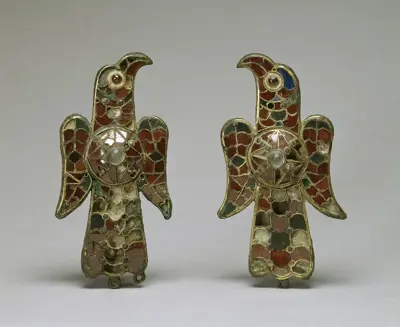
The Visigoths (/ˈvɪzɪɡɒθs/; Latin: Visigothi, Wisigothi, Vesi, Visi, Wesi, Wisi) were an early Germanic people who, along with the Ostrogoths, constituted the two major political entities of the Goths within the Roman Empire in Late Antiquity, or what is known as the Migration Period. The Visigoths emerged from earlier Gothic groups, including a large group of Thervingi, who had moved into the Roman Empire beginning in 376 and had played a major role in defeating the Romans at the Battle of Adrianople in 378. Relations between the Romans and the Visigoths were variable, alternately warring with one another and making treaties when convenient. Under their first leader, Alaric I, they invaded Italy and sacked Rome in August 410. Afterwards, they began settling down, first in southern Gaul and eventually in Hispania, where they founded the Visigothic Kingdom and maintained a presence from the 5th to the 8th centuries AD.
