Samuel Adams Quotes
A standing army, however necessary it may be at some times, is always dangerous to the liberties of the people. Soldiers are apt to consider themselves as a body distinct from the rest of the citizens ... They soon become attached to their officers and disposed to yield implicit obedience to their commands.
Samuel Adams, 1722-1803, Member of the Continental Congress, Governor of Massachusetts, Letter to James Warren
Sourced by: Eigen's Political and Historical Quotations

Root was serving as Secretary of War at the time. The army of the United States was in sad shape. Congress did not want to appropriate much money for the military as there was no one to fight any longer. Indians had been subdued, relations with Canada were excellent. Mexico was too weak to be a threat, and the Pacific and Atlantic Oceans protected against invasion by large forces. The navy was in much better shape and could protect against invasion from abroad anyway. The Republicans then were in control of government and were generally very isolationist. And there was the traditional American animus to a standing Army. See {601390} and {592824} for examples of that attitude. The army itself was a set of individual fiefdoms with nepotism and cronyism rampant with no general staff to have the big picture. Theodore Roosevelt and Root, unlike most other Republicans, wanted to reform and build up the army as well as strengthen the navy,

This size standing army which alarmed so many at the beginning of the 20th century, looked very small when compared with the standing army of America a century later. For earlier American Politician’s views on a standing army, see {592824}, {631687}, {622888}, and {641008}.

There was a fear of standing armies in early America that lasted to some extent until the 20th century.

These two states actually prohibited their legislatures from maintaining a standing army. Similar sentiments were in the constitutions or bill of rights of New Hampshire, Delaware, Maryland and Massachusetts but the option was left with the legislatures. A similar phrase appears in the Virginia Bill of Rights of 1776.


A state militia is necessary


Four years later Eisenhower had changed his mind.

Congress and most of the Founding Fathers were very distrustful of standing armies. They were aware that standing armies had taken over societies ever since ancient Rome and Julius Caesar.


The irony is that it is just for the lack of this fundamental principle that Napoleon eventually became the Government and the Military in France.

President James Madison expressed a similar sentiment in his first inaugural address.


Porfirio Diaz - the longtime dictator of Mexico stole the election of 1910 and had his opponent Francisco Madero arrested and imprisoned. Madero got out, crossed the border to San Antonio, and issued this declaration which started the Mexican Revolution. See {613620} for the statement that declared the Revolution.
America is almost unique among nations where the military has never been a force that either dominated or controlled the government or acted independently from it. The Founding Fathers knew well the history of Europe and other nations, and built many checks into our Constitution and our traditions with George Washington, setting the example for American military men forever after.


In early America, there was great concern about a standing army—a military force that exists and is organized in peacetime. History showed the founding fathers that tyrants who siezed power almost always did so by getting control of the standing army. The logic was if there is no standing army, no one can control it and therefore no tyrant can control the country by force. At the time, however, with oceans protecting us, there was penty of time to mobilize a defensive army should any foreign power invade. However, with modern military technology, and the importantance of retaliation as a protective3 strategy, it is virtually impossible to not have a standing army and stoll be secure.
The call for individual liberty and the right of personal property by clergy is surprising to many. This Cahier was the consensus of the Clergy of Blois in 1789. There were cahiers of several provinces of France—some by the clergy, some by the nobles. What is fascinating is the emergence of many of the pre-Revolutionary French concepts. The example of the American revolution and its principles was known throughout the educated classes of France.

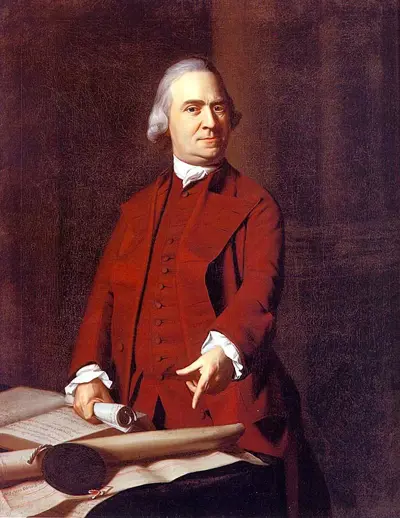
- Born: September 27, 1722
- Died: October 2, 1803
- Nationality: American
- Profession: Revolutionary
Samuel Adams was an American statesman, political philosopher, and one of the Founding Fathers of the United States. He was a politician in colonial Massachusetts, a leader of the movement that became the American Revolution, and one of the architects of the principles of American republicanism that shaped the political culture of the United States. He was a second cousin to his fellow Founding Father, President John Adams.
