Elbridge Gerry Quotes
... to prevent the establishment of a standing army, the bane of liberty.... Whenever governments mean to invade the rights and liberties of the people, they always attempt to destroy the militia in order to raise an army upon their ruins.
A state militia is necessary
Elbridge Gerry, 1744-1814, U. S. Congressman (Anti-Federalist, MA), Vice President of the United States (Democrat), Debate in first Congress on James Madison's proposed Bill of Rights, 1789, Quoted by former Chief Justice Warren E. Burger, Parade Magazine, January 14, 1990
Sourced by: Eigen's Political and Historical Quotations

Root was serving as Secretary of War at the time. The army of the United States was in sad shape. Congress did not want to appropriate much money for the military as there was no one to fight any longer. Indians had been subdued, relations with Canada were excellent. Mexico was too weak to be a threat, and the Pacific and Atlantic Oceans protected against invasion by large forces. The navy was in much better shape and could protect against invasion from abroad anyway. The Republicans then were in control of government and were generally very isolationist. And there was the traditional American animus to a standing Army. See {601390} and {592824} for examples of that attitude. The army itself was a set of individual fiefdoms with nepotism and cronyism rampant with no general staff to have the big picture. Theodore Roosevelt and Root, unlike most other Republicans, wanted to reform and build up the army as well as strengthen the navy,


It would be more than a decade before the phrase “well regulated militia” would be added into the Constitution as the 2nd Amendment of the Bill of Rights. This resolution was the last of several passed at this meeting by which Maryland endorsed resistance to the British. So these resolations would have been widely distributed throughout the colonies and known by the leaders. In 1788 Alexander Hamilton Published Federalist 29 which also used the phrase. (See {588393}.) Then on September 25, 1789, the Congress proposed the Bill of Rights and the 2nd Amendment using the same key phrase, “well regulated militia.” Whether the drafters of the 2nd Amendment got the phrase from Hamilton’s Federalist 29 or from the Maryland Resolutions is not known but Hamilton’s was much more current. Did he get the phrase from Maryland? Did Congress get it from him? Did Maryland originate the phrase or was there an earlier use that influenced the Maryland drafters? At this point no one is sure, but the phrase is critical to the meaning of the 2nd Amendment because the Supreme Court has repeatedly held that the Second Amandment does not apply to individuals but only to the State’s right to bear arms within the “well regulated militia” and not as individual citizens. The right is that of the State government and that is why a state can control guns including banning them if they choose. So an individual in America does not have the constitutional right to bear arms. He may have a state constitutional right but in other states he may not use a gun in certain places and may not possess certain types of guns like hand guns which are illegal in New York, Washington DC and some other places.


He was a conscientious objector and pacifist and served a year in jail.


President James Madison expressed a similar sentiment in his first inaugural address.

More than a decade before Hamilton wrote this, a Maryland commission used the phrase “well regulated militia” earlier. (See {588394}.) It would be less than 2 years before the phrase “well regulated militia” would be added into the Constitution in the 2nd Amendment of the Bill of Rights—September 25, 1789. The Maryland resolution was the last of several passed at a meeting by which Maryland endorsed resistance to the British before the actual Revolution. So these resolations would have been widely distributed throughout the colonies and known by the leaders. Whether the drafters of the 2nd Amendment got the phrase from Hamilton’s Federalist 29 or from the Maryland Resolutions is not known but Hamilton’s was much more current. Did he get the phrase from Maryland? Did Congress get it from him? Did Maryland originate the phrase or was there an earlier use that influenced the Maryland drafters? At this point no one is sure, but the phrase is critical to the meaning of the 2nd Amendment because the Supreme Court has repeatedly held that the Second Amandment does not apply to individuals but only to the State’s right to bear arms within the “well regulated militia” and not as individual citizens. The right is that of the State government and that is why a state can control guns including banning them if they choose. So an individual in America does not have the constitutional right to bear arms. He may have a state constitutional right but in other states he may not use a gun in certain places and may not possess certain types of guns like hand guns which are illegal in New York, Washington DC and some other places.

The first Civil Rights Act {587712} was passed a few months before and has some of the same language as Congress wanted to make the laws very clear. The Southern Rebels who insisted on their right to have guns during Reconstruction, viciously denied that same right to the newly freed slaves. Sickles tried to remedy this, but the KKK and other terrorists intimidated most of the Blacks into not using the right that they had. Later, they would do that with the right to vote. In January, the Commanding General in charge of South Carolina had issued an order protecting the rights of Blacks to have guns {629894}. This law applied that to the entire country. The Southerners have always supported the 2nd Amendment except when Blacks wanted to have arms.


He wrote it under the pseudonym of “The Pennsylvanian”.


The issue of whether the military has any rights per se in a democracy or is an institution established and controlled by the people is one that separates many countries today. In one philosophy—held by America and most industrial democracies—the military is completely subservient to and under the control of the people and their government. The other view held by many societies controlled by the military is that the military is a subset of the people with specific rights granted to it. In some countries the military can name representatives, can veto legislation and are considered a faction just like political parties. See China, Turkey, Argentina, and Indonesia for examples of the latter view.


Congress and most of the Founding Fathers were very distrustful of standing armies. They were aware that standing armies had taken over societies ever since ancient Rome and Julius Caesar.


This is probably the first known use of the Bill of Rights phrase in the English language. For the earliest American use, see Edward Rutledge.

Jefferson and others insisted on a Bill of Rights where rights were explicit and not inferred or dependent on the goodness of the particular government in power.


The Southern Rebels who insisted on their right to have guns during Reconstruction, viciously denied that same right to the newly freed slaves. Sickles tried to remedy this, but the KKK and other terrorists intimidated most of the Blacks into not using the right that they had. Later, they would do that with the right to vote.


Originally it was published in Boston under the name “A Columbian Patriot.”
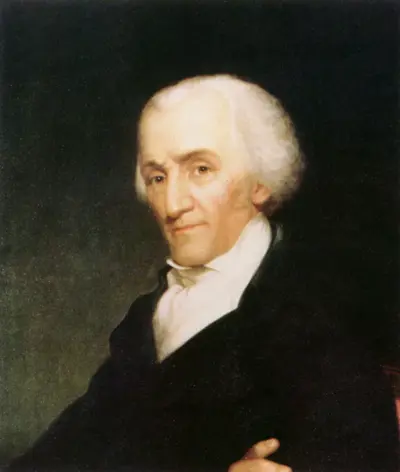
- Born: July 17, 1744
- Died: November 23, 1814
- Nationality:
- Profession:
Elbridge Thomas Gerry was an American politician and diplomat. As a Democratic-Republican he served as the fifth vice president of the United States under President James Madison from March 1813 until his death in November 1814. The political practice of gerrymandering is named after him.
