William Blackstone Quotes
The Bill of Rights
This is probably the first known use of the Bill of Rights phrase in the English language. For the earliest American use, see Edward Rutledge.
William Blackstone, 1723-1780, British Jurist, Description of a 1689 act of Parliament entitled, An Act Declaring the Rights and Liberties of the Subject and Settling the Succession of the Crown, 1765
Sourced by: Eigen's Political and Historical Quotations


Note the use of the phrase “against the government.” One of the unique aspects of the American Constitution and The Bill of Rights is that the government is considered a potential and even probable infringer on the liberties of the people. It is almost as though the government was the potential enemy. Modern libertarians state this very explicitly and it is ever present in the views of both the right and left wings of American politics. Most centrists recoil at the thought that some citizens see the government as the enemy, but even in America there have been times where the government has infringed on the rights of citizens only to have the courts or future administrations and Congresses correct the error.
Note the use of the phrase “against the government.” One of the unique aspects of the American Constitution and The Bill of Rights is that the government is considered a potential and even probable infringer on the liberties of the people. It is almost as though the government was the potential enemy. Modern libertarians state this very explicitly and it is ever present in the views of both the right and left wings of American politics. Most centrists recoil at the thought that some citizens see the government as the enemy, but even in America there have been times where the government has infringed on the rights of citizens only to have the courts or future administrations and Congresses correct the error.


It is ironic that Pakistan, the creation of Jinnah’s efforts, has to a great extent adopted Sharia (Islamic Law) resulting in severe curtailment of freedom of speech and thought. Professors languish in jail for not teaching the history of Muhammed in the orthodox way, people are sentenced to death for what the local mullahs regard as blasphemy—results which from Jinnah’s point of view were terrible.

Many New Yorkers and others felt that since the attack on the World Trade Center was made in the name of Islam, the mosque and commuity center should be built in another location further from Ground Zero. Ellison was debating someone who argued that the Mosque should not be built so that sensitivity can be shown for those New Yorkers who lost relatives and friends in the attack of September 11. Rather than insist on their Constitutional rights, the Muslim leadership of the project, moved the location somewhat further away from Ground Zero.


Jefferson and others insisted on a Bill of Rights where rights were explicit and not inferred or dependent on the goodness of the particular government in power.


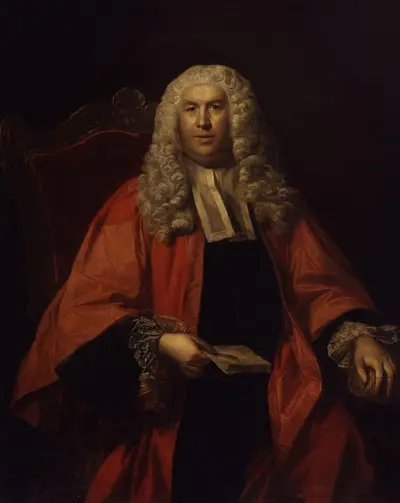
Sir William Blackstone SL KC was an English jurist, judge and Tory politician of the eighteenth century. He is most noted for writing the Commentaries on the Laws of England. Born into a middle-class family in London, Blackstone was educated at Charterhouse School before matriculating at Pembroke College, Oxford, in 1738. After switching to and completing a Bachelor of Civil Law degree, he was made a fellow of All Souls, Oxford, on 2 November 1743, admitted to Middle Temple, and called to the Bar there in 1746. Following a slow start to his career as a barrister, Blackstone became heavily involved in university administration, becoming accountant, treasurer and bursar on 28 November 1746 and Senior Bursar in 1750. Blackstone is considered responsible for completing the Codrington Library and Warton Building, and simplifying the complex accounting system used by the college. On 3 July 1753 he formally gave up his practice as a barrister and instead embarked on a series of lectures on English law, the first of their kind. These were massively successful, earning him a total of £453 (£71,000 in 2021 terms), and led to the publication of An Analysis of the Laws of England in 1756, which repeatedly sold out and was used to preface his later works.
