Andrew Jackson Quotes
Considering standing armies as dangerous to free governments in time of peace, I shall not seek to enlarge our present establishment, nor disregard that salutary lesson of political experience which teaches that the military should be held subordinate to the civil power.
Andrew Jackson, 1767-1845, 7th President of the United States (Democrat, TN), First Inaugural Address, March 4, 1829
Sourced by: Eigen's Political and Historical Quotations

In early America, there was great concern about a standing army—a military force that exists and is organized in peacetime. History showed the founding fathers that tyrants who siezed power almost always did so by getting control of the standing army. The logic was if there is no standing army, no one can control it and therefore no tyrant can control the country by force. At the time, however, with oceans protecting us, there was penty of time to mobilize a defensive army should any foreign power invade. However, with modern military technology, and the importantance of retaliation as a protective3 strategy, it is virtually impossible to not have a standing army and stoll be secure.

These two states actually prohibited their legislatures from maintaining a standing army. Similar sentiments were in the constitutions or bill of rights of New Hampshire, Delaware, Maryland and Massachusetts but the option was left with the legislatures. A similar phrase appears in the Virginia Bill of Rights of 1776.

President James Madison expressed a similar sentiment in his first inaugural address.


Congress and most of the Founding Fathers were very distrustful of standing armies. They were aware that standing armies had taken over societies ever since ancient Rome and Julius Caesar.

In 1776 General Charles Lee imposed a loyalty test on inhabitants of New York in the name of the new government. Four distinguished public men wrote this letter.

The only soldier ever so honored

America is almost unique among nations where the military has never been a force that either dominated or controlled the government or acted independently from it. The Founding Fathers knew well the history of Europe and other nations, and built many checks into our Constitution and our traditions with George Washington, setting the example for American military men forever after.
Many of the fundamental principles of government that were in the United States Constitution, were already in the Constitutions of different states. Vermont had a substantial number of them. When we speak of the Constitution as a “revolutionary document” it was to the rest of the world but not to many Americans who had these concepts in their state constitutions and had been living with them for some time.


There was a fear of standing armies in early America that lasted to some extent until the 20th century.
The first clause is exactly that used by the state of Pennsylvania in its constitution. These had no reference to the militia as did the Virginia Bill of Rights and later the Federal Constitution.

Civilian control of the Military did not just pop in to the Constitution 11 years later. This and many other fundamental ideas had come from the State Constitutions and other documents.


This size standing army which alarmed so many at the beginning of the 20th century, looked very small when compared with the standing army of America a century later. For earlier American Politician’s views on a standing army, see {592824}, {631687}, {622888}, and {641008}.
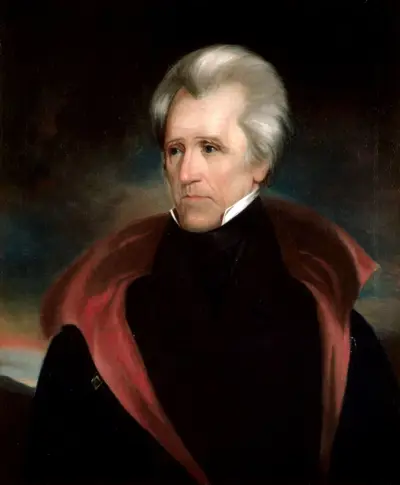
Andrew Jackson was an American lawyer, soldier, and statesman who served as the seventh president of the United States from 1829 to 1837. Before being elected to the presidency, Jackson gained fame as a general in the United States Army and served in both houses of the U.S. Congress. An expansionist president, Jackson sought to advance the rights of the "common man" against a "corrupt aristocracy" and to preserve the Union.
