Karl Marx Quotes
A great deal of capital, which appears to-day in the United States without any certificate of birth, was yesterday, in England, the capitalised blood of children.
Marx, Karl. Capital: A Critique of Political Economy, Volume I. Translated by Samuel Moore and Edward Aveling, Progress Publishers, 1887, p. 535.


He called attention to the relationship between the poverty living conditions, sanitation, and the outbreak of cholera in the Manchester Cholera epidemic of 1832. He went on to advocate shorter working hours, better sanitation, and education for the mill workers.

3rd Earl Russell of Kingston


He in that same year then persuaded sympathetic MP, John Hobhouse, to introduce the first bill into the House of Commons regulating child labor in the mills. Considered radical in its day, forbade employment of children under the age of 9 from working in the mills, and then limited the hours that children from 9 to 18 to 12 hours a day. The bill was rejected with the same claims that have been made regarding child labor reform attempts ever since. It would slow growth, harm the economy, exacerbate the poverty of poor families and interfere with the parents right to bring up their children. It was not until after his death in 1861 that meaningful child labor laws were passed for the British mills.
Oastler was a mill owner himself.


This report and others like it eventually led to French labor reforms, but only many years later.
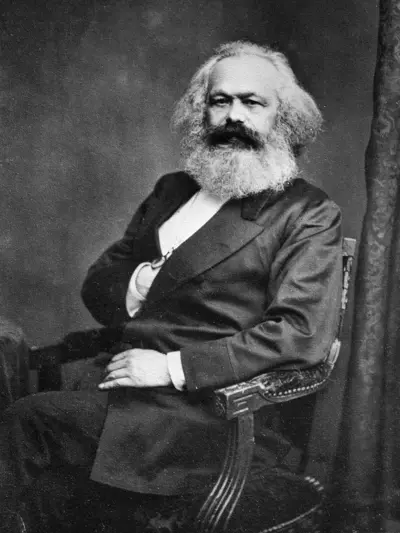
Karl Heinrich Marx was a German philosopher, economist, historian, sociologist, political theorist, journalist and socialist revolutionary. Born in Trier, Germany, Marx studied law and philosophy at university. He married Jenny von Westphalen in 1843. Due to his political publications, Marx became stateless and lived in exile with his wife and children in London for decades, where he continued to develop his thought in collaboration with German thinker Friedrich Engels and publish his writings, researching in the reading room of the British Museum. His best-known titles are the 1848 pamphlet The Communist Manifesto and the three-volume Das Kapital (1867–1883). Marx's political and philosophical thought had enormous influence on subsequent intellectual, economic and political history. His name has been used as an adjective, a noun, and a school of social theory.
