Oliver Cromwell Quotes
You are no Parliament. You are no Parliament! .... It is not fit that you sit here any longer! You should now give place to better men.
This statement transformed Cromwell from a bully to a dictator. If the chief executive can dismiss the legislature, then there is no real check on the powers of the executive and he/she is a de facto dictator.
Oliver Cromwell, 1599-1658, Revolutionist, Ruler, & Lord Protector of England, Statement dismissing the Rump Parliament, January 22, 1655
Sourced by: Eigen's Political and Historical Quotations

The Parliament was paralyzed by the issue of wartime leadership when PM Neville Chamberlain failed so miserably in standing up to the Germans at Munich. The speech urging the termination of the Prime Minister’s government reminded all of the famous speech whereby Lord Protector Oliver Cromwell dismissed Parliament in 1655 (see related quote). In this case Amery had no power, but much influence as the Government fell a few days later and Winston Churchill assumed British leadership.


This was Executive Privilege of the time. The result of this type of conflict between the executive and the legislative body was a Civil War in which Parliament won. This concept of executive privilege operates to this day in America where the President typically refuses to have his special assistants and staff be questioned by Congressional investigating committees. IT also extends to documents where the President has refused to allow Congress access to papers. In the Watergate scandal, it was the Supreme Court Decision that President Nixon could not claim Executive Privilege with respect to the Watergate tapes. Their exposure forced his resignation.


From this quotation, {624648} and {615901} it is clear that the framers of the Constitution intended the treaty making powers to be shared by the President and the Senate. In practice, in modern times treaties are usually initially negotiated by diplomats under the supervision of the President and the Senate gets to concur or not in the ratification process. However, there have been a number of treaty failures including the League of Nations where the lack of coordination has resulted in a situation where the Senate had to accept or reject something which the President had negotiated and the Senate rejected the treaty.

money for the king's government In 1628 there was a classic English struggle between the king, Charles I, and Parliament. While Parliament was sitting, Dr. Manwaring, an Anglican Bishop, preached a sermon. He claimed that God intended all private property to be at the disposal of the King in times of national emergency. Further, that the King could levy an taxes without the consent of Parliament. The King liked the sermon so much that he had it printed and distributed by special command. The House of Commons went bonkers and impeached Manwaring. He was imprisoned by order of the House, fined the then huge sum of 1,000 pounds, and prohibited from holding any ecclesiastical or secular office in the future. As soon as the session of Parliament ended, the king pardoned him, gave him a huge salary raise, and several years later Manwaring was appointed Bishop of Asaph. King Charles I, perhaps England’s worst sovereign, then provoked two civil wars and was finally tried for treason and beheaded. Manwaring was in and out of prison during the conflicts. He faded from public view.
Sealed under duress and later repudiated by the King with Papal assistance


In 1628 Parliament, in response to abuses by King Charles I, was about to pass The Petition of Rights–-a type of Bill of Rights. The King gave assurances that the practices—such as forcing nobles to lend him money—would not continue and didn't want to be embarrassed by passage of a law which he claimed would indicate that the Parliament did not trust him and weaken the dignity of the monarchy. The Petition of Rights passed with Cole’s leadership.


If the executive can select the legislators, there is really no separation of powers and the checks are only one way—the executive can check the legislature but not the other way around.


In the English system the checks and balances of the American system are not present. Historically in England the Monarch and the Parliament acted as checks upon each other. With a Constitutional Monarch there is no institutional check on Parliament. The checks are their restraint--respect for precedent--and the voters. The Prime Minister is a member of Parliament and has no powers other than what Parliament gives him/her. The courts in England are under Parliament and the upper house, the House of Lords is the equivalent of the highest court—but it may always be overruled by the parliament itself.


At the time there was no concept of serious separation of powers. For all practical purposes, the King ruled and he shared some of his powers with the Parliament. The next centuries in England would see the great battle for governmental power between the monarch and the Parliament. Today, the British monarch has no power but still retains a great deal of influence in England but largely because Queen Elisabeth is so well loved and respected.

This was the case where the Supreme Court reversed its earlier opinion and declared the Income Tax Unconstitutional.

This was taken by some as prophesy or what Quakers refer to as “specific fore-seeing.”


Barstow the Democratic Governor who had no serious opposition in 1853 found himself challenged for reelection by Coles Bashford of the new Republican Party. The Board of Canvassers reported that Governor Barstow had won reelection but by less than 200 votes in the whole state. The Republicans charged that there had been fraud in some of the rural districts and petitioned the Wisconsin Supreme Court which ruled that nonexistent precincts had indeed voted for the Governor. The Barstow however refused to recognize the decisions of the court claiming that the court had no jurisdiction over the Board of Canvassers who were part of the executive branch. The Republicans held their own inauguration and two men claimed to be Governor. But the Governor claimed that the state constitution did not give the court any authority to deal with the crisis, He even called out the State Militia to maintain his office and intimidate the Supreme Court and keep the “other governor” from the state house. Nonetheless the court ruled that even the Governor had to obey the law and the Supreme Court would determine what the law was. Barstow finally “resigned.” See {587917} & {587914}.
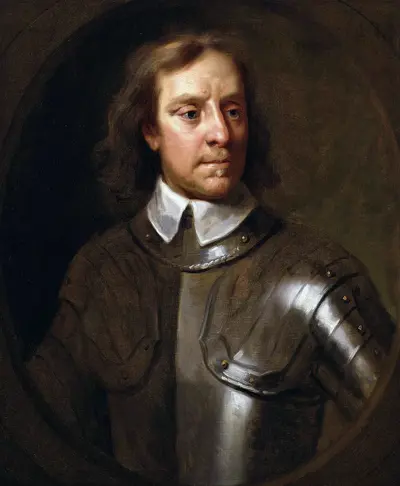
- Born: April 25, 1599
- Died: September 3, 1658
- Nationality: English
- Profession: Farmer, Parliamentarian, Military Commander
Oliver Cromwell was an English general and statesman who, first as a subordinate and later as Commander-in-Chief, led armies of the Parliament of England against King Charles I during the English Civil War, subsequently ruling the British Isles as Lord Protector from 1653 until his death in 1658. He acted simultaneously as head of state and head of government of the new republican commonwealth.
